INSTALLING AND LEVELING LIFT
EASY LEVEL™ LEVELING LEGS (patented)
FLOE vertical lifts come standard with FLOE’s exclusive
Easy-Level Leveling Leg. With the Easy-Level legs
you can effortlessly raise, level, or lower the lift without
getting in the water. Also, these legs allow for easy
adjustment if the lift should settle or if the water level
fluctuates measurably.
WARNING
Never adjust leveling legs (up or down) with a boat on the
lift. The added weight of the boat will apply extreme
pressure to the adjustment system causing potential
mechanical failure and/or serious bodily injury.
As you prepare to install and level the lift, keep in mind
how crucial it is to prevent a boat hull from rubbing or
hitting the bunks or lifting beams and causing undue
pressure on the lift frame. Read the warning below, and
refer back to Fig. 14a on page 11, which diagrams a
properly leveled lift in adequate water depth.
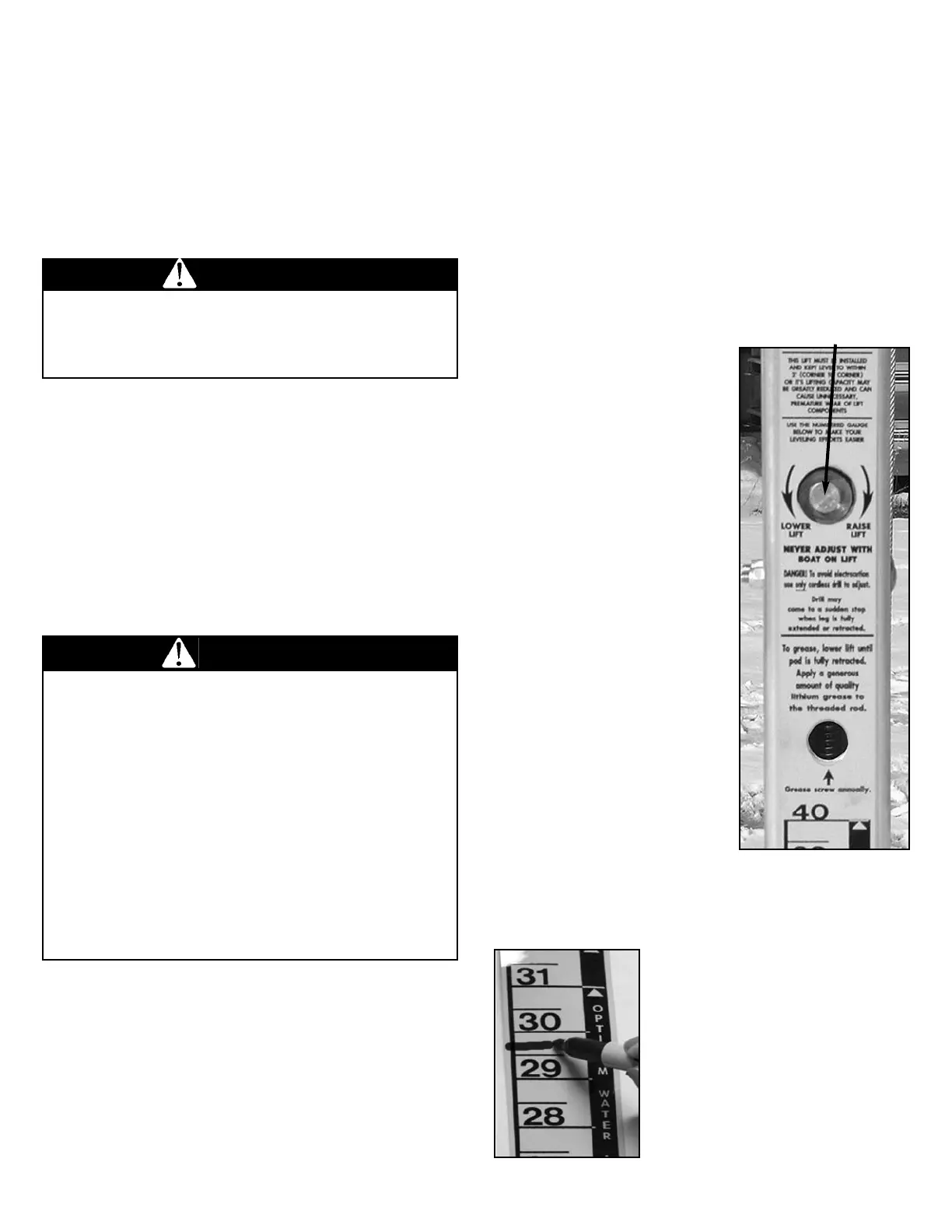
To raise or lower the lift frame, simply turn the nut inside
the leg as shown in Fig. 24. Turning clockwise will raise
the lift, counterclockwise will lower it. Use a 3/4” socket
with a socket wrench or a 14 volt (or larger) cordless drill
to adjust. Each of the four legs adjusts independently so
the lift can be perfectly leveled. As the lift is raised or
lowered, alternate among all four legs after 1-1/2” to 2” of
adjustment - similar to tightening lug nuts on a tire rim. If
the drill is working too hard, you
are lifting too much on an
individual leg and need to
proceed to the other legs.
For leveling leg adjustment
range, see boat lift
specifications, page 7. The
decal pictured in Fig. 24 and 25
has a useful measuring tape so
that you can see the water level
on each corner post. It is
important that the water level
reads the same on all four
corner posts. Once you
determine what leg extension
measurement works best for
your boat and lift, you can use a
waterproof marker to draw a line
at that point on the tape of one
corner post. This will be very
helpful in following seasons,
either for you or especially for a
hired installer who may be
unfamiliar with your boat,
shoreline, and lift.
Drill will come to a sudden stop when leg is fully
extended or retracted. When approaching the end of the
leg’s travel, reduce the speed of the drill. This will
prevent you from twisting your wrist or accidentally
dropping the drill. Do not use an impact wrench to adjust
as this will cause damage to the lift.
When positioning the lift it is important that it is placed in
adequate water depth (Fig. 14a on page 11). The cradle
must be lowered far enough for the boat to easily float on
and off without touching the lift bunks. If the boat hull
rubs on the bunks when entering or exiting the lift, the
horizontal forces can cause severe damage to the lift
and will void the warranty on affected components.
WARNING
Leveling Nut Fig. 24
Fig. 25
Measuring Tape
(being permanently
marked for next
year’s installation)
14



 To Next Page