28
EXERCISE GUIDELINES
Theseguidelineswillhelpyoutoplanyourexercise
program.Fordetailedexerciseinformation,obtaina
reputable book or consult your physician. Remember,
proper nutrition and adequate rest are essential for
successful results.
EXERCISE INTENSITY
Whether your goal is to burn fat or to strengthen your
cardiovascularsystem,exercisingattheproperinten-
sity is the key to achieving results. You can use your
heart rate as a guide to find the proper intensity level.
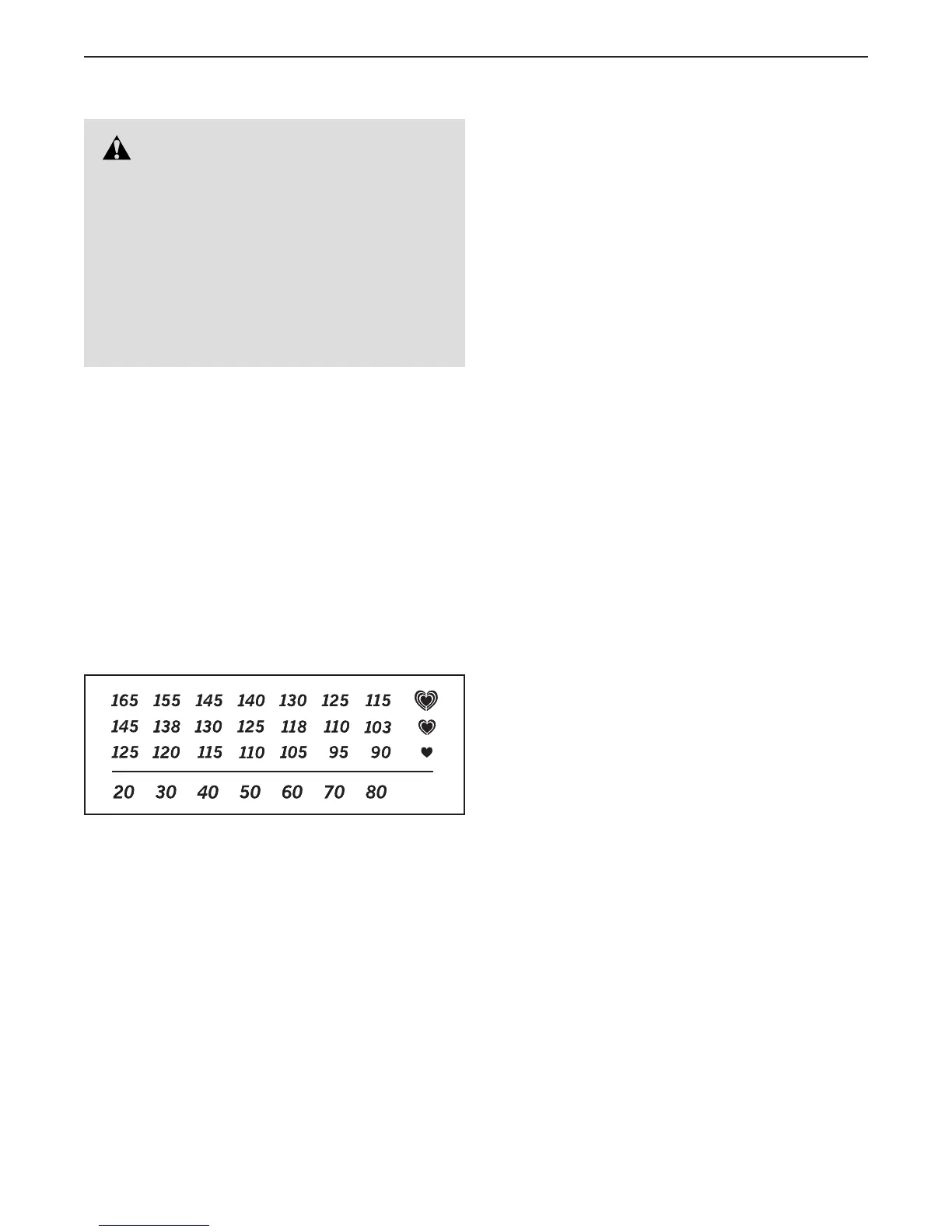
The chart below shows recommended heart rates for
fatburningandaerobicexercise.
To find the proper intensity level, find your age at the
bottom of the chart (ages are rounded off to the near-
est ten years). The three numbers listed above your
age define your “training zone.” The lowest number is
the heart rate for fat burning, the middle number is the
heartrateformaximumfatburning,andthehighest
numberistheheartrateforaerobicexercise.
Burning Fat—Toburnfateffectively,youmustexer-
cise at a low intensity level for a sustained period of
time.Duringthefirstfewminutesofexercise,your
body uses carbohydrate calories for energy. Only after
thefirstfewminutesofexercisedoesyourbodybegin
to use stored fat calories for energy. If your goal is to
burnfat,adjusttheintensityofyourexerciseuntilyour
heart rate is near the lowest number in your training
zone.Formaximumfatburning,exercisewithyour
heart rate near the middle number in your training
zone.
Aerobic Exercise—If your goal is to strengthen your
cardiovascular system, you must perform aerobic
exercise,whichisactivitythatrequireslargeamounts
ofoxygenforprolongedperiodsoftime.Foraerobic
exercise,adjusttheintensityofyourexerciseuntilyour
heart rate is near the highest number in your training
zone.
WORKOUT GUIDELINES
Warming Up—Start with 5 to 10 minutes of stretch-
ingandlightexercise.Awarm-upincreasesyourbody
temperature, heart rate, and circulation in preparation
forexercise.
Training Zone Exercise—Exercisefor20to30min-
utes with your heart rate in your training zone. (During
thefirstfewweeksofyourexerciseprogram,donot
keep your heart rate in your training zone for longer
than 20 minutes.) Breathe regularly and deeply as you
exercise—neverholdyourbreath.
Cooling Down—Finish with 5 to 10 minutes of stretch-
ing.Stretchingincreasestheflexibilityofyourmuscles
andhelpstopreventpost-exerciseproblems.
EXERCISE FREQUENCY
To maintain or improve your condition, complete three
workouts each week, with at least one day of rest
betweenworkouts.Afterafewmonthsofregularexer-
cise, you may complete up to five workouts each week,
if desired. Remember, the key to success is to make
exercisearegularandenjoyablepartofyoureveryday
life.
WARNING: Before beginning this
or any exercise program, consult your physi-
cian. This is especially important for persons
over age 35 or persons with pre-existing
health problems.
The heart rate monitor is not a medical device.
Various factors may affect the accuracy of
heart rate readings. The heart rate monitor is
intended only as an exercise aid in determin-
ing heart rate trends in general.



 To Next Page