36
Time alignment
Where exact physical alignment isn’t possible it is best to employ the electronic delay facility built into a
good electronic crossover system. A Funktion One XO series loudspeaker management system may be
used to delay the nearest element back to the furthest.
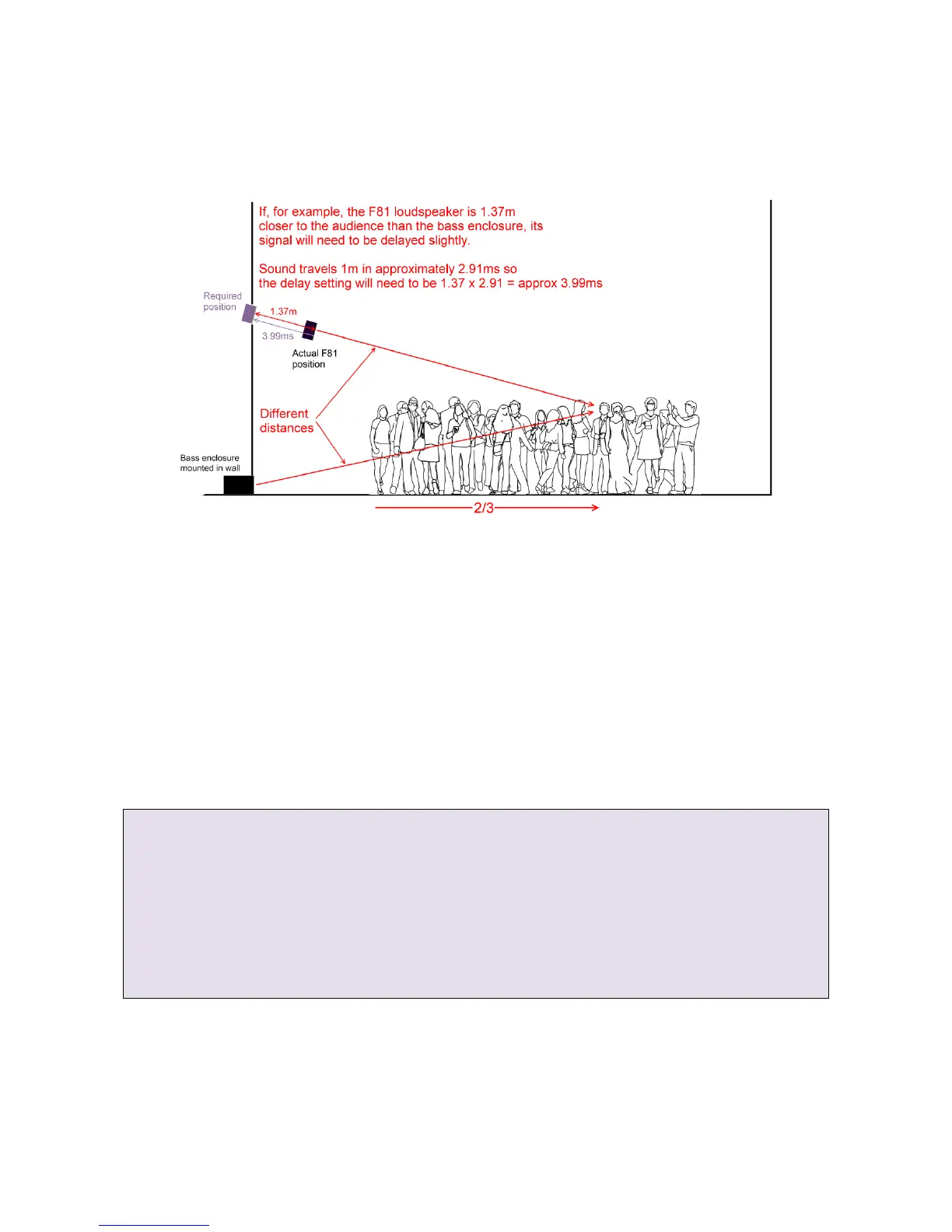
Fig 10.1-2 Time aligning the F81 with the bass enclosure for a 2/3 audience reference position
Time alignment procedure
Start with Funktion One’s recommended loudspeaker management bass-to-mid-high alignment settings.
This will ensure that internal driver offsets are already allowed for. See www.funktion-one.com or the
appropriate bass enclosure user guide for details.
1) Accurately measure the distance to the front of the mid-high enclosure and the front of the bass
enclosure from your preferred reference/mix/dance position.
2) Sound travels 1 metre in approximately 2.91ms (2.91 milliseconds)
a) If the bass system is closer than the F81 system, increase the bass output channel
delay by 2.91ms for every metre of misalignment.
b) If the F81 system is closer than the bass system, increase the F81 output channel
delay by 2.91ms for every metre of misalignment.
Imperial measurements
If you’re working with imperial measurements, the physical offset in feet should be multiplied by 0.887
to get the required delay in milliseconds.
In the above example, the F81 enclosure is 4ft 6” closer to the audience. Sound travels 1ft in
approximately 0.887 milliseconds so the required delay is 4.5 x 0.887 = 3.99ms.
(Hint: If you don’t have a calculator, the multipliers may be rounded to 3.0 for metric and 0.9 for imperial)
Note that horn loaded and bandpass bass enclosures exhibit their own fixed acoustical delay due to
internal path lengths. Your F81 delay may need to be slightly longer to allow for this.
www.funktion-one.com © Funktion One Research Limited 2011


 To Next Page