44
Appendix A - Clipping
Caution
Prolonged heavy clipping can subject loudspeaker voice coils and passive crossover components to double
their rated power dissipation leading to overheating, premature ageing or early failure. The high
frequency components are particularly vulnerable in systems with passive crossovers.
In extreme cases this could pose a fire hazard.
What is clipping and why is it a problem?
When an audio signal is amplified beyond the voltage or maximum digit capabilities of the equipment in
use, the peaks of the waveform can get flattened. This is referred to as clipping and is heard as distortion.
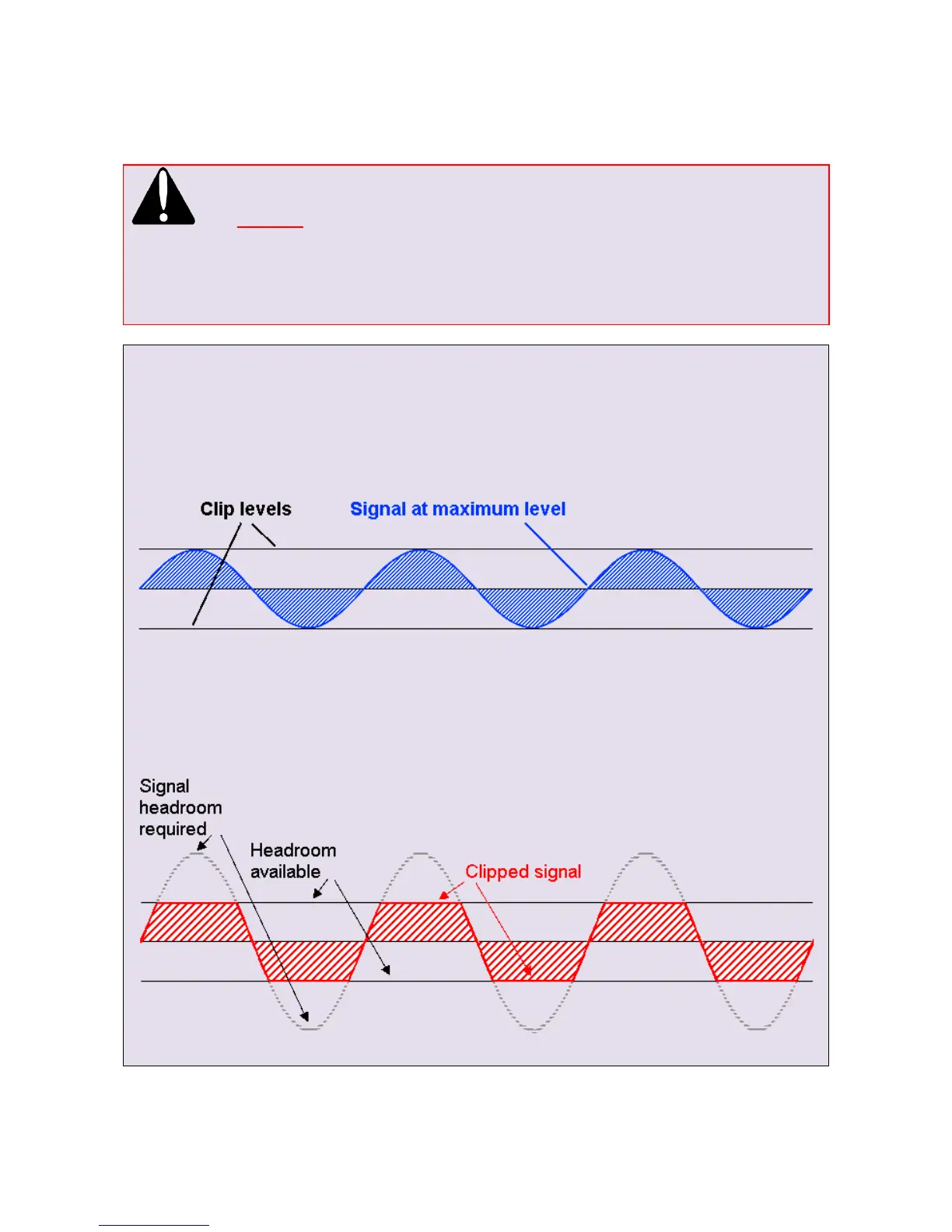
Here’s a normal signal at maximum level – just below clipping and still within the available “headroom”...
(The clip level sets the maximum available headroom)
Pure tone (single frequency) signal just below clip level
(Vertical = voltage, horizontal = time)
The blue positive and negative shaded areas represent the power the signal would cause to be dissipated
in a load – usually a loudspeaker voice coil.
Here’s the same signal amplified beyond the available “headroom” – i.e. beyond the clip level...
Signal amplified beyond clip level
www.funktion-one.com © Funktion One Research Limited 2011


 To Next Page