38
However, if the bass enclosure is positioned at an increment of half a wavelength from the wall the
reflected and direct sound can combine once again maximising the energy despite the phase lag.
The most dangerous position for destructive interference is close to but not against a wall or boundary.
Reinforcement and cancellation are dependent on the specific frequency and dimensions.
For instance, an enclosure 1m from a wall will have an extra distance of 1m there and 1m back. 86Hz has
a wavelength of 4m so the 2m round trip will cause a ½ wavelength delay. ½ wavelength delay will cause
the reflected wave at 86Hz to have a 180° phase lag.
This will cause maximum cancellation when it combines with direct wave at the front of the enclosure.
For a more in depth understanding of this, please see the Funktion One handbook.
Boundary effects (and how they cause low frequency phase shifts)
Smaller loudspeaker systems are less directional than larger ones at low frequencies and are, therefore,
more affected by a nearby floor, wall or ceiling. These local boundaries can affect the low frequency
phase response of F81 and bass systems differently leading to phase misalignment through the F81-to-
bass crossover region. The effect can be compensated for using a Funktion One XO series loudspeaker
management system.
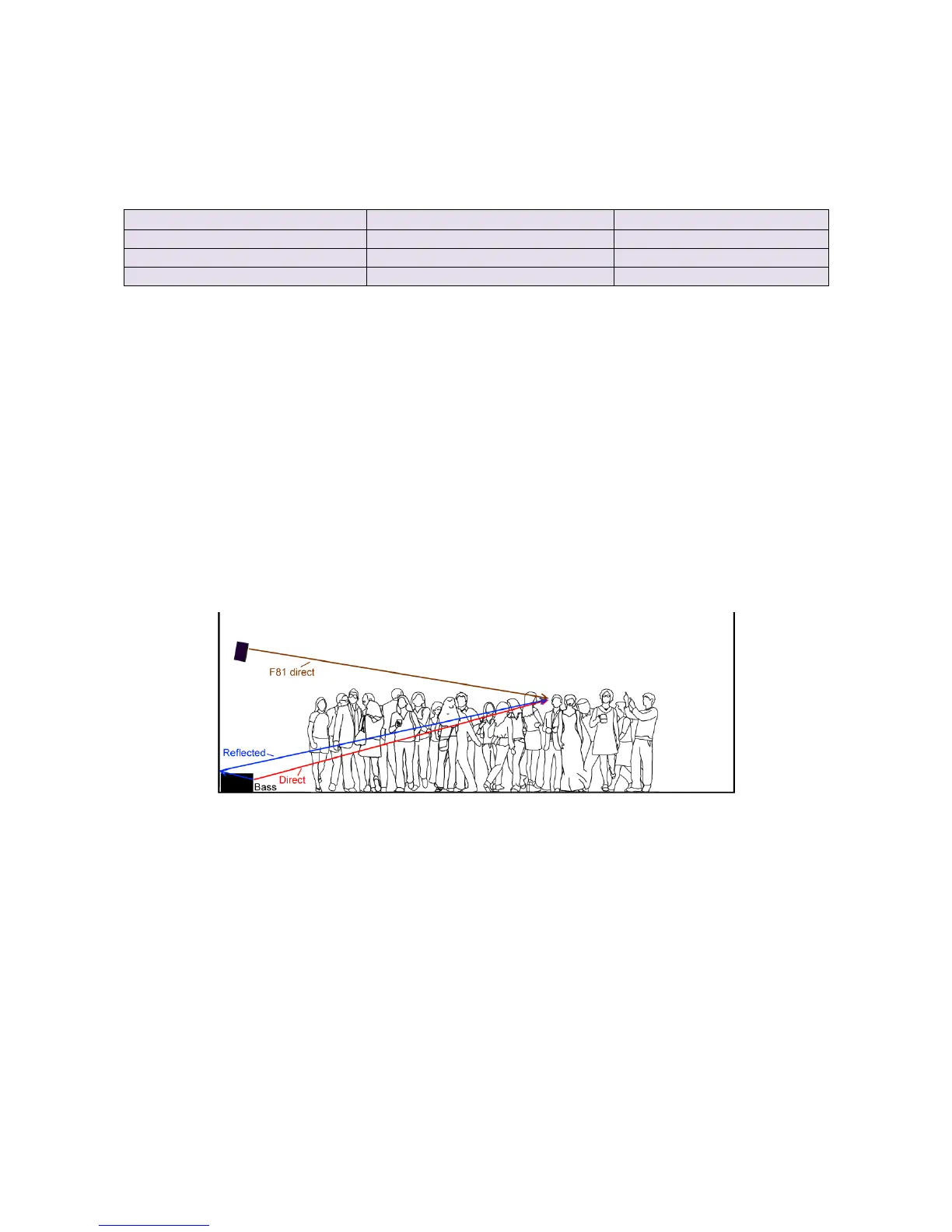
Fig 10.1-3 Direct bass (red) plus a close rear wall reflection (blue)
(In reality, of course, multiple boundary effects will occur for both F81 and bass enclosures)
In the example shown, the direct sound from the bass system (red) is closely followed, a few milliseconds
later, by bass sound reflected from the rear boundary (blue).
If the reflected bass arrives within ⅓ of a wavelength for frequencies up to the bass-F81 crossover
frequency, then the direct and reflected levels will add – albeit with an overall phase lag.
The addition varies from almost +6dB for very small phase lags to 0dB (unity gain) for 120° phase lag.
Note that subtraction will start to occur for phase differences beyond 120° with complete cancellation
occurring at 180°.
www.funktion-one.com © Funktion One Research Limited 2011


 To Next Page