61
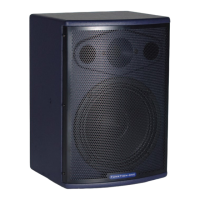
Powered loudspeakers
Maximum spl figures are often quoted for powered loudspeakers but very few manufacturers quote
figures for continuous power as per the drivers’ AES power ratings.
Before miniature power modules were available, amplifier recommendations were based on the driver’s
AES power rating. This was tested using noise with a 6dB peak-to-rms voltage ratio. This implied that a
good power amplifier would be capable of supplying the driver’s AES power continuously and that it
would be able to supply four times that power in bursts.
Amplifiers built into loudspeakers tend to be quite small for aesthetic and weight reasons and are often
based on designs with large enough voltage swings for instantaneous peaks, but inadequate power
supply capacity for sustained performance. It is not unusual for powered loudspeaker manufacturers and
power module OEM suppliers to quote maximum power for just a few hundred milliseconds (often less)
and to quote peak or burst power for only a few tens of milliseconds. So that impressive maximum spl
figure wouldn’t be relevant for sustained bass or keyboard notes.
Such systems tend to sound impressive on opening percussion runs with single or sparse
instrumentation, but they rapidly degenerate into a mush once the full band and vocals strike up.
Limiters
Limiters are usually employed to protect the drivers from accidental overload – especially in powered
loudspeakers and professional touring systems. But they can also be used to provide a more acceptable
spectral balance when the system is being driven hard.
Go to www.funktion-one.com/settings/ for further information.
Most maximum spl figures are calculated from driver sensitivities and AES power ratings so limiters don’t
really feature in the arithmetic. It would be helpful if manufacturers stated the decrease in maximum spl
expected with their recommended limiter settings dialled in. This, of course, should be with AES noise
that is band-limited to the pass-band of the relevant loudspeaker or section.
Note that these figures will depend on limiter attack and decay characteristics, and not simply on limiter
thresholds.
Again, when measured figures are quoted, it would be helpful if manufacturers quoted the maximum
continuous spl and maximum peak or burst spl using the recommended or in-built power amplifier and
using the recommended or pre-programmed limiter settings.
Conclusion
Neither calculated nor measured maximum spl figures are a reliable figure of merit or comparison as
there are no hard and fast rules when it comes to assessing a loudspeaker’s maximum sound pressure
level.
Current methods are not transparent enough for potential purchasers to assess different products from
a variety of manufacturers and make sensible comparisons.
Many years ago loudspeaker driver manufacturers embraced AES2-1984 to provide consistency between
driver manufacturers’ power ratings. The professional audio industry has enjoyed an improvement in
driver quality and reliability since then because the competitive focus shifted perceptibly from “smoke
and mirror” sales techniques to genuine technical improvement.
We now need a similar industry shift towards an agreed standard for testing and reporting complete
loudspeaker system specifications. These specifications should include distortion versus frequency – and
versus operating levels. The current single-figure maximum spl specification owes more to the alarm
industry that to a serious professional sound industry.
www.funktion-one.com © Funktion One Research Limited 2011


 To Previous Page