CHAPTER 4: FUNCTIONALITY OVERCURRENT FAULT CONDITIONS
LM10 MOTOR PROTECTION SYSTEM – INSTRUCTION MANUAL 4–27
4.1.2 Trip Curves Example
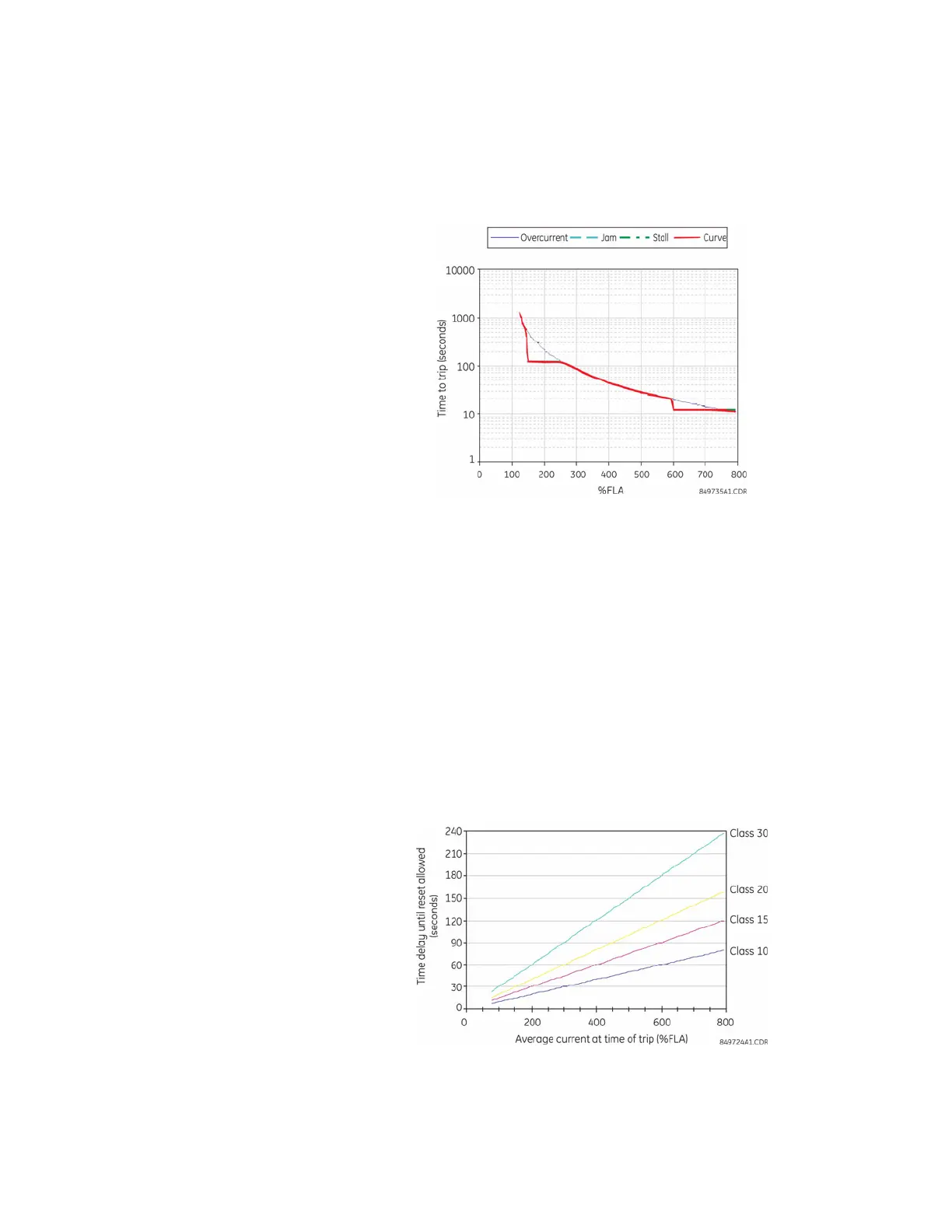
A trip curves example with jam and stall enabled is shown below. In this example, we have
trip class 20, cold motor, with jam at 150% FLA for 120 seconds, and stall at 600% FLA for
12 seconds.
FIGURE 4–3: Trip Curve with Jam and Stall Enabled
The LM10 will trip on a jam or stall condition if these faults are enabled (see Run 1 and Run
2 Setup on page 4–32). The overcurrent curve cannot be disabled. Therefore, if the jam or
stall values are set greater than the time allowed by the standard trip curve, the LM10 will
trip before a jam or stall condition can be reached.
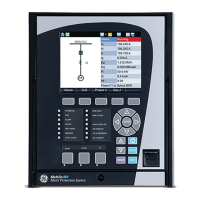
Upon an overcurrent, jam, or stall fault, the LM10 forces a cool-down period before the
motor may be restarted. The time to reset is calculated as a function of the trip class and
percent of full load current (FLA) at the time of the trip. For example, a class 30 motor
tripping on a 6 × FLA fault will take 9 times longer before it is ready to reset than a class 10
motor tripping on a 2 × FLA fault.
FIGURE 4–4: Cool Down Times


 To Next Page