8
Safety precautions
Safety precautions
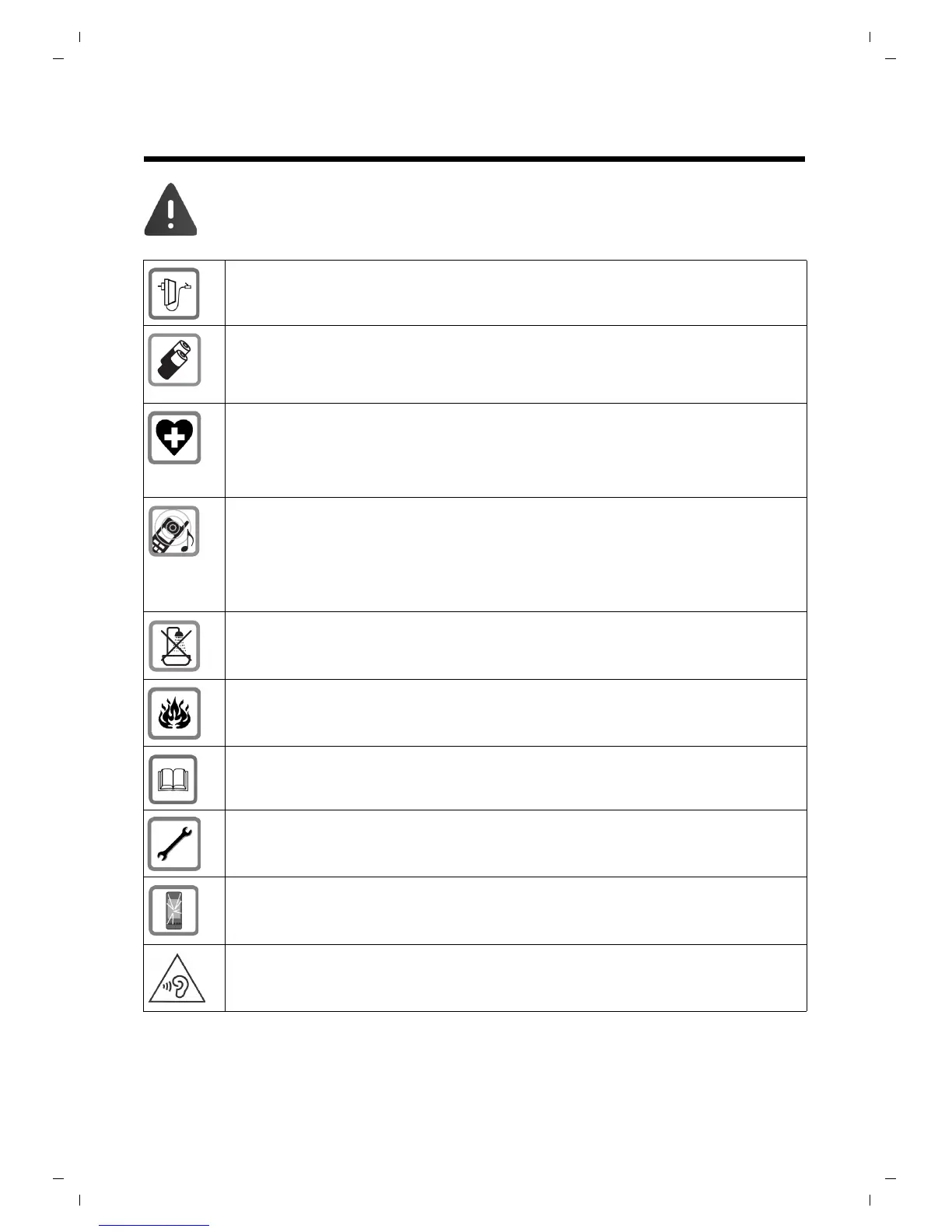
u Read the safety precautions and the user guide before use.
u Explain their content and the potential hazards associated with using the device
to your children.
Use only the power adapter indicated on the device.
Use only recha
rgeable batteries that correspond to the specification (see "Technical data").
Never use a conventional (non-rechargeable) battery or other battery types as this could
result in significant health risks and personal injury. Rechargeable batteries, which are notice-
ably damaged, must be replaced.
Using your telephone may affect nearby medical equipment. Be aware of the technical con-
ditions in your particular environment, e.g., doctor's surgery.
If you use a medical device (e.g., a pacemaker), please contact the device manufacturer. They
will
be able to advise you regarding the susceptibility of the device to external sources of high
frequency energy (for the Technical data of your Gigaset product see "Technical data").
Do not hold the rear of the handset to your ear when it is ringing or when speaker mode is
ac
tivated. Otherwise you risk serious and permanent damage to your hearing.
Your Gigaset is compatible with the majority of digita
l hearing aids on the market. However,
perfect function with all hearing aids cannot be guaranteed.
The phone may cause interference in analogue hearing aids (humming or whistling) or cause
th
em to overload. If you require assistance, please contact the hearing aid supplier.
The devices are not splashproof. For this reason do not install them in a damp environment
su
ch as bathrooms or shower rooms.
Do not use the devices in environments with a
potential explosion hazard (e.g., paint shops).
If you give your Gigaset to a third party, make sure
you also give them the user guide.
Remove faulty devices from use or have them r
epaired by our Service team, as these could
interfere with other wireless services.
Do not use the device if the display is cracked
or broken. Broken glass or plastic can cause
injury to hands and face. Send the device to our Service department to be repaired.
To prevent loss of hearing, avoid listening at hig
h volume over long periods of time.


 To Next Page