·
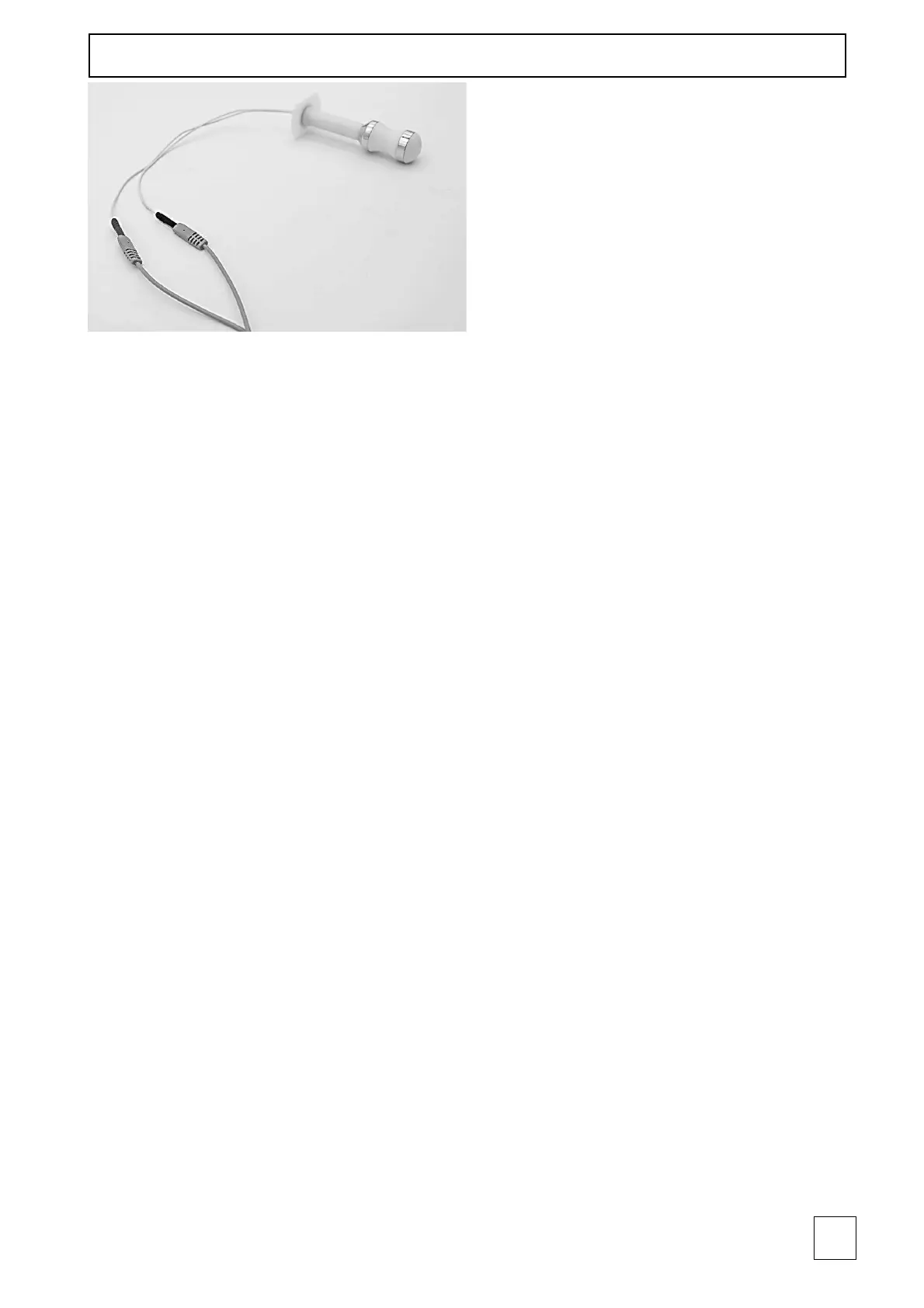
Connect the cable to the device.
·
For the vaginal stimulation, lie flat supine with bended knee and opened legs. To use
the anal probe, lie on one side in lateral decubitus position
·
Insert the probe in the vagina or anus using, if necessary, some water-based gel
·
Choose and start the incontinence program
·
Gradually increase the intensity until perceiving a muscular contraction.
Once the program is finished, turn the device off, extract the probe and disconnect the
connection cables. Clean the accessory and put it in a clean bag.
Indications for the use of ionophoresis
This program uses a low-intensity and continuous current (between 5 and 10 mA) that
helps the absorption of the active ingredients of a drug in a specific area of the body. It
is often required that a drug is administered directly on the area that needs to be healed,
avoiding an oral or intravenous administration. With ionophoresis it is possible to
administrate a drug through transcutaneous penetration directly on the body area that
needs to be treated.
The drug must be prepared in ionic form and must have an electric charge. The principle
on which ionophoresis is that the continuous current flows through skin from one
electrode to the other (from anode to cathode) consequentially transporting the
electrically charged iones that are inside the treated body area.
In practice, sponges soaked in a solution containing the active ingredient are used,
bearing in mind that if it has a negative charge, it must be applied to the negative
electrode and vice versa. The current will carry the active principle inside the tissues,
because the ions of the active principle itself will migrate towards the opposite pole until
the product is completely absorbed. The kit with sponges and electrodes for
ionophoresis is an extra accessory that can be purchased separately.
The intensity value is adjustable from a minimum of 0 mA to a maximum of 10 mA.
To ensure safety, the maximum intensity, calculated with the smallest ionophoresis
electrodes (50 x 50 mm), is 0.40 mA per cm² of electrode.



 To Next Page