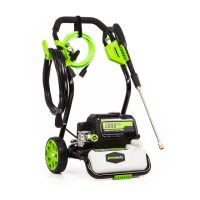
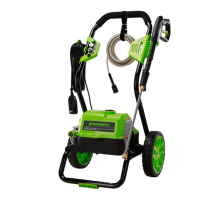
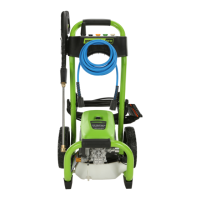
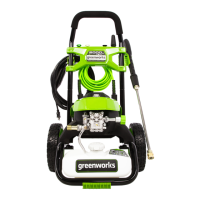
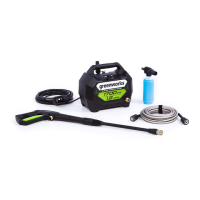
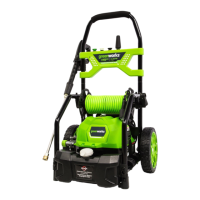
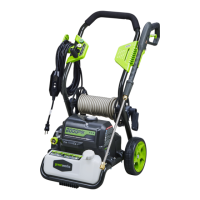
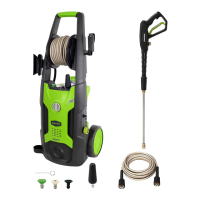
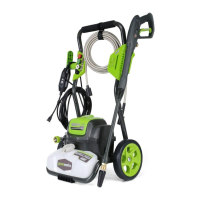
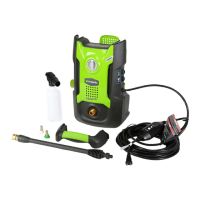
The Greenworks GPW2000-1 is a 2000 PSI Electric Pressure Washer designed for various cleaning tasks. This owner's manual provides comprehensive information on its operation, maintenance, and safety guidelines.
Function Description:
The GPW2000-1 is an electric pressure washer that uses a high-pressure stream of water to clean surfaces. It is equipped with a universal motor that generates up to 2000 PSI (Pounds Per Square Inch) of pressure, making it suitable for removing dirt, grime, and other stubborn stains from a variety of outdoor surfaces. The device features an Auto Start/Stop function, which means the pump pressurizes and shuts down immediately when the power switch is turned on and the trigger is not depressed. When the trigger of the gun is depressed, the unit turns on, and it will shut off and enter standby mode when the trigger is released. This feature helps conserve energy and prolong the life of the pump. The pressure washer is designed for use with cold water only, and it includes a detergent tank for applying cleaning solutions, enhancing its effectiveness on tougher cleaning jobs.
Important Technical Specifications:
- Model: GPW2000-1
- Motor Type: Universal Motor
- Voltage: 120 V~60 Hz
- Amperage: 14 Amps
- Max. Pressure: 2000 PSI
- Rated Gallons Per Minute (gpm): 1.2 gpm
- Maximum Inlet Water Temperature: 104°F (40°C)
- Cleaning Units (C.U.): 2400 C.U.
- Net Weight: 31 lbs. (14 kg)
- Warranty: 1 Year
Usage Features:
The pressure washer comes with several features designed for ease of use and versatility:
- Trigger and Wand Assembly: This allows the user to operate the pressure washer by depressing the trigger to activate the pump and spray water using the desired spray tip. The spray wand is securely attached to the trigger handle by pushing and rotating clockwise.
- Spray Tip Panel Assembly: The unit includes a spray tip panel assembly with various spray tips, allowing users to select the appropriate spray pattern for different cleaning tasks.
- Detergent Tank: A dedicated detergent tank is integrated into the unit. Users can remove the cap and add detergent to the tank for enhanced cleaning power.
- High Pressure Hose: The device is equipped with a high-pressure hose that connects the pump to the trigger and wand assembly, delivering the pressurized water.
- Power Cord Storage: The power cord can be conveniently wrapped and stored around a hook on the unit, helping to keep it tidy and prevent tangles.
- Wheels: The pressure washer is fitted with wheels for easy maneuverability, allowing users to transport it around the work area without difficulty.
- GFCI Plug: The power cord is equipped with a Ground Fault Circuit Interrupter (GFCI) plug to protect against ground fault currents, enhancing electrical safety during operation. It's important to note that this plug does not protect against short circuits, overloads, or shocks.
- Drip Loop Recommendation: To prevent water from flowing along the power cable and potentially reaching the electrical outlet and plug, a simple drip loop is recommended when connecting the power cord.
- Extension Cord Guidelines: Specific guidelines are provided for using extension cords, including recommended wire sizes (AWG) for different cord lengths (e.g., 12 AWG for 25 ft) to prevent overheating and power loss. It explicitly states that 50 ft and 100 ft extension cords are "Not Allowed" with this product, indicating the importance of proper cord selection for optimal performance and safety.
Maintenance Features:
The manual emphasizes several maintenance aspects to ensure the longevity and safe operation of the pressure washer:
- Regular Inspections: Users are advised to check bolts and nuts fixing the pressure washer shell for looseness before each use, as loose fasteners can lead to serious motor problems.
- Cleaning: The product should be kept dry, clean, and free from oil and grease. A clean cloth should be used for cleaning, and brake fluids, gasoline, petroleum-based products, or any solvents should never be used, as they can damage the product.
- Damaged Parts: Before further use, all parts should be carefully checked for proper operation, including alignment of moving parts, binding, breakage, and mounting. Any damaged guard or part must be properly repaired or replaced by an authorized service center to prevent personal injury.
- Extension Cord Care: Extension cords should be checked before each use for damage. Damaged cords must be replaced immediately to avoid electrical shock.
- Motor Care: The motor should be kept free of grass, leaves, or grease to reduce the risk of fire.
- Storage: Before storing, the motor should be allowed to cool down.
- Service: Servicing requires extreme care and knowledge and should only be performed by a qualified service technician. For repair, returning the product to an authorized service center is recommended, and only identical replacement parts should be used.
The manual includes extensive safety information, highlighting warnings and precautions:
- General Safety: Read all instructions carefully, be familiar with controls, stay alert, and avoid operating when tired or under the influence of substances. Keep children, pets, and bystanders away from the operating area.
- Personal Protective Equipment: Always wear eye protection with side shields (ANSI Z87.1 compliant) and, when needed, a full face shield. Protective footwear is recommended.
- Water Stream Safety: Never direct the water stream at people, animals, or electrical devices. High-pressure jets can be dangerous if misused.
- Chemical Use: DO NOT USE acids, alkalines, bleaches, solvents, flammable materials, or industrial-grade solutions in the product, as they can cause chemical burns, physical injuries, and irreversible damage to the machine.
- Electrical Safety: Keep connections dry and off the ground. Do not touch the plug with wet hands. Avoid exposing the product to rain or using it in damp locations.
- Kickback: Hold the spray wand securely with both hands when the machine is on to reduce the risk of injury from kickback.
- Proposition 65 Warning: The product contains chemicals, including lead, known to the State of California to cause cancer, birth defects, or other reproductive harm. Do not drink water from the hose and wash hands after use. Dust created by power sanding, sawing, grinding, drilling, and other construction activities may also contain chemicals known to cause cancer, birth defects, or other reproductive harm. Work in well-ventilated areas and use approved safety equipment like dust masks.



 To Next Page

 General