
 Need help?
Do you have a question about the Grundfos UPM3 and is the answer not in the manual?
Explains symbols and hazard statements used in Grundfos instructions.
Details suitable and unsuitable liquids for the pump, including safety warnings.
Instructions for safe lifting and transporting of the pump.
Steps to ensure the product received matches the order and specifications.
Explains how to position the control box for optimal access and orientation.
Step-by-step guide to repositioning the pump's control box.
Guidance on how to prevent the pump from blocking.
Illustrates the electrical wiring for a mains-connected pump.
Details the required supply voltage and frequency for the pump.
Information on leakage current and ELCB requirements for the pump.
Essential checks and preparations before starting the pump.
Step-by-step guide for safely starting the pump after installation.
Troubleshooting steps when the pump has no power.
Troubleshooting steps when the pump has power but doesn't run.
Identifies causes and remedies for insufficient flow from the pump.
Troubleshooting steps when the pump runs at maximum speed uncontrollably.
Explains fault indications shown on the operating panel's LEDs.
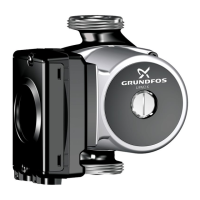
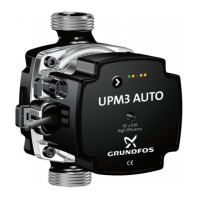
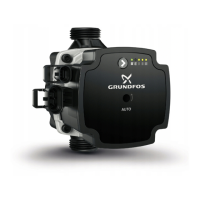
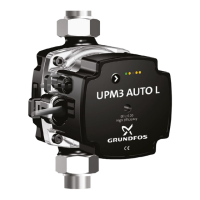
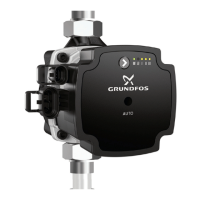
The Grundfos UPM3 is a series of speed-controlled, high-efficiency pumps featuring an electronically commutated motor (ECM) with a permanent-magnet rotor and frequency converter. These pumps are designed for various applications, including heating systems, solar thermal systems, and domestic hot water systems. They can be controlled either externally via a digital pulse-width modulation (PWM) low-voltage signal or LIN bus signal, or internally through constant pressure, proportional pressure, or constant speed modes, which can be set via a smart operating panel or factory presets.
The UPM3 pumps are primarily used to circulate liquids in heating, solar, and domestic hot water systems. Their speed-controlled operation ensures high efficiency and adaptability to system demands. The ECM motor, combined with a permanent-magnet rotor and frequency converter, allows for precise control of pump performance.
For external control, the pump responds to PWM or LIN bus signals. In PWM A profile (heating), the pump runs on constant speed curves, with speed decreasing as the PWM value increases. If PWM is 0, the pump runs at maximum speed. This profile is designed to transfer heat from the primary heat exchanger even if a cable breaks, making it suitable for gas boiler systems and heat pumps. In PWM C profile (solar), the pump also runs on constant speed curves, but speed increases with the PWM value. If PWM is 0, the pump stops, which is a safety feature to prevent overheating of the solar thermal system in case of a signal loss.
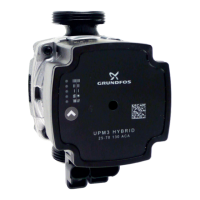
Internally, the UPM3 HYBRID variants offer three control modes: proportional pressure, constant pressure, and constant curve, with an additional AUTOADAPT function.
The UPM3 FLEX AS and UPM3 DHW variants are externally controlled by a PWM A profile signal or speed selection, allowing the maximum curve of the pump operating range to be defined. With a PWM signal, the pump runs at the corresponding speed; without a PWM signal, it runs at maximum speed.
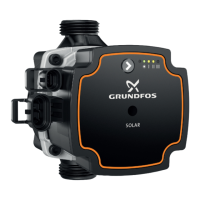
The UPM3 SOLAR variant is externally controlled with a PWM C profile signal or internally operates in constant curve mode.
The UPMO variant is internally controlled with CC mode or externally with PWM signal control with profile A. It automatically enables PWM input-signal control mode by SignalDetect when the signal cable is plugged in. If no PWM signal is detected or if the signal is 0, the pump reverts to its previous control mode.
The UPM3 pumps are designed for ease of installation and operation. The control box, which provides access to the terminals, can be rotated in 90-degree steps (3, 6, 9, or 12 o'clock positions) to suit various installation orientations. The operating panel's front foil can also be placed in four different positions, allowing for horizontal placement regardless of the control box's orientation. IP44 versions without drain holes permit all positions, while IPX4D versions with drain holes (UPM3K, UPM3 SOLAR) require the drain hole to point downwards, limiting connector positions to the side.
For electrical connection, the pump requires a 1 x 230 V +10%/-15%, 50/60 Hz supply. It is crucial not to use an external speed control that varies the supply voltage. The pump's mains filter causes a leakage current to earth during operation, typically less than 3.5 mA. The control box has two electrical connections: power supply and signal. If the signal connection is not needed, it can be covered by a blind plug.
The operating panel for UPM3 features a single red/green LED that indicates external control or an error. For UPM3 HYBRID variants, the operating panel includes a button, one red/green LED, and four yellow LEDs, displaying the control mode and alarm status. The button allows users to cycle through different control modes, with the LEDs indicating the selected mode.
Before startup, the system must be filled with liquid and vented. The pump is self-venting, so air inside the pump is transported into the system shortly after startup. It is recommended to run the pump for about two hours after installation to vent the system and ensure it runs daily to prevent blocking.
The UPM3 pumps are generally maintenance-free. However, if the pump becomes blocked by impurities, it can be deblocked by opening the deblocking screw at the front of the pump head and using a screwdriver.
For cleaning the impeller or pump housing, the system must first be drained or isolating valves closed. The pump head screws can then be removed to access and clean the components. After cleaning, the pump head is re-positioned, and the screws are tightened.
When insulating the pump, the front plate of the control box must remain uncovered to allow for cooling by ambient air. If the pump is installed within a cabinet, boiler, or heating kit with insulation shells, the internal air temperature must not exceed 70 °C.
The pump provides feedback signals via PWM, offering information such as current power consumption, warnings, alarms, and operating status. This feedback can assist in fault finding. The operating panel also indicates fault conditions through LED patterns, with different colors and flashing sequences corresponding to various alarms like low supply voltage, blocked rotor, or electrical error. The system prioritizes alarms, displaying the highest priority error if multiple are active.
For storage, the product should be protected from rain, humidity, condensation, direct sunlight, and dust. The permissible storage temperature ranges from -40 to +75 °C, and the maximum storage time without power supply is two years from delivery.
When disposing of the product, it should be done in an environmentally sound way, using public or private waste collection services, or by contacting a Grundfos company or service workshop. The crossed-out wheelie bin symbol indicates that the product must be disposed of separately from household waste.
 General
| Type | Circulator Pump |
|---|---|
| Category | Water Pump |
| Max Flow Rate | 3.5 m³/h |
| Voltage | 230 V |
| Frequency | 50/60 Hz |
| Protection Class | IP44 |
| Maximum Operating Pressure | 10 bar |
| Housing Material | Cast Iron |
| Control Mode | Constant Pressure, Constant Curve |
| Power Input | 3 to 45 W |
| Motor Power | 0.55 kW |
| Energy Efficiency Index | ≤ 0.20 |
| Impeller Material | Composite |
| Application | Heating systems |



 To Next Page


