The Grundig CCF 8300 is a HiFi front-loading twin-cassette tape deck, featuring two drive mechanisms: A-CMAY-6 and B-CMAY-2.
Function Description
The device offers four main operating modes, selectable via a mode switch:
- Normal Operation: Playback from either drive mechanism A or B.
- Reverse Once: Drive mechanism B plays back in reverse once.
- Continuous Reverse: Drive mechanism B plays back continuously in reverse.
- Autoplay (Alternative Auto Repeat): Alternating playback between drive mechanisms A and B.
Drive Mechanism A (Left):
- Stereo playback with automatic equalization time constant switching based on tape type (refer to point 6 in the Electrical Section).
- In "Reverse Once" and "Continuous Reverse" modes, drive mechanism A operates in normal playback.
Drive Mechanism B (Right):
- Stereo recording/playback.
- Automatic switching of tape (bias) and equalization time constant via a tape select lever.
Reverse Once Mode:
After recording or playback starts, drive mechanism B changes direction at the tape's end. The tape is then recorded or played back in reverse until automatic stop at the tape's end.
Continuous Reverse Mode:
In this mode, tape on drive mechanism B plays in both directions without manual cassette reversal. During recording, the tape records to the end, changes direction, records in reverse, and switches off at the tape's end.
Autoplay Mode:
This mode enables continuous playback using both drive mechanisms.
- Insert a cassette into each deck.
- Select DOLBY NR off, DOLBY NR-B, or -C according to the recording.
- Press the START button on deck A.
- Drive mechanism A plays to the tape's end and then fast-rewinds (autorepeat).
- Simultaneously, drive mechanism B starts playback, playing both cassette sides sequentially.
- Drive mechanism A then restarts playback. These steps repeat automatically.
- Starting with drive mechanism B is also possible.
- If drive mechanism B is in record mode, it switches off at the tape's end as in normal operation.
Dubbing:
Cassettes can be copied from deck A to deck B. Pressing the DUBBING button starts both decks, with A playing and B recording. During dubbing, Dolby NR and recording level controls are inactive. Dolby B or C only affect monitoring and do not influence the dubbing process.
- DUBBING NORMAL: Normal copying speed, normal monitoring volume.
- DUBBING HIGH: Increased copying speed, reduced monitoring volume.
Operation with External Timer:
Playback or recording, along with special modes like reverse, continuous reverse, and autoplay, can be started and stopped using an external timer.
- Select functions via TIMER or mode select switches (refer to the operating manual).
- Connect the deck's mains plug and the timer to the mains.
- Set the switch-on/off time on the timer.
- Caution: In REC position, a recording might be accidentally erased if the deck is switched on inadvertently when connected to the mains or timer.
Remote Control:
The CCF 8300 features an RC-Bus remote control socket on the rear. Deck A cannot be controlled remotely. Deck B functions can be remote-controlled in combination with a V 8300 or V 8400 amplifier and the RC 8400 remote control unit. The V 8300 or V 8400 amplifier acts as a central remote control receiver and distributor, picking up infrared signals from the RC receiver and supplying them via bus lines to other audio components (e.g., Tuner 8200, CCF 8300 tape deck, or CD 8200/CD 8400 CD player).
Important Technical Specifications
Operating Voltages (at 220 V a.c. ± 2% mains voltage, playback, start):
- C711: 12.5 V ± 10%
- C712: 15.0 V ± 5%
- C713: 5.0 V ± 5%
Power Consumption:
- Maximum 22 Watts at 220 V ± 2% mains supply (HIGH SPEED DUBBING with a blank Me-tape).
Tape Winding Time:
- Approximately 110 seconds for a C 60 cassette.
Synchronization:
- Wow and flutter: ±0.2% (DIN 45507, level-adjusted, 3150 Hz cassette, external-source playback).
- Playback testing time: at least 30 seconds.
Equalizing Time Constants (to IEC standard):
- Cr tape (IEC II): 70 µs + 3180 µs
- Me tape (IEC IV): 70 µs + 3180 µs
- Fe tape (IEC I): 120 µs + 3180 µs
(3180 µs for low frequencies, 70 µs or 120 µs for high frequencies).
Distortion Factor (Tape B, red LED just out, 200 nWb/m max. level, channels measured individually):
- Cr: K3 < 3.5%
- Fe: K3 < 2%
- Me: K3 < 3%
External and Noise Voltage (Tape B, f=333 Hz, Vin approx. 500 mV, record start):
- Cr Tape:
- Dolby off: > 52 dB (external voltage effective), > 55 dB (curve A effective)
- Dolby B on: > 55 dB (external voltage effective), > 63 dB (curve A effective)
- Dolby C on: > 57 dB (external voltage effective), > 69 dB (curve A effective)
- Fe Tape:
- Dolby off: > 48 dB (external voltage effective), > 51 dB (curve A effective)
- Dolby B on: > 54 dB (external voltage effective), > 61 dB (curve A effective)
- Dolby C on: > 56 dB (external voltage effective), > 67 dB (curve A effective)
- Me Tape:
- Dolby off: > 50 dB (external voltage effective), > 54 dB (curve A effective)
- Dolby B on: > 52 dB (external voltage effective), > 61 dB (curve A effective)
- Dolby C on: > 56 dB (external voltage effective), > 68 dB (curve A effective)
Usage Features
- Tape Drive Adjustment: Requires a head gauge (part no. 72008-401.00) and a tape drive cassette (e.g., MC-112 C, part no. 72008-247.00).
- Head Gap Vertical Adjustment (Azimuth): For playback head LW 1-A and record/playback-erase head LW 1-B, adjustment is done via specific holes (j, l, m) using a watchmaker's screwdriver (1.5 mm blade width, 17 mm blade length, similar to DIN 8320). This can be done with the drive mechanism installed or removed.
- Tape Speed Adjustment: Requires a frequency counter (e.g., GRUNDIG-TG 5) and a 3150 Hz test cassette (Cr-test 448 or Fe-test 449). Adjustments are made via R 799 (double speed) and R 787/R 785 (normal speed).
Maintenance Features
- MOS Component Handling: Always observe guidelines for handling MOS components when working on integrated circuits.
- Cleaning: Before service, check that sound heads, capstan spindle, and rubber pinch rollers are free of tape residue. Clean these parts with cotton wool soaked in white spirit or cleaning fluid to improve tape transport, recording, and playback.
- Component Replacement: After replacing magnetic heads or other components, the technical data must be checked against specified test values using GRUNDIG test equipment.
- Screws in Plastic: When driving screws into plastic parts, twist counter-clockwise first until the thread engages, then tighten to avoid cutting new threads.
- Safety: For device safety, only use replacement components that meet VDE and IEC safety requirements and have identical specifications. Heavy inflammable resistors and fuses must comply with safety requirements.
- Drive Belt Replacement: For LW 43 (drive belt), it's easier to place the belt around the flywheel first, then the outsert clamp, and finally around the motor pulley using tweezers.
- Clutch Replacement: For LW 9 (forward run) or LW 10 (rewind) clutch, ensure the sector disk (LW 9) does not come into contact with oil or grease, as this can interfere with sensor LW 45.
- Motor Replacement: For LW 36 (capstan motor) and LW 35 (winding motor), mind the polarity when unsoldering/soldering leads and the mounting position. After replacing the capstan motor, check and readjust the tape speed.
- Flywheel Replacement: For LW 49/LW 50 (flywheels), clean the capstan with spirit and benzene after fitting the new flywheel and dust washer.

 Need help?
 General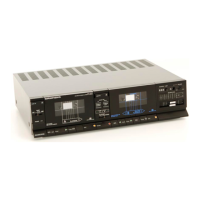

 To Next Page