The Halyard COOLIEF Cooled Radiofrequency Pain Management Generator (PMG) is a medical device designed for pain management through cooled radiofrequency (RF) ablation. It is available in two models: PMG-Basic and PMG-Advanced, with the manual covering both. The device generates radiofrequency energy to create lesions in nerve tissue, thereby interrupting pain signals. The "cooled" aspect refers to a continuous flow of water through the electrode, which maintains a lower temperature at the electrode tip, allowing for larger lesion creation without excessive heating of surrounding tissue.
Function Description
The PMG is a radiofrequency generator that delivers controlled RF energy to target nerve tissue. It supports various treatment modes, including:
- Voltage Stimulation: Used for sensory and motor nerve mapping to ensure accurate probe placement and avoid unintended nerve damage.
- Current Stimulation: Similar to voltage stimulation, used for nerve mapping.
- Auto Temp Lesion: Automatically adjusts RF energy to maintain a set temperature at the electrode tip, creating a lesion.
- Manual Power Lesion: Allows the user to manually set the power output for lesion creation.
- Auto Pulsed Lesion: Delivers pulsed RF energy, which is a non-ablative technique often used for neuromodulation.
- Manual Pulsed Lesion: Manual control over pulsed RF energy delivery.
- Cooled RF Treatment: Utilizes the cooled RF technology to create larger, spherical lesions, particularly beneficial for treating larger nerves or areas requiring more extensive ablation.
- TransDiscal Treatment: Specifically designed for treating discogenic pain, often involving bipolar or monopolar RF energy delivery.
- RFA Treatment Mode: General radiofrequency ablation mode.
- IDL Mode: Intradiscal Lesioning mode, used for treating discogenic pain.
The device features a user interface with a display screen that shows real-time treatment parameters, including impedance, temperature, voltage, current, and time. It also includes a graph window for visualizing treatment progress. The PMG is designed for use with specific Halyard COOLIEF probes and accessories, including cannulas, electrodes, and dispersive return electrodes.
Important Technical Specifications
- Size: 9.5 x 12.5 x 14.0 inches (24 x 32 x 35 cm) maximum.
- Weight: 21.0 lbs (9.5 kg) maximum (not including power cord or shipping box).
- Moisture Protection Rating: IPX0 (ordinary, per IEC601).
- Operational Temperature: 10°C to 35°C.
- Storage & Transportation Temperature: -40°C to 70°C.
- Storage & Transportation Humidity: 20% to 95% non-condensing.
- Power Supply: 100VAC – 240VAC, 50Hz – 60Hz.
- Fuses: Replaceable mains fuses (4A/250V, T-lag, 5x20mm).
- Stimulation Voltage Range: 0.00 – 10.0 V, 0.01 V increment.
- Stimulation Current Range: 0.00 – 10 mA, 0.01 mA increment.
- Stimulation Pulse Duration: 0.1, 0.2, 0.5, and 1.0 ms.
- RF Output Frequency: 460.8 kHz ± 1% (Quasi-sinusoidal).
- Maximum RF Power: 50 W (available into an impedance range of 60 Ω – 520 Ω, resistive). The generator reduces available power to maintain specified voltage and/or current limits.
- Maximum Output of 50 W is restricted by:
- Maximum voltage: 100 Vrms.
- Maximum current: 0.9 Arms.
- Maximum peak voltage: 254 V (under normal operating conditions).
- Power output is available into loads of 25 Ω – 3000 Ω.
- 100 Ω is the nominal "rated" load.
- Measurement Accuracy (at time of manufacture):
- Power: ±5%, ±0.25 W.
- Impedance: ±10%, ±10 Ω (25 – 300 Ω); ±20%, ±10 Ω (301 – 3000 Ω).
- Multi-RF Mode: Accuracy subject to condition that impedances of all other probes are within 100 – 1000 Ω; accuracy defined at ambient temperature of 25°C.
- Temperature: ±3°C for thermocouple probes.
- Elapsed time: ±1 second.
- Software Shutdown Limits During RF Delivery or Stimulation:
- Measured Impedance: <25 Ω or >3000 Ω.
- Measured Temperature: <15°C, >100°C, or >SET TEMPERATURE +5°C for 5 s, or <SET TEMPERATURE -10°C for 1 s.
- Measured RF Power: >55 W, or >SET POWER +50% + 5 W for 100 ms, or >SET POWER +20% + 5 W for 1 s.
- Measured RF Voltage: >180 Vrms.
- Measured RF Current: >0.9 Arms.
- Hardware Shutdown Limits:
- Measured RF Power: >60 W.
- Measured RF Voltage: >200 Vrms.
- Measured RF Current: >1 Arms.
- Stimulation Current: >40 mA.
- Stimulation Voltage: >11 V.
- Expected Service Life: 5 years.
- Compliance: This device is compliant with RoHS Directive 2011/65/EU.
Usage Features
- User-Friendly Interface: The device features a clear display and intuitive controls for easy operation. The main screen provides an overview of the current treatment status, while dedicated buttons allow for mode selection, parameter adjustment, and saving settings.
- System Initialization and Self-Test (POST): Upon power-on, the PMG performs a system initialization and a Power-On-Self-Test (POST) to ensure all components are functioning correctly. This process takes approximately 40 seconds. A "STANDBY" state is reached upon successful completion of the POST.
- Nerve Mapping: The voltage and current stimulation modes are crucial for nerve mapping, allowing clinicians to precisely locate target nerves and avoid motor nerves before lesioning. This helps minimize the risk of adverse events.
- Adjustable Parameters: Most treatment parameters, such as stimulation rate, pulse duration, temperature limits, power limits, and treatment time, are adjustable within specified ranges, allowing for customized treatment plans.
- Save Settings Feature: Users can save custom treatment settings, which can be recalled for future procedures, streamlining workflow and ensuring consistency.
- Error Detection and Display: The system continuously monitors various parameters and displays error messages or fault indicators if any issues arise, such as impedance out of range or temperature deviations. This ensures patient safety and proper device function.
- Audio/Language Settings: The device supports multiple languages (English, Spanish, French, Italian, German) and allows for adjustment of audio output, enhancing usability for a diverse user base.
- Footswitch Control: A footswitch can be connected for hands-free control of stimulation and RF output, improving procedural efficiency.
- Connector Cable Connection: The device includes clearly labeled connectors for various cables, including the generator cable, dispersive return electrode cable, and footswitch.
- Patient Isolation: The device is designed with an isolated patient circuit to ensure electrical safety.
- Defibrillator-Proof: The device is defibrillator-proof, meaning it can withstand the electrical discharge from a defibrillator without damage.
Maintenance Features
- Cleaning and Disinfection: The generator's exterior surfaces should be cleaned and disinfected using standard hospital alcohol solution or other approved disinfectants. It is crucial to avoid spraying liquids directly onto the generator.
- Fuse Replacement: The PMG operates over a wide AC voltage range. If a fuse blows, it must be replaced with the specified type (4A/250V, T-lag, 5x20mm) to ensure proper and safe operation. The manual provides instructions for accessing and replacing the fuse drawer.
- Regular Inspections: The manual recommends periodic inspections by qualified personnel to ensure the device remains in good working condition.
- Warranty: Halyard provides a warranty for the product, covering defects in materials and workmanship. The warranty period for the generator is 1 year from the shipment date, and for components like PMG-BASIC, PMG-ADVANCED, and Footswitch, PMG-FS, it is 90 days from the shipment date.
- Service and Repair: In the event of a malfunction or damage, the device should be returned to Halyard Health for repair. Unauthorized repairs or modifications will void the warranty.
- Recycling: The manual advises contacting the distributor or manufacturer for information on recycling the device at the end of its life cycle.

 Need help?
 General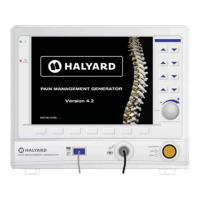

 To Next Page