21
10 15 20
40
100
150
25
200
!
"
!
#
DO NOT
USE !
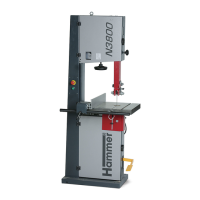
Bandsaw
N3700 e-classic / N3800 / N4400
Operation
7.2 Blade selection and maintenance
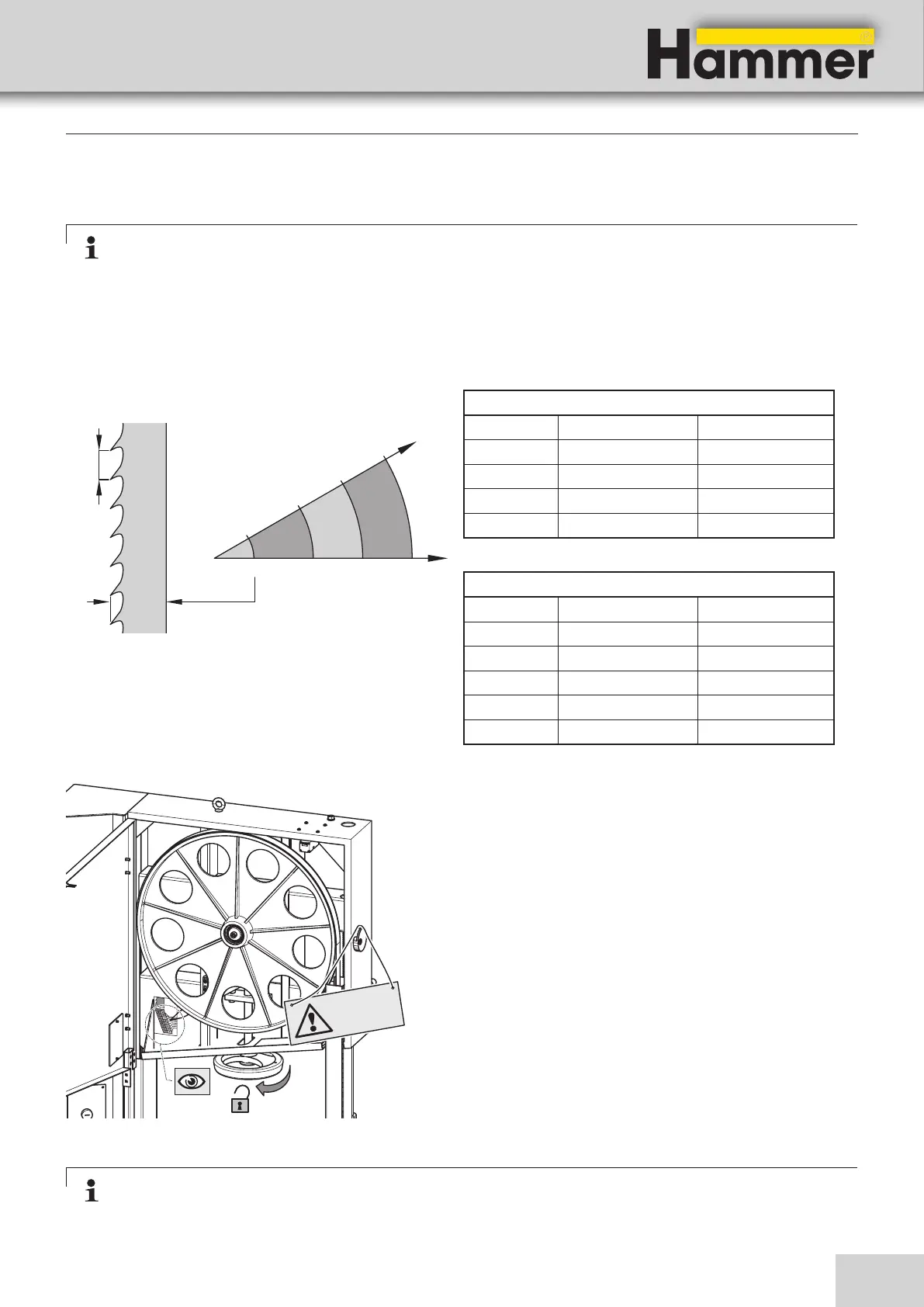
The gap between the individual teeth should be large
enough to carry the material chips and to throw them
away. If the gap is too small, the blade will overheat and
rupture.
Do not use kinked, ruptured or bent saw blades.
For soft wood, the set should be a max. of twice the
thickness of the saw blade and for hard wood, a max. of
1.5 times the thickness of the saw blade.
Change blunt blades and have them sharpened by a
specialist workshop or purchase a new saw blade.
It is recommended to use only high quality saw blades.
The following saw blades may be used:
!Blade width
"Radius cut
#Tooth spacing
Fig. 7-1: Saw blades
Attention! Once the machine is no longer in use, loosen the belt tension and place an appropriate
warning sign on the machine. This will thus prevent damage to the wearing surface of the wheels.
Selecting the type of saw blade and its width, depends on the material to be cut and the type of cut:
• Narrow saw blades are designed for curved and circular cuts, whereas wide saw blades are desi-
gned for straight cuts.
• A fine-toothed saw blade is required for hard wood, whereas a coarse-toothed saw blade is required
for soft wood.
Fig. 7-2: Scale
N3700/N3800 - Saw blade length: 3556 mm
Art. No. Blade width Tooth spacing
13.7.3806 6 mm 4,0 mm
13.7.3810 10 mm 6,0 mm
13.7.3815 16 mm 8,0 mm
13.7.3820 20 mm 8,0 mm
N 4400 - Saw blade length: 3980 mm
Art. No. Blade width Tooth spacing
13.7.3406 6 mm 6,0 mm
13.7.3410 10 mm 8,0 mm
13.7.3415 16 mm 8,0 mm
13.7.3420 20 mm 8,0 mm
13.7.3425 25 mm 9,0 mm


 To Next Page