EN
38
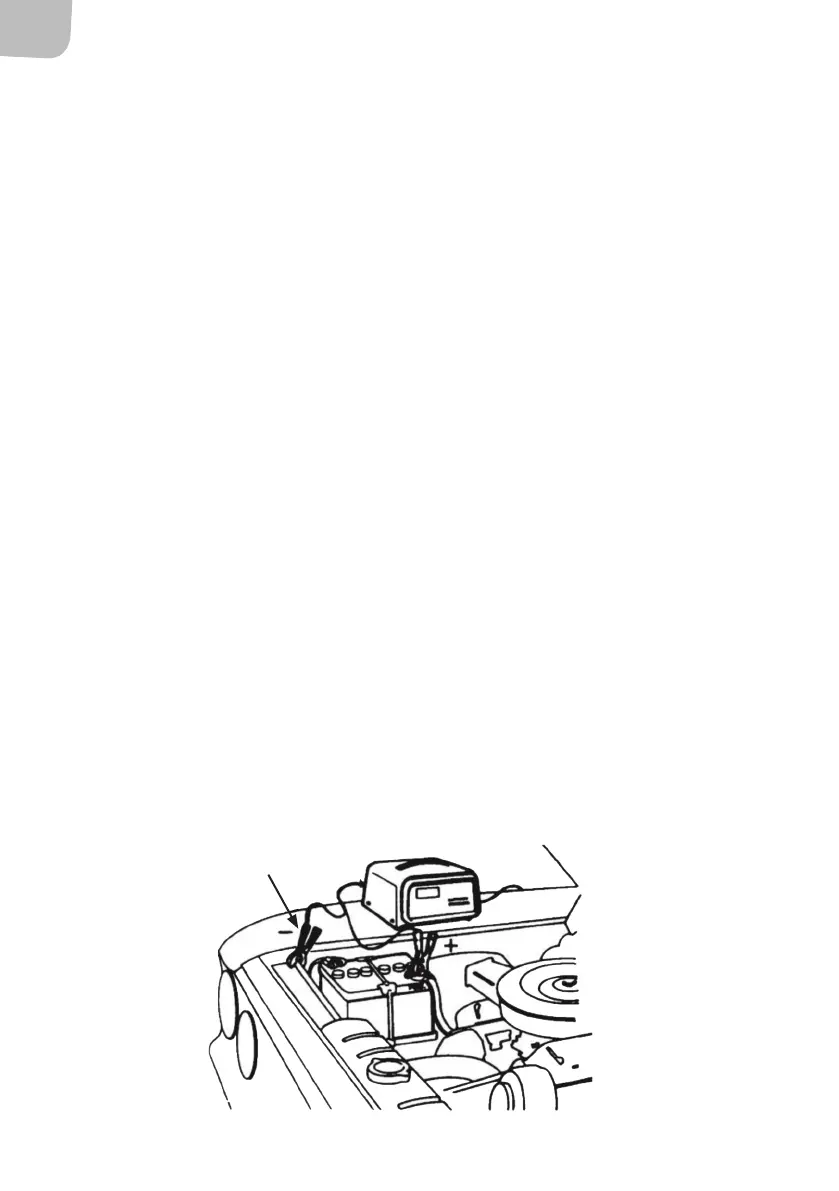
CHARGING OF BATTERY IN VEHICLE
NOTE:
• Check that the battery voltage matches the charger voltage.
• Place the power cord and charging cables so that there is no risk of them being damaged by the
bonnet, doors or moving parts.
• Pay attention to fan blades, belts, pulleys and other parts that could cause personal injury.
• Never charge the battery when the engine is running.
• Connect the battery terminal that is not connected to the chassis rst. Connect the other clip to the chassis,
at a safe distance from the battery and the fuel lines. Plug the battery charger into a 230V mains outlet.
• After charging, unplug the power cord from the mains. Disconnect the chassis connection rst,
and then the battery connection.
1. Check the polarity of the battery. The battery’s positive terminal (POS, P, +) may have a larger
diameter than the negative terminal (NEG, N, -).
2. Connect the positive lead (red) to the output terminal with the required voltage (12V or 24V).
Undo the nuts.
3. Check which battery terminal is earthed (connected to the vehicle chassis).
• If the negative terminal is connected to the chassis (generally is):
– Connect the charger’s positive clip (red) to the battery’s unearthed positive terminal (POS, P, +).
– Connect the negative clip (black) to the vehicle chassis or engine block, away from the
battery. Do not connect the clip to the carburettor, fuel line, or sheet metal bodywork.
Connect it to a solid metal part in the chassis, or to the engine block.
• If the positive terminal is connected to the chassis:
– Connect the charger’s negative clip (black) to the battery’s unearthed negative terminal (NEG, N, -).
– Connect the positive clip (red) to the vehicle chassis or engine block, away from the
battery. Do not connect the clip to the carburettor, fuel line, or sheet metal bodywork.
Connect it to a solid metal part in the chassis, or to the engine block.
Earth (NEG)


 To Next Page