12
Flying the Arrow Trainer
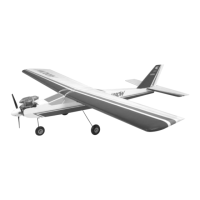
For first time pilots, the thought of flying the Arrow Trainer through
loops, rolls and perfect three-point landings can be thrilling.
Learning to fly, however, takes time, patience, most importantly, a
good instructor. If you’re a first time pilot, don’t try to fly your
model without an experienced instructor. Your local hobby shop
can put you in touch with an instructor in your area who can test
fly your Arrow Trainer, and then give you your first chance on the
“sticks” with very little risk of damage to the airplane. We cannot
over emphasize the importance of having a qualified instructor to
help you through your first flights.
The JR™ Quattro radio system has a built-in trainer system or
“buddy box” option. The transmitter can be used with any JR
transmitter and a trainer cord (JRPA130). Use of the “buddy box”
for the first few flights is highly recommended.
More experienced pilots will find the Arrow Trainer to be a
confidence-inspiring airplane. Its super stable and slow-flight
characteristics make pinpoint landings easy. At full throttle, the
Arrow Trainer is more than capable of most Sport
aerobatics maneuvers, making it truly the trainer that goes
where you point it.
Repair Information
Should you have the misfortune of a crash or broken part, see your
local hobby dealer for replacement parts.
Engine Adjustments
Model engines run on a mixture of fuel and air. The high-speed
and low-speed needle valves control the ratio of fuel to air that
the engine receives. If you find that small adjustments are needed,
have an experienced modeler help you to fine-tune your engine.
Do not attempt to move the needles past the preset stops.
Warning: Make all adjustments to the Evolution engine’s
low-speed needle valve with the engine stopped.
Our technicians have preset the needle valves of the Evolution
engine. Your engine should run properly at these preset needle
settings. On occasion, depending on your location, you may find
it necessary to adjust the high-speed and low-speed needle
valves to optimize the performance of your engine. The needle
valves have limiters to allow small adjustments to the engine.
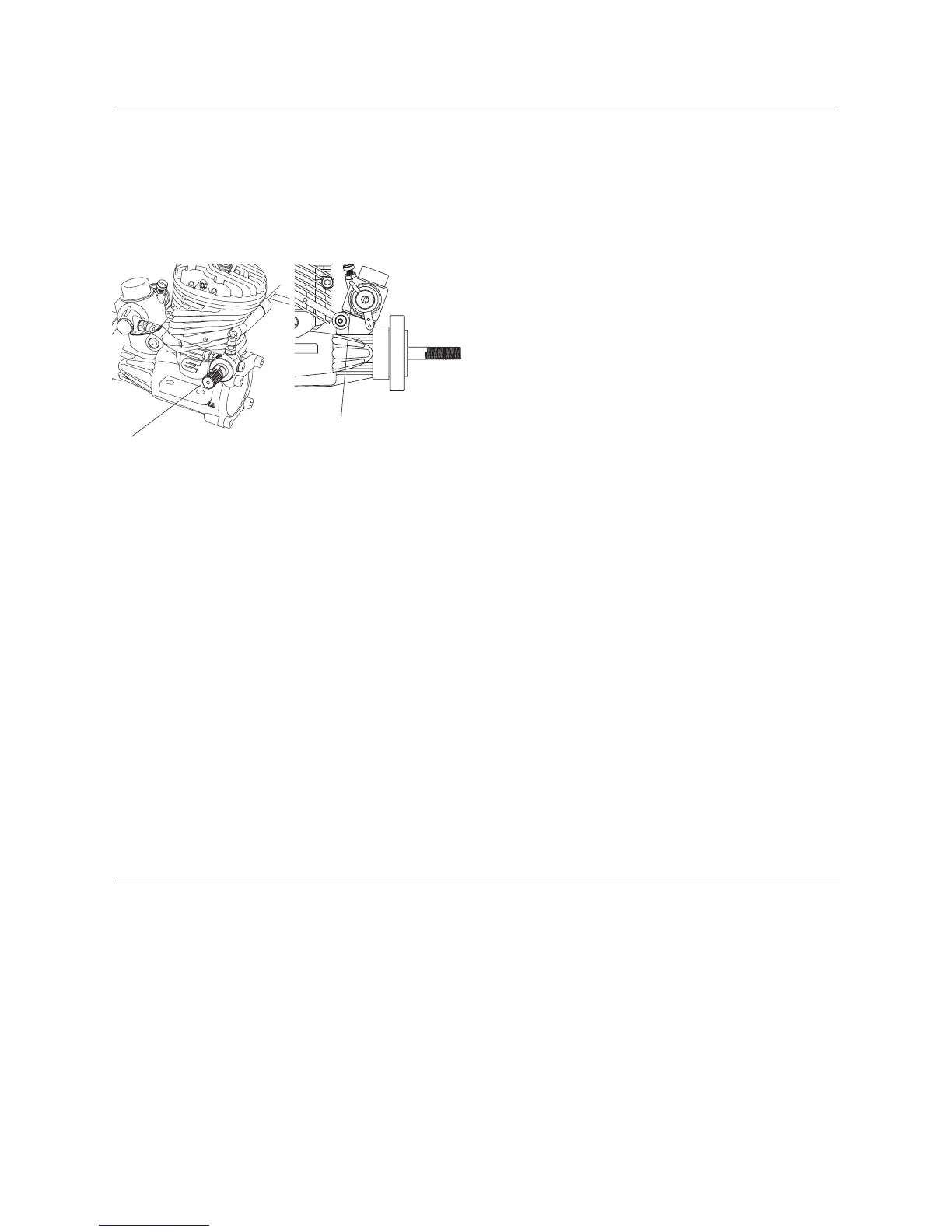
The low-speed needle valve limiter allows 1/4 turn of the needle
valve, turning clockwise (in) will lean the mixture while turning
counterclockwise (out) will richen the mixture to the low-speed
or idle setting of the engine. The high-speed needle valve limiter
allows one full turn of the needle valve. As with the low-speed
adjustment, turning the high-speed needle valve clockwise (in)
will lean the mixture, while turning counterclockwise (out) will
richen the mixture of the high-speed setting of the engine.
Fine-Tuning the High-Speed Needle
Start your engine and advance the throttle to full, then pinch the
red fuel line going to the engine. If the engine dies immediately
without an increase in rpm, the setting is too lean. Adjust the
high-speed needle valve counterclockwise (out) 1/2 turn and
repeat the test. When the high-speed needle is adjusted correctly,
the engine should increase rpm slightly and then quit. If the
engine rpm increases more than 200–300 rpm and continues to
run, the needle valve setting is too rich. Adjust the needle valve
clockwise (in) 1/8th of a turn and repeat the test until the engine
responds correctly to the pinch test.
Fine-Tuning the Low-Speed Needle
After fine-tuning the high-speed needle, you can begin to test the
low-speed needle. Start your engine and go to full throttle for
approximately 5–10 seconds then return to idle. Pinch the red
fuel line going to the engine. If the engine dies immediately
without an increase in rpm, the setting is too lean. Adjust the
needle valve counterclockwise (out) 1/8th of a turn and repeat the
test. When the low-speed needle is adjusted correctly, the engine
should increase rpm slightly and then quit. If the engine rpm
increases more than 200–300 rpm and continues to run, the
needle-valve setting is too rich. Adjust the needle valve clockwise
(in) 1/16th of a turn and repeat the test until the engine responds
correctly to the pinch test.
High-Speed Needle Adjustment
Low-Speed Needle
Adjustment



 To Next Page