EasyManua.ls Logo

Heathkit SW-7800 - Frequency Conversion

Heathkit SW-7800
47 pages
Print Icon
To Next Page IconTo Next Page
To Previous Page IconTo Previous Page
Loading...
Heathkit
Page
109
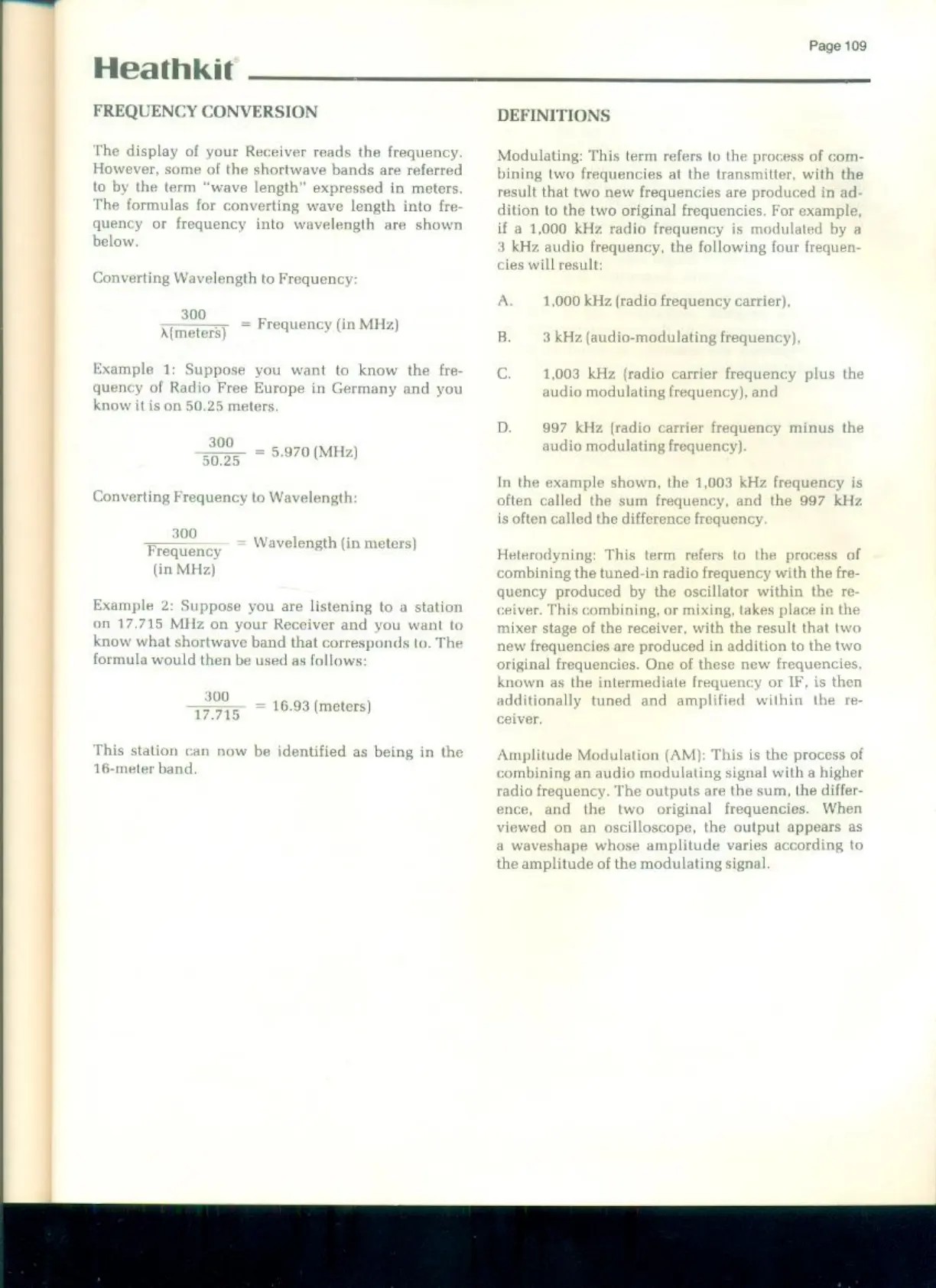
FREQUENCY
CONVERSION
The
display
of
your
Receiver
reads
the
frequency
However,
some
of
the
shortwave
bands
are
referred
to
by
the
term
“wave
length”
expressed
in
meters.
The
formulas
for
converting
wave
length
into
fr
quency
or
frequency
into wavelength
are
shown
below.
Converting
Wavelength to
Frequency
300
i
Ximetemy
=
Frequency
(in
MHz)
Example
1:
Suppose
you
want
to
know
the
fre-
quency
of
Radio
Free
Europe
in
Germany
and
you
know
it
is
on
50.25
meters.
Converting
Frequency
to
Wavelength
300
Frequency
(in
MHz)
Wavelength
(in
meters)
Example
2:
Suppose
you
are
listening
to
a
station
on
17.715
MHz
on
your
Receiver
and
you
want
to
know
what
shortwave
band
that
corresponds
to.
The
formula
would
thi
be
used
as
follows
300
peo
iF
715,
=
16-93
(meters)
This
station
can now
be
identified
as
being
in
the
16-meter band
DEFINITIONS
Modulating:
This
term
refers
to
the
process
of
com-
pining
two
frequencies
at the tran:
with
the
result that
two
new
frequencies
are
produced
in
ad:
dition
to
the
two
original
frequencies.
For
example
if
a
1,000
kHz
radio
frequen
3
kHz
audio
frequency,
the
following
four
frequen
cies
will result
A.
1,000
kHz
(radio
frequency
carrier)
B.
kHz
(audio-modulati
C.
1,003
kHz
frequency
plus
the
audio
modulating
frequency),
and
D.
997
kHz
(radio
carrier frequency
minus
the
audio
modulating
frequency).
In
the
example
shown,
the
1,003
kHz
frequency
is
often
called
the
sum
frequency,
and the
997
kHz
is
often
called the
difference
frequency
Helerodyning:
This
term
refers
to
the
process
of
combining
the
tuned-in
radio
frequency
with
the
fre-
quency
produced
by
the
oscillator
within
the
re-
ceiver.
This
combining,
or
mixing,
takes
place
in
the
mixer
stage
of
the
receiver,
with the result
that
two
new
frequencies
are
produced
in
addition
to
the
two
ies.
One
of
these
new
frequencies,
original frequenci
equency
or
IF,
is
then
fied
within
the
re-
known
as
the intermediate
£
additionally
tuned and
an
Amplitude
Modulation
(AM):
This
is
the
process
of
combining
an
audio
modulating
signal
with
a
higher
radio
frequency.
The
outputs
are
the
sum,
the differ-
ence,
and the
two
original
frequencies.
When
viewed
on
an
oscilloscope,
the
output
appears
as
a
waveshape
whose
amplitude
varies
according
to
the
amplitude
of
the
modulating
signal.

Related product manuals