EasyManua.ls Logo

Heathkit SW-7800 - Page 33

Heathkit SW-7800
47 pages
Print Icon
To Next Page IconTo Next Page
To Previous Page IconTo Previous Page
Loading...
Heathkit
Page
121
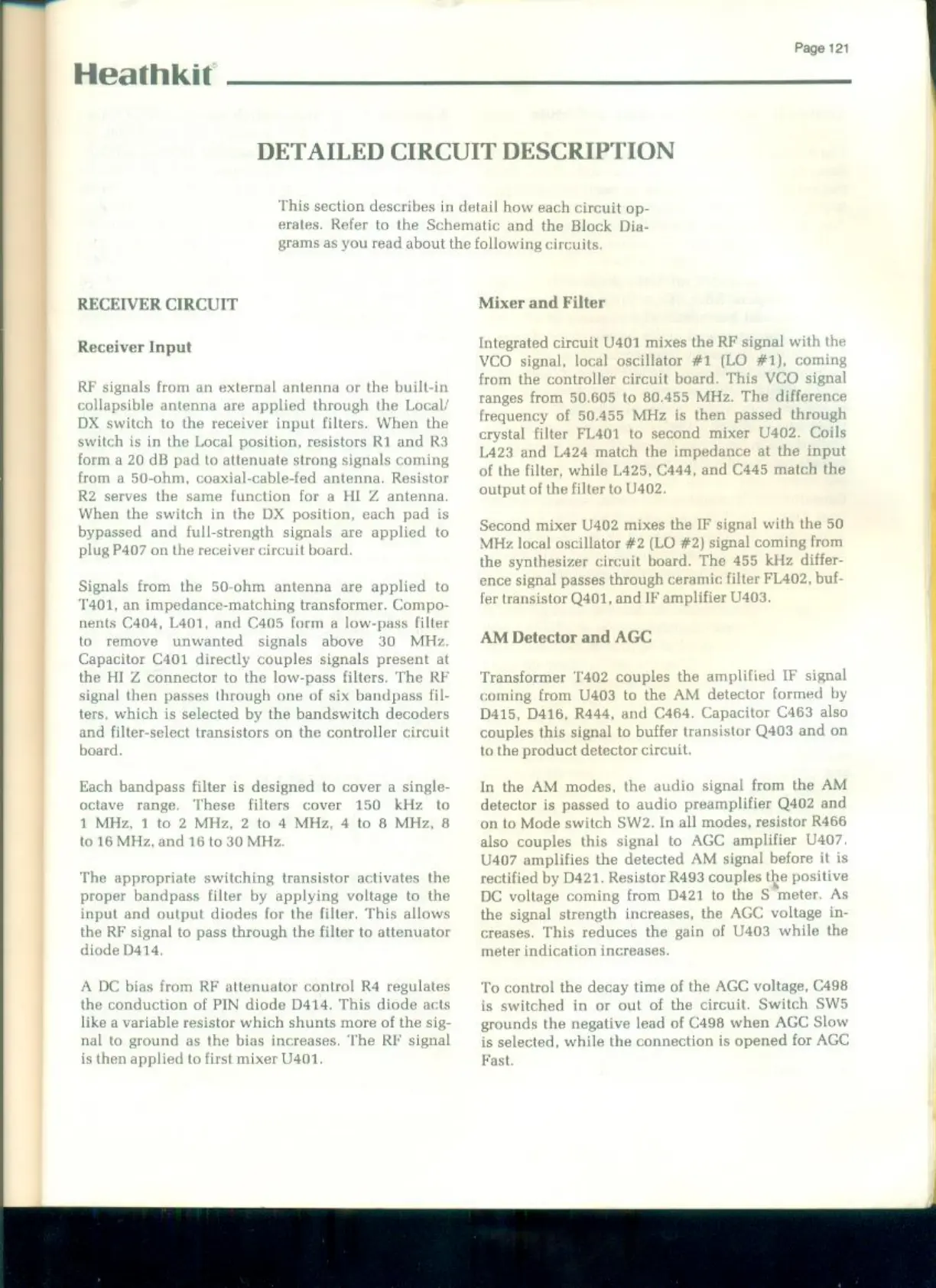
DETAILED
CIRCUIT
DESCRIPTION
This
section
de
ribes
in
detail
how
each
circuit
op-
erates.
Refer
to
the Schematic
and
the
Block
Di
grams
as you read
about
the
following
circuits.
RECEIVER
CIRCUIT
Receiver
Input
RF
signals
from
an
external
antenna
or
the
built-in
collapsible
antenna
are
applied
through
the
Local
DX
switch
to
the
receiver
input
filters, When
the
switch
is
in
the Local
position,
resistors
R1
and
R3
form
a
20
dB
pa
from
a
50-oh
to
attenuate
strong
signals
coming
coaxial-cable-fed
antenna.
Resistor
R2
serves
the
same
function
for
a
HI Z
antenna:
When
the
switch
in
the
DX
position,
each
pad
is
bypassed
and
full-strength
signals
are
applied
to
plug
P407
on
the
receiver
circuit
board.
Signals
from
the
50-ohm
antenna
are
applied
to
T401,
an
impedance-matching
transformer.
Compo-
nents
C404,
L401,
and
C405
form
a
low-pass
filter
to
remove
unwanted
signals
above
30
MHz.
Capacitor
C401
directly
couples
signals
present
at
the
HI
Z
connector
to
the
low-pass
filters.
The
RF
signal
then
passes
through
one
of
six
bandpass
fil-
ters,
which
is
selected
by
the
bandswitch decoders
and
filter-select
transistors
on
the
controller
circuit
board.
Each
bandpass
filter
is
designed
to
cover
a
single-
octave
range.
These filters
cover
150
kHz
to
1
MHz,
1
to
2
MHz,
2
to
4
MHz,
4
to 8
MHz,
8
to 16
MHz,
and
16
to
30
MHz
The
appropriate
switching
transistor activates the
proper
bandpass
filter
by
applying
voltage
to
the
input
and
output
diodes
for
the
filter. This
allows
the
RF
signal
to
pass
through
the
filter
to
attenuator
diode
D414.
A
DC
bias
from
RF
attenuator
control
R4
regulates
the
conduction
of PIN
diode
D414.
This diode
acts
like
a
variable
resistor
which shunts
more
of
the
sig-
nal
to
ground
as
the bias
increases.
‘The
RF
signal
is
then
applied
to
first
mixer
U401
Mixer
and
Filter
Integrated
circuit
U401
mixes
the
RF
signal
with
the
VCO
signal,
local
oscillator
#1
(LO
#1),
coming
from
the
controller
circuit
board.
This
VCO
signal
ranges
from
50.605
to
80.455
MHz.
The
difference
frequency
of
50.455
MHz
is
then
passed
through
crystal
filter
FL401
to
second
mixer
U402.
Coils
1423
and
L424
match
the
impedance
at
the
input
of
the
filter,
while
L425,
C444,
and
C445
match
the
output
of
the
filter
to
U402.
Second
mixer
U402
mixes
the
IF
signal
with
the
50
MHz
local oscillator
#2
(LO
#2)
signal
coming
from
the
synthesizer
circuit
board.
The
455
kHz differ-
ence
signal
passes
through
ceramic
filter
FL402,
buf-
fer
transistor
Q401,
and
IF
amplifier
U403.
AM
Detector
and
AGC
Transformer [402
couples
the
amplified
IF
signal
coming
from
U403
to
the
AM
detector
formed
by
D415,
D416, R444,
and
C464.
Capacitor
C463
also
couples
this
signal
to
buffer
transistor
Q403
and
on
to
the
product
detector
circuit
In
the
AM
modes,
the
audio
signal
from the
AM
detector
is
passed
to
audio
preamplifier
Q402
and
on
to
Mode
switch
SW2.
In
all
modes,
resistor
R466
also
couples
this
signal
to
AGC
amplifier
U407.
U407
amplifies
the
detected
AM
signal
before
it
is,
rectified
by
D421.
Resistor
R493
couples
the
positive
DC
voltage
coming
from
D421
to
the
S
"meter.
As
the
signal
strength
increases,
the
AGC
voltage
in-
This
reduces
the
gain
of
U403
while
the
meter
indication
increases.
To
control
the
decay
time
of
the
AGG
voltage,
C498
is
switched
in or
out
of
the
circuit.
Switch
SWS
grounds
the
negative
lead
of
C498
when
AGC
Slow
is
selected,
while the
connection
is
opened
for
AGC
Fast

Related product manuals