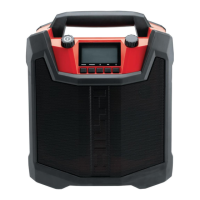
The Hilti RC 4/36 is a versatile radio charger designed for professional use in jobsite conditions. It functions primarily as a battery charger but also offers extensive audio playback capabilities, including a built-in radio and connectivity options for external devices.
Function Description
The core function of the RC 4/36 is to charge specified Hilti Li-ion batteries (B12, B14, B18, B22, B36). When connected to an AC supply, it automatically charges an inserted battery. The device can also operate on battery power when not connected to AC.
Beyond charging, the RC 4/36 serves as an audio player. It features a built-in radio with AM and FM frequency bands. For external audio sources, it supports Bluetooth connectivity, allowing it to pair with mobile devices, cellphones, or tablet computers. An AUX input is also available for wired connections to external audio devices. Additionally, the RC 4/36 includes a USB port that can be used to charge other devices connected to it.
Usage Features
The RC 4/36 is designed for ease of use. To power on/off, a simple press of the power button is required. The device's display provides continuous information, including the battery state of charge (represented by 4 bars, each indicating 25%), connection status to the electric supply, and active audio source (AM, FM, AUX, or Bluetooth).
For radio operation, users can select between AM and FM bands. Stations can be searched for automatically by quickly turning the knob a short distance, and desired frequencies can be saved to memory slots using the preset button. The antenna can be swiveled to optimize reception.
Audio playback from external devices is facilitated through Bluetooth or AUX. When using Bluetooth, the device can be manually paired by pressing and holding the Bluetooth button until the symbol flashes, then selecting "Hilti Radio Charger" on the external device. Once paired, the Bluetooth and pairing symbols will show continuously. For devices already paired, a short press of the Bluetooth button initiates automatic pairing. NFC connectivity is also supported for quick pairing with compatible mobile devices; users simply activate NFC on their mobile device and hold it near the RC 4/36's NFC interface. For AUX playback, users select AUX mode and control playback (start/pause, change tracks) from their external device.
The RC 4/36 offers customizable audio settings. Volume can be adjusted by turning the power button clockwise to increase and counterclockwise to decrease. Equalizer settings for bass and treble can be accessed and adjusted using the "EQ" button and the knob.
A clock function is included, allowing users to set the time by pressing the clock button, adjusting with the knob, and saving by briefly pressing the knob again. The device also features a cradle for securely holding external mobile devices.
For power, the RC 4/36 requires 2 AAA backup batteries to save settings. These batteries must be correctly installed for settings to be retained. The USB charging function for external devices is available when the RC 4/36 is connected to an AC supply or when it is switched on in battery mode.
Maintenance Features
Maintaining the RC 4/36 involves simple care routines to ensure its longevity and safe operation. The appliance should be kept clean and free from oil and grease. It is important not to use cleaning agents containing silicone. The air vents should be cleaned regularly with a dry brush to prevent clogging and to ensure proper ventilation; foreign matter should not be allowed to penetrate inside the appliance. The exterior of the appliance can be cleaned with a slightly damp cloth, but sprays, steam pressure cleaning equipment, or running water should be avoided.
For the Li-ion batteries, it's important to note that battery discharge is automatically stopped before cells are damaged, and conditioning charges are not necessary. Charging can be interrupted or started at any time without negative effects on battery life. For optimal results, batteries should be stored fully charged in a cool, dry place, and moisture should not be allowed to enter the interior. If a battery no longer reaches full charge due to aging or overstressing, it should be replaced. Damaged batteries (e.g., with cracks or broken contacts) should not be charged or used.
In case of malfunctions, the manual provides troubleshooting steps. For issues like the battery indicator flashing or the appliance not starting, solutions include waiting for the battery to reach operating temperature, charging the battery, inserting a new battery, or connecting to AC supply. If these steps do not resolve the issue, or if the battery or appliance is suspected to be defective, users are advised to contact Hilti Service. For settings loss, replacing the back-up batteries is recommended.
The RC 4/36 is designed to be serviced by qualified specialists using only genuine Hilti spare parts to maintain its safety.



 To Next Page

 General