Need help?
Do you have a question about the Himoinsa CEA7 and is the answer not in the manual?
Describes the electrical characteristics, engine inputs, outputs, and commands of the CEA7 control unit's measurements module.
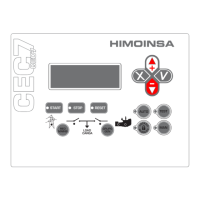
Details the types of buttons on the control unit: operating mode, command, display, and contactor activation buttons.
Describes the status LEDs for engine status, alarms, and contactor status.
Details the types of buttons on the control unit: operating mode, command, display, and contactor activation buttons.
Explains buttons for selecting operating modes: Automatic, Test, Locked, and Manual, with their LED indicators.
Details function of command buttons: Start, Stop, Alarms Reset, and Fuel Transfer Pump, including LED indicators.
Describes display navigation buttons: Confirm, Cancel, Up, and Down for menu interaction.
Explains buttons for controlling network and genset contactors in manual mode.
Details LEDs indicating engine status: started, preheating, start engine, and alternator status.
Lists LEDs for alarms: Fuel reserve, Battery level, High temperature, Starting failure, Overspeeding, Low oil pressure, Aux 1, Aux 2.
Explains LEDs for network and genset contactors status: active, flashing, or disconnected.
Describes LEDs for network signal status (active, errors, inactive) and engine status.
Details two password levels (User, Maintenance) for protecting access to control unit settings and parameters.
Describes operating the genset manually using front panel buttons for start, stop, and contactor control.
Explains automatic operation, where the unit manages the genset based on programmed conditions like network voltage and frequency.
Details test mode, where the genset starts and contactors activate, except during network failure.
Explains locked mode, which disables genset startup under any condition.
Describes locking and unlocking Automatic mode by pressing Auto or Man keys for 5 seconds.
Details the step-by-step procedure for starting the engine, including delays, preheating, activation, and stabilization.
Illustrates the sequence of events during a start operation with LED indications and timing.
Explains the process for stopping the engine, including cooling time, stop conditions, and confirmation.
Demonstrates sequence of actions for stopping the engine, including manual and automatic methods.
Describes operation modes (Inhibited, Manual, Automatic, Combined, Control Unit) for the fuel transfer pump.
Explains engine heating management, including activation modes and temperature-based control of the heating resistor.
Details connection and configuration of the battery charging alternator, including voltage monitoring and alarms.
Describes alternator mode operation, including excitation and voltage detection.
Explains dynamo mode operation using continuous excitation.
Details the function of the start/stop key for powering the control unit's electronic devices.
Explains automatic start-up based on network power consumption, including programming details.
Describes electronic protection for activating outputs during overload and short circuit alarms.
Explains the screen heater function for maintaining display operation at low temperatures.
Details the control unit's timer for managing time, date, and weekly programming of events.
Describes defining up to 4 input sets based on digital input values for various functions and alarms.
Explains assigning oil pump control to programmable outputs and its operation sequence.
Details pre-established and programmable digital inputs, their functions, and detection methods.
Details pre-established and programmable digital inputs, their functions, and detection methods.
Describes pre-set digital inputs: High Temperature, Low Oil Pressure, Water Level, and Emergency Stop.
Explains analogue inputs for measuring engine values (fuel, oil, temp) and their display.
Details programmable inputs for contactor confirmation, tariff warning, and external start functions.
Details programmable inputs for contactor confirmation, tariff warning, and external start functions.
Describes the test signal input for checking the genset without load activation.
Explains forced operation input for maintaining genset operation under specific regulations, with different modes.
Details 3 programmable alarms associated with programmable inputs.
Describes 2 additional programmable alarms associated with programmable inputs.
Details 15 programmable alarms associated with programmable inputs.
Details analogue inputs for measuring engine values (fuel, oil, temp) and their display.
Details oil pressure analogue input for monitoring and setting alarms.
Explains engine temperature analogue input for monitoring coolant and its role in heating management.
Describes fuel level analogue input for indicating fuel, including calibration and low fuel alarms.
Details analogue inputs for measuring engine values (fuel, oil, temp) and their display.
Details alternator voltage analogue input for monitoring battery charging voltage and detecting start conditions.
Explains auxiliary analogue input, typically for oil temp, programmable for other measurements.
Describes expansion for PT100 temperature probes and configurable analogue inputs.
Details pickup inputs for measuring engine speed (RPM) and calculating speed from flywheel teeth.
Explains preheating output for engine spark plugs during starting and its configurable activation time.
Explains preheating output for engine spark plugs during starting and its configurable activation time.
Details engine starting output that activates the starter until a startup condition is detected.
Explains preheating output for engine spark plugs during starting and its configurable activation time.
Describes engine stop output and its configurable modes: de-energisation, excitation, or PULL/HOLD.
Explains network contactor output for managing closing and opening of the network contactor.
Details genset contactor output for managing closing and opening of the genset contactor.
Describes BT relay output configurable for fuel transfer pump, engine heating, or electronic protection.
Explains D+ output for exciting battery charging alternator during starting process.
Details alarm output signalling unit states, activating reset LED and display buzzer.
Explains preheating output for engine spark plugs during starting and its configurable activation time.
Describes SC output activated by alarms that stop engine, remaining active until alarms are resolved.
Describes programmable outputs configured as inhibited, which are permanently disabled.
Describes programmable outputs configured as inhibited, which are permanently disabled.
Explains programmable outputs activated based on detection of associated inputs like fuel reserve or water level.
Details programmable outputs activated upon detection of an active alarm or pending notification.
Describes programmable outputs configured as inhibited, which are permanently disabled.
Describes programmable outputs indicating unit mode (locked, manual, auto, test).
Explains programmable outputs activating heater when engine temp is below a threshold.
Details programmable outputs for activating loading bank to prevent low-load operation and optimize engine load.
Describes programmable outputs for initiating engine start-up with fumes control, active for a set duration.
Explains programmable outputs monitoring network status, active when network presence detected under programmed conditions.
Details 4 additional programmable outputs from the Second Zero Suppression expansion.
Explains assigning external devices (CCPT100, CCIn8) digital inputs to functionalities via communications bus.
Categorizes alarms and warnings: Engine, Generator, and Network alarms, detailing type and action.
Lists engine alarms: High temp, Low oil pressure, Emergency Stop, Starting failure, detailing type and action.
Provides examples of alarm operations: 'EN' Alarm with engine stopped, 'AN' Warning needing reset, 'A' Auto-resettable warning.
Provides examples of alarm operations: 'EN' Alarm with engine stopped, 'AN' Warning needing reset, 'A' Auto-resettable warning.
Illustrates an alarm causing engine stop, detailing acoustic signal, LED, and output activation.
Shows a warning requiring manual reset, not stopping the engine, and displaying its status.
Provides examples of alarm operations: 'EN' Alarm with engine stopped, 'AN' Warning needing reset, 'A' Auto-resettable warning.
Describes an auto-resettable warning (fuel level/network thresholds), clearing when conditions normalize.
Lists generator alarms: Overload, Voltage asymmetry, Max voltage/frequency, Short Circuit, detailing type and action.
Lists generator alarms: Overload, Voltage asymmetry, Max voltage/frequency, Short Circuit, detailing type and action.
Lists network alarms: voltage/frequency failures, sequence errors, signal drop, detailing type and action.
Describes 5 programmable alarms associated with engine alarms, reflected via Aux1 and Aux2 LEDs.
Details high water temp alarm, activation conditions, debounce, and default action (immediate stop).
Details high water temp alarm, activation conditions, debounce, and default action (immediate stop).
Details high water temp alarm, activation conditions, debounce, and default action (immediate stop).
Explains low oil pressure alarm, detection after start, debounce, and default action (immediate stop).
Describes emergency stop alarm, its input connection, and immediate shutdown action without cooling.
Details battery charging alternator failure alarm, activated by low voltage from DI input.
Explains starting failure alarm generated by exceeded consecutive retries or failures during engine start.
Describes low water level alarm, detection conditions, debounce, and default action (immediate stop).
Details high water temp alarm, activation conditions, debounce, and default action (immediate stop).
Details fuel reserve alarm, detection via RC input, debounce, and default action (no action/warning).
Explains overspeeding alarm based on engine speed, debounce, and default action (immediate stop).
Describes under speed alarm based on engine speed, debounce, and default action (stop with cooling).
Details overload alarm based on RMS current exceeding limits, including detection phases and default action (stop with cooling).
Details high water temp alarm, activation conditions, debounce, and default action (immediate stop).
Explains genset voltage asymmetry alarm, detecting phase voltage differences, with debounce and default action.
Details max genset voltage alarm, activated when RMS voltage exceeds limits, with phase evaluation and default action.
Describes max genset frequency alarm, activated when frequency exceeds limits, with phase measurement and default action.
Explains incorrect phases sequence alarm for three-phase configurations, with detection and default action.
Details high water temp alarm, activation conditions, debounce, and default action (immediate stop).
Details reverse power alarm activated by negative power measurement exceeding a percentage of nominal power.
Explains low battery voltage alarm, activated when battery voltage falls below limits, with debounce and default action.
Describes high water temp by sensor alarm, activated when temp exceeds limits, with debounce and no action.
Details low oil pressure by sensor alarm, activated when pressure is below limits, with debounce and no action.
Details high water temp alarm, activation conditions, debounce, and default action (immediate stop).
Explains low fuel level by sensor alarm, activated when fuel level drops below limits, with debounce and no action.
Details low auxiliary battery voltage alarm, activated when voltage falls below limits, with debounce and no action.
Describes high battery voltage alarm, activated when voltage exceeds limits, with debounce and no action.
Explains low battery voltage when starting alarm, activated when voltage falls below limits during startup, with debounce and no action.
Details high water temp alarm, activation conditions, debounce, and default action (immediate stop).
Details minimum genset frequency alarm, activated when frequency drops below limits, with debounce and default action (stop with cooling).
Explains short circuit alarm, activated when RMS current exceeds limits, with phase evaluation and default action (stop with cooling).
Describes minimum genset voltage alarm, activated when RMS voltage drops below limits, with phase evaluation and default action (stop with cooling).
Details high water temp alarm, activation conditions, debounce, and default action (immediate stop).
Details low engine temperature alarm, activated when temperature is below limits, with debounce and no action (warning).
Explains genset signal failure alarm, generated when no voltage detected during running, with debounce and default action (stop with cooling).
Describes programmable alarm 1, activated via digital inputs, debounce time, and default action (warning).
Details programmable alarm 2, activated via digital inputs, debounce time, and default action (warning).
Details high water temp alarm, activation conditions, debounce, and default action (immediate stop).
Describes programmable alarm 3, activated via digital inputs, debounce time, and default action (warning).
Details programmable alarm 4, activated via digital inputs, debounce time, and default action (warning).
Explains programmable alarm 5, activated via digital inputs, debounce time, and default action (warning).
Details max network voltage alarm, activated when voltage exceeds limits, with phase evaluation and configuration options.
Details high water temp alarm, activation conditions, debounce, and default action (immediate stop).
Describes min network voltage alarm, activated when voltage drops below limits, with phase evaluation and configuration options.
Explains max network frequency alarm, activated when frequency exceeds limits, with phase measurement and configuration options.
Details min network frequency alarm, activated when frequency drops below limits, with phase measurement and configuration options.
Details high water temp alarm, activation conditions, debounce, and default action (immediate stop).
Explains incorrect network phases sequence alarm for three-phase configurations, with detection and configuration options.
Details network signal failure alarm, generated when no voltage detected, with detection and configuration options.
Describes network contactor switching failure alarm, detected when activation confirmation is missing.
Explains genset contactor switching failure alarm, detected when activation confirmation is missing.
Details high water temp alarm, activation conditions, debounce, and default action (immediate stop).
Details genset power alarm, activated when measured power exceeds a percentage of nominal power.
Explains engine J1939 communication alarm, verifying communication between unit and engine via J1939 bus.
Describes high temp alarms for PT100 probes 1-4, activated when temp exceeds limits or probe not connected.
Details high temp alarms for PT100 probes 5-8, activated when temp exceeds limits or probe not connected.
Details high water temp alarm, activation conditions, debounce, and default action (immediate stop).
Explains IDMT alarm associated with genset current to prevent heating in installation components.
Describes high temp alarms for PT100 probes 5-8, activated when temp exceeds limits or probe not connected.
Details high water temp alarm, activation conditions, debounce, and default action (immediate stop).
Details programmable alarms 6 to 20, activated via digital inputs, debounce time, and default action (warning).
Explains genset low power alarm, activated when measured power falls below a percentage of nominal power.
Details current asymmetry alarm for multi-phase gensets, detecting phase current differences.
Details high water temp alarm, activation conditions, debounce, and default action (immediate stop).
Describes water in fuel alarm, detected by engine electronics and notified via J1939 protocol for specific engines.
Details operation counters: total/partial hours, starts, and energy counters recorded by the control unit.
Details operation counters: total/partial hours, starts, and energy counters recorded by the control unit.
Explains 3 maintenance counters (engine, rental) triggering alarms when zero, and how to program/display them.
Describes how the control unit records and stores the last 100 detected alarms and errors.
Explains identifying and monitoring connected electronic devices via the 'List of Equipment' menu.
Explains identifying and monitoring connected electronic devices via the 'List of Equipment' menu.
Details equipment info: model, ID, firmware, and associated measurement equipment.
Explains assigning unique IDs to modules for interconnected control units.
Describes performing zero calibration for current readings when the genset is uncharged.
Details programming sensor curves for temp, pressure, and fuel level, with configurable points for nonlinear responses.
Details programming sensor curves for temp, pressure, and fuel level, with configurable points for nonlinear responses.
Explains programming nonlinear response curves for fuel level sensors and auxiliary tank inputs, using configurable points.
Describes adding display screens for monitoring status, controlling the genset, and viewing errors/LEDs.
Details Telesignal device connection with 12 relay outputs, programmable by alarms, inputs, outputs, or mode.
Explains J1939 device connection for monitoring engine parameters: pressure, temp, alarms, and errors.
Details C2Lan device connection for remote TCP/IP connection, monitoring, and control.
Describes announcement panel connection with 16 LEDs for displaying alarms, I/O status, and unit mode.
Details C2Lan MODBUS device connection for remote TCP/IP over MODBUS protocol.
Explains C2Lan CCRS485 device connection for remote RS485 over MODBUS protocol.
Details C2CLOUD device connection for remote connection using a 3G mobile telephone network.
Explains CCPT100 device connection for measuring up to 4 temperature probes.
Details SNMP C2Lan device connection for management using SNMP protocol.
Explains precision gauge device connection for measuring fuel tank level.
Describes User level access for reading level 1 values (default password: 1111).
Details Maintenance level access for writing level 1 and 2 parameters (default password: 1911).
Describes Supervisor level access for writing level 1, 2, and 3 parameters (restricted, for manufacturer only).
Describes viewing control unit status, including current measurements and accessing display options.
Details network measurement screens showing phase voltages, currents, and frequency.
Details network measurement screens showing phase voltages, currents, and frequency.
Describes generator measurement screens showing phase voltages, currents, frequency, and alternative displays.
Explains engine status screen displaying RPM, hours, fuel level, temp, voltage, and oil pressure.
Explains engine status screen displaying RPM, hours, fuel level, temp, voltage, and oil pressure.
Details control unit status screen showing programmable input status with icons and meanings.
Describes power and energy screen showing actual phase power and accumulated energy (Day, Month, Year).
Describes power and energy screen showing actual phase power and accumulated energy (Day, Month, Year).
Explains viewing error list, codes, engine hours, and status (active/passive).
Details temperature readings from PT100 probes with CCPT100 expansion module.
Describes auxiliary analogue inputs from CCPT100 module, showing readings and configurable text.
Explains the status of digital inputs from the CCIn8 expansion module.
Explains the status of digital inputs from the CCIn8 expansion module.
Details password entry procedure using control unit keys and navigation.
Details password entry procedure using control unit keys and navigation.
Explains navigating the main menu to access sections: Inputs/Outputs, Parameters, and Counters.
Shows display format for inputs/outputs with a legend for signal detection.
Shows display format for inputs/outputs with a legend for signal detection.
Describes J1939 engine status display: intake manifold temp, fuel consumption.
Provides specific J1939 parameters for Stage V/Final Tier 4 engines: ASH, SOOT, Regeneration status.
Describes J1939 engine status display: intake manifold temp, fuel consumption.
Details counters display: total/partial hours, correct/failed starts, and energy counters.
Explains viewing error list, conditions at alarm time, and navigation through screens.
Describes scheduling function for programming weekly or bimonthly events.
Describes scheduling function for programming weekly or bimonthly events.
Lists scheduled actions: Lock (BLOQ), Forced Start (ARRF), Test (TEST), and Free, with priority order.
Describes scheduling function for programming weekly or bimonthly events.
Details entering language selection menu and choosing from available languages.
Explains setting date and time using control unit navigation keys.
Explains customizing user and maintenance passwords using the control unit interface.
Details J1939 menu options: listing errors and starts.
Explains calculation of voltage/current harmonics, including spectrum graphics and THD values.
Details entering control unit programming menus, restricted to maintenance level password.
Details entering control unit programming menus, restricted to maintenance level password.
Explains customizing manufacturer's screen text using programming texts option.
Details programming sensor curves for temp, pressure, and fuel level, with configurable points.
Explains associating custom text (max 15 chars) with programmable inputs.
Describes customizing texts associated with programmable alarms.
Details programming sensor curves for temp, pressure, and fuel level, with configurable points.
Explains setting display operation of the control unit using configurable screen parameters.
Details displaying active/passive past errors stored in engine electronics via J1939.
Details displaying active/passive past errors stored in engine electronics via J1939.
Explains displaying starts from J1939 expansion in standalone mode.
Provides table of menu access (CEM, CEA, CEC) for Maintenance and Parameters.
Details dimensions, installation, and wiring of the PHG7 module.
Details dimensions, installation, and wiring of the PHG7 module.
Provides wiring diagram for the PHG7 module, including power supply and connection details.
Details signals, descriptions, types, and characteristics of inputs/outputs for J1939 Bus and digital input modules.
Details signals, descriptions, types, and characteristics of inputs/outputs for J1939 Bus and digital input modules.
Lists voltage-free relay outputs for breakers and fuel pumps, specifying type and characteristics.
Provides general info, environmental characteristics, and installation guidelines for the equipment.
Details electrical characteristics for power supply, digital inputs, CAN Bus, and analogue inputs, including voltage/current ratings.
Provides physical dimensions of the PHG7 module through detailed diagrams.
Details dimensions, installation, and wiring of the PHG7J module.
Details dimensions, installation, and wiring of the PHG7J module.
Provides wiring diagram for PHG7J module, including power supply and connection details.
Details signals, descriptions, types, and characteristics of inputs/outputs for J1939 Bus and digital input modules.
Details electrical characteristics for power supply, digital inputs, and CAN Bus for the CEA7 module.
Details electrical characteristics for power supply, digital inputs, and CAN Bus for the CEA7 module.
Provides operating temperature, humidity, and IP degree of protection for the control unit.
Details dimensions, installation, and wiring of the CEA7 module.
Provides physical dimensions of the CEA7 module through detailed diagrams.
Details electrical characteristics for power supply, digital inputs, and CAN Bus for the CEA7 module.
Provides physical dimensions of the CEA7 module through detailed diagrams.
Explains common symbols: warning, electric shock, and WEEE disposal.
Provides general info, environmental characteristics, and installation guidelines for the equipment.
Introduces CAN BUS: industrial bus with capacity, length, and baud rate characteristics.
Explains CAN network topology, node connections, and requirement for 120Ω terminators at end nodes.
Explains CAN network topology, node connections, and requirement for 120Ω terminators at end nodes.
Details CAN network wiring requirements based on distance, baud rate, and nodes, including cable characteristics.
Details CAN network wiring requirements based on distance, baud rate, and nodes, including cable characteristics.
Illustrates wiring diagrams for manual/auto units, switching, CCrs, and USB options.
Details the process for calibrating genset and network voltages, requiring manufacturer level password.
Details handling of digital inputs from expansion modules, supporting up to 32 inputs.
Explains handling temperature inputs from up to 2 CCPT100 modules (8 probes total).
Describes handling analogue inputs from 1 CCPT100 module (5 inputs total).
Discusses causes of communication failure between CEA7 and PHG7 modules, including CAN bus issues and power failures.
 General
| Brand | Himoinsa |
|---|---|
| Model | CEA7 |
| Category | Control Unit |
| Voltage | 12/24 Vdc |
| Display | LCD |
| Protection Degree | IP65 |
| Manufacturer | Himoinsa |
| Operating Temperature | -20°C to +70°C |
| Type | Control Unit |


 To Next Page