❏ 1. Assemble the model in as in preparation for
flight. (No fuel is required for this procedure.)
❏ 2. With the wing level, lift the model by the
engine propeller shaft and the fin post (this may
require two people). Do this several times.
❏ 3. If one wing always drops when you lift the
model, it means that side is heavy. Balance the
airplane by adding weight to the opposite, lighter
wing tip.
Note: An airplane that has been laterally balanced
will track better in loops and other maneuvers.
At this time check all connections including servo
horn screws, clevises, servo cords and extensions.
Charge the Batteries
Follow the battery charging procedures in your
radio instruction manual. You should always
charge your transmitter and receiver batteries the
night before you go flying and at other times as
recommended by the radio manufacturer.
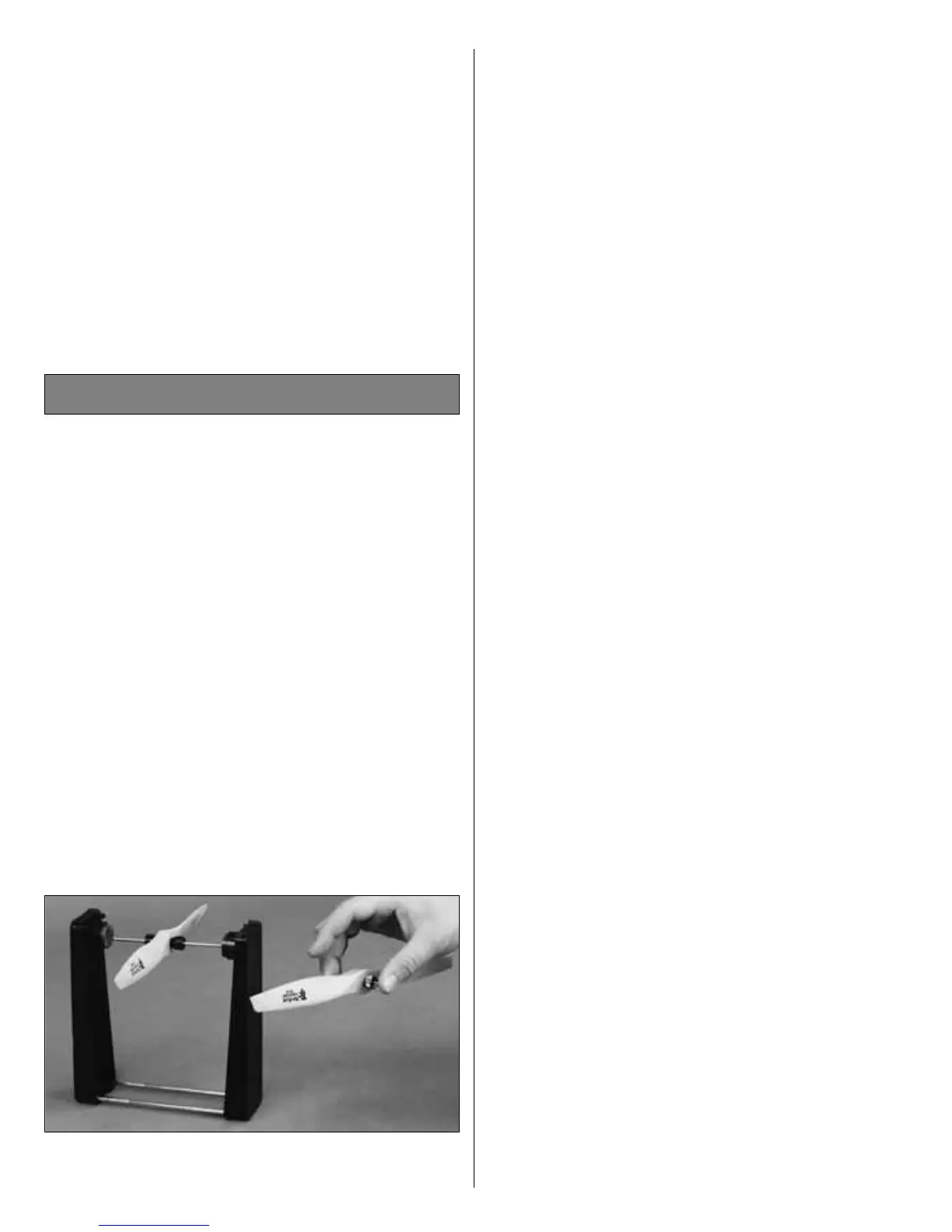
Balance the Propeller
Carefully balance your propellers before flying. An
unbalanced prop is the single most significant
cause of vibration. Not only may engine mounting
screws vibrate out, possibly with disastrous effect,
but vibration may also damage your radio receiver
and battery. Vibration may cause your fuel to foam,
which will, in turn, cause your engine to run lean
or quit.
We use a Top Flite Precision Magnetic Prop
Balancer
™
(TOPQ5700) in the workshop and keep
a Great Planes Fingertip Balancer (GPMQ5000) in
our flight box.
Find A Safe Place to Fly
Since you have chosen the Spectrum ARF, we
assume that you are an experienced modeler.
Therefore, you should already know about AMA
chartered flying fields and other safe places to fly.
If for some reason you are a relatively
inexperienced modeler and have not been
informed, we strongly suggest that the best place
to fly is an AMA chartered club field. Ask the AMA
or your local hobby shop dealer if there is a club in
your area and join. Club fields are set up for R/C
flying and that makes your outing safer and more
enjoyable. The AMA address and telephone
number are in the front of this manual. If a club and
flying site are not available, find a large, grassy
area at least 6 miles away from houses, buildings
and streets and any other R/C radio operation like
R/C boats and R/C cars. A schoolyard may look
inviting but is too close to people, power lines and
possible radio interference.
Ground Check the Model
Inspect your radio installation and confirm that all
the control surfaces respond correctly to the
transmitter inputs. The engine operation must also
be checked by confirming that the engine idles
reliably, transitions smoothly and rapidly to full
power and maintains full power, indefinitely. The
engine must be “broken-in” on the ground by
running
it for at least two tanks of fuel. Follow the
engine
manufacturer’s recommendations for
break-in.
Make sure that all screws remain tight, that the
hinges are secure and that the prop is on tight.
Range Check Your Radio
Whenever you go to the flying field, check the
operational range of the radio before the first flight
of the day. First, make sure no one else is on your
frequency (channel). With your transmitter on, you
should be able to walk at least 100 feet away from
the model and still have control. While you work
the controls, have a helper stand by your model
and tell you what the control surfaces are doing.
Repeat this test with the engine running at various
speeds with a helper holding the model. If the
control surfaces are not always responding
correctly, do not fly! Find and correct the problem
first. Look for loose servo connections or corrosion,
Preflight
26



 To Next Page