
 Need help?
Do you have a question about the HOLMS 300 and is the answer not in the manual?
Details specific warnings about crushing risks and maintaining safe distances from the machine.
Covers instructions for safe use, handling flying objects, and proper tool transport.
Addresses correct lifting procedures and specific crushing hazards for the machine.
Outlines crucial safety considerations, operator duties, and general safety rules for machine operation.
Provides instructions for safely lifting and securing the sweeper during transport.
Offers recommendations for proper parking and preparing the sweeper for storage, including draining the system.
Details the standard equipment and specifications of the Holms 300 sweeper.
Step-by-step guide on how to attach the Holms 300 sweeper to a tractor or loader.
Lists the key settings operators need to adjust for optimal sweeper performance.
Explains how to adjust the machine's vertical position and tilt for correct operation.
Details how to adjust the height indicator to compensate for brush wear and ensure correct ground contact.
Describes the procedure for adjusting the ground pressure for different working conditions.
Instructions for safely emptying the collected debris from the sweeper's container.
Step-by-step process for safely detaching the sweeper from the carrying vehicle.
Explains how to connect the optional side brush unit to the sweeper.
Information on using and maintaining the sweeper's water sprinkler system, including freeze protection.
Guidance on using the optional side brush for enhanced sweeping performance.
Details on adjusting the sideways and forwards inclination of the side brush for optimal contact.
Instructions on how to start and operate the side brush in conjunction with the main roller.
Steps to follow after using the sweeper, including cleaning and inspection for damage.
Detailed instructions for safely removing the main brush roller from the machine.
Step-by-step guide for replacing the main brush roller and its components.
Instructions on how to correctly install the brush roller assembly back into the machine.
Guide on how to replace the brush on the optional side brush unit.
Instructions for replacing the cassette-type brush on the Swish model.
A helpful tip to simplify the process of brush replacement.
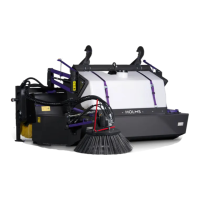
The device described in this manual is the Holms 300 Pick-up Sweeper, available in widths of 2.0, 2.2, 2.5, and 3.0 meters. It is a front-mounted, pick-up sweeper designed for use with loaders, tractors, and similar carrier vehicles.
The Holms 300 is engineered for efficient sweeping, particularly against kerbs and other irregularities. Its core function involves a rotating brush roller that picks up refuse into an integrated container. The brush roller is driven by two direct-acting hydraulic motors, which are available in two sizes: 2000 (195 cm³) and 4000 (311 cm³). These motors are designed to operate within specific hydraulic oil flow ranges, ensuring optimal performance.
A key design feature is the suspension of the sweeper brush, which ensures constant and uniformly distributed contact pressure to the surface being swept. This design minimizes brush wear and enhances the roller's ability to handle surface irregularities like tram tracks and kerbs effectively. The refuse container has an effective volume ranging from 360 to 700 liters, depending on the chosen width of the sweeper.
The standard model of the Holms 300 includes a 400-liter water tank and an electric water pump for dust suppression via a sprinkler system. The machine's attachment hooks are of the screw type, allowing for lateral displacement and simplifying the process of switching between different carrier vehicles.
Optional extra equipment includes one or two side brushes, which can be fitted on the right, left, or both sides to improve sweeping efficiency, especially in areas with kerbs.
| Specification | 2.2 m model | 2.5 m model | 3.0 m model |
|---|---|---|---|
| Working width (m) | 2.2 | 2.5 | 3.0 |
| Max width (m) | 2.4 | 2.7 | 3.2 |
| Max height without hook (m) | 1.3 | 1.3 | 1.3 |
| Water tank volume (litres) | 400 | 400 | 400 |
| Effective refuse volume (approx. litres) | 360 | 660 | 700 |
| Weight, empty (kg)a | 470 | 570 | 650 |
| Additional weight with side brush (per brush) (kg) | 70 | 70 | 70 |
| Weight, full water tank and full container (kg)b | 1395 | 1935 | 2055 |
| Centre of gravity, dimension A (empty) (mm) | 140 | 140 | 130 |
| Centre of gravity, dimension B (empty) (mm) | 320 | 340 | 340 |
| Max oil flow (litres/min) 2000/4000 motors | 130/210 | 130/210 | 130/210 |
a. Weights and centres of gravity excluding attachment. b. Applies to material with a density of 1.4-1.5.
The hydraulic motors are available in two sizes:
Connection to Carrier: The sweeper connects to the carrier by tilting the machine attachment forward, connecting the hook part, lifting, and tilting back. This process is crucial to prevent damage to the loader arms. Quick-couplings for the drive hoses connect to the carrier's third function hydraulic outlet or hydraulic motor circuit. It is critical to ensure these couplings are clean to prevent dirt from entering the hydraulic system. An electric cable for the water pump also connects to the carrier.
Operator Settings: Operators must set the vertical position and tilt of the machine, adjust the height indicator to compensate for brush wear, and set the ground pressure.
Emptying the Refuse Container: The machine is lifted and tilted backward to empty the refuse. Care must be taken to ensure the machine's bar tube does not jam against the loader arms. Rotating the roller a few turns helps free rubbish.
Disconnection from Carrier: Supports are lowered and secured in the parking position to prevent brush deformation. Hydraulic quick-couplings and electric cables are released. Attachment lock pins are released, and the attachment is tilted forward to place the machine on the ground, preventing damage from loader arms.
Side Brush Operation (Extra Equipment): The side brush control unit attaches to the driver's seat with magnets and plugs into a 12/24 volt socket.
Sprinkler System: The electric water pump should not run dry. The system has two water filters (one in the tank filling hole, one on the pump's suction side) that must be in place when filling to prevent damage. Both filters are reusable and can be flushed clean. In freezing conditions, the water tank, pump, filters, and hoses must be drained. The tank's suction pipe is designed to end slightly above the bottom, leaving rough particles in the container. A bottom plug must be removed to empty the tank.
After Operation:
Brush Replacement:
Replacement of Brush on Side Brush (Extra Equipment): Unscrew the five nuts a few turns and slowly twist the brush loose. When fitting a new brush, pass the nuts up through the plate and twist clockwise for right-side fitting or anticlockwise for left-side fitting.
Replacement of the Swish Brush: The Swish brush uses a cassette system, so the brush core does not need to be dismantled.
General Safety and Maintenance:

 To Next Page

 General