●
Be sure the drip pans and the vent ducts are
not covered and are in place.
Their absence
during cooking could damage range parts and
wiring.
. Do
not use aluminum foil to line drip pans
or
anywhere in the oven except as described in this
book. Misuse could result in a shock, fire hazard
or damage
to
the range.
.
Only certain types of glass,
glasdceramic,
earthenware or other glazed containers are
suitable for range-top service;
others may break
because of the sudden change in temperature. See
section on Surface Cooking for suggestions.
●
Never clean the
cooktop
surface when it is hot.
Some cleaners produce noxious fumes and wet
cloths could cause steam burns if used on a
hot
surface.
●
To minimize the possibility of burns,
ignition of
tlammable
materials, and spillage, the handle of a
container should be turned toward the center of the
range without extending over nearby surface units.
●
Always
turn the surface unit to OFF before
removing cookware.
●
Keep an eye on foods being fried at HI or
MEDIUM HIGH heat.
●
To avoid the possibility of a burn or electric
shock,
always be certain that the controls for all
surface units are at the OFF position and all
surface units are cool before attempting to lift or
remove the unit.
●
Do not immerse or soak removable surface
units. Do not put them in a dishwasher. Do not
self-clean the surface units in the oven.
●
When flaming foods are under the hood,
turn the fan off.
The fan, if operating, may
spread the flame.
●
Foods for frying should be as dry as possible.
Frost on frozen foods or moisture on fresh foods
can cause hot fat to bubble up and over sides of
the pan.
●
Use little fat for effective shallow or deep-fat
frying.
Filling the pan too full of fat can cause
spillovers
when food is added.
●
If a combination of oils or fats will be used
in frying,
stir together before heating, or as fats
melt
sIowly.
●
Always heat fat slowly,
and watch as it heats.
●
Use a deep fat thermometer whenever
possible
to prevent overheating fat beyond the
smoking point.
●
Never try to move a pan of hot fat, especially
a deep fat fryer. Wait unit the fat is cool.
SAVE THESE
INSTRUCTIONS
Installing
Your
range,
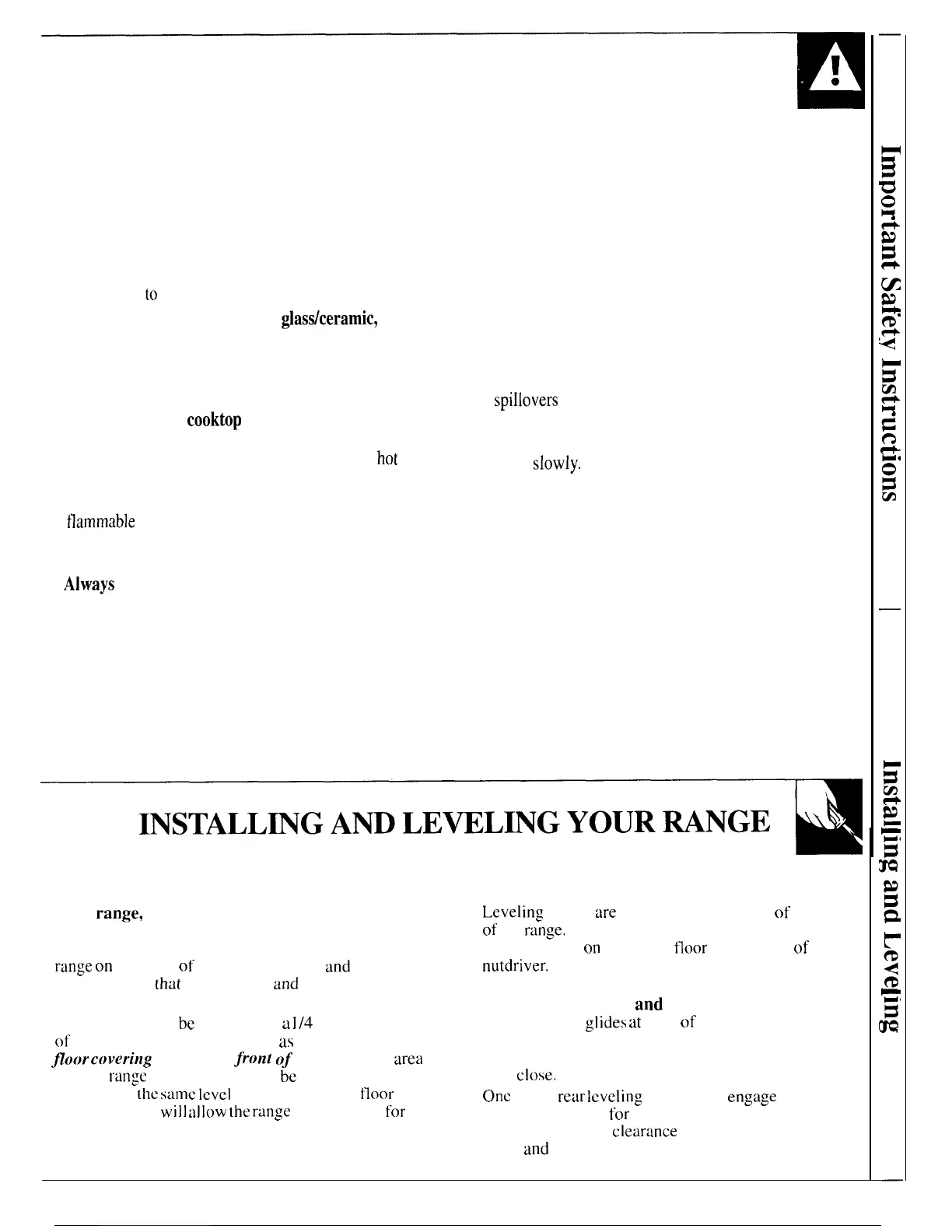
like many other household items, is
heavy and can settle into soft floor coverings such as
cushioned vinyl or carpeting. When moving the
range
on
this type of flooring, use care,
and
it is
recommended
that
these simple
and
inexpensive
instructions be followed.
The range should
be
installed on
a
1/4
inch thick sheet
of plywood (or similar material)
as
follows: When the
floor
covering ends at the
jront
of
the range,
the area
that the
range
will rest on should
be
built up with
plywood to
the
same
Icvet
or higher than the
floor
covering. This
wit]
at]ow
the
range
to be moved
for
cleaning or servicing.
Leveling
Leveting
screws
are
located on each comer of the base
of the
range.
Remove the bottom drawer and you can
level the range
on
an uneven floor with the use
of
a
nutdriver.
To remove the drawer, pull the drawer out all the
way, tilt up the front
and
take it out. To replace the
drawer, insert
gtides
at
back of the drawer beyond
stop on the range glides. Lift drawer if necessary to
insert easily. Let the front of drawer down, then push
in to
ctose.
Onc
of the
rear
teveting
screws will
engage
the Anti-
Tip device. Allow
for
some side to side adjustment.
Allow a minimum
ctearance
of l/8 inch between the
range
and
the leveling screw that is to be installed
into the Anti-Tip device.
5



 To Next Page