10
3.3 Peripheral slide seal
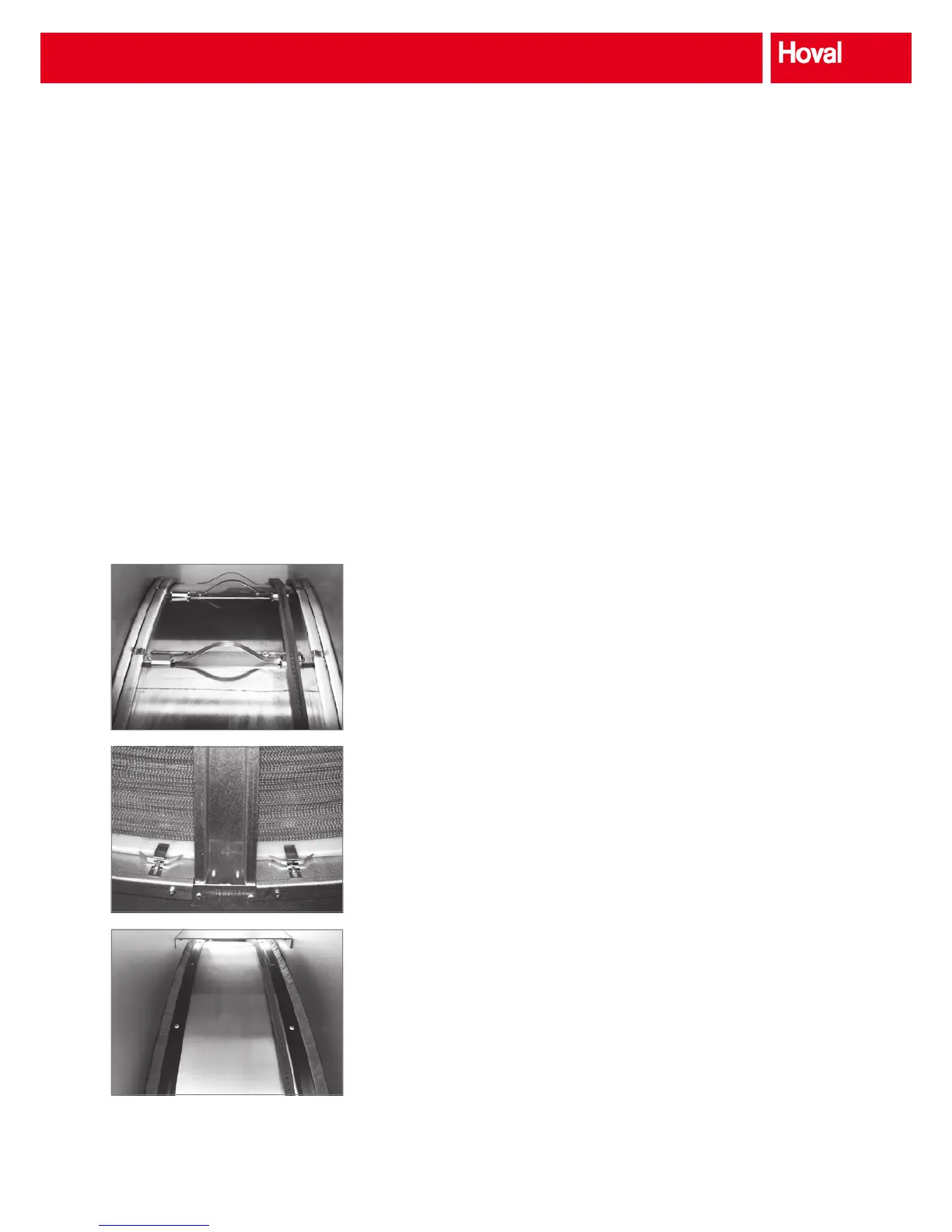
High tightness seal
■ In rotary heat exchangers with sheet-metal casing auto-
matically adjustable constant-force springs are mounted
on the wheel mantle; they press the abrasion-resistant
slide seal against the casing. The patented system perma-
nently minimises leakage and allows the unit to be sized
for smaller air ow rates.
■ In the prole casing a ring seal with externally accessible
double springs is used. They press the seal to the casing
and to the wheel.
Basic tightness seal
■ In rotary heat exchangers with sheet-metal casing, sealing
strips are mounted on the wheel mantle (e.g. brushes).
These guarantee the minimal sealing effect for the air
ows that is usual for devices on the market.
Fig. 14:
High tightness seal
Fig. 15: Peripheral slide
seal in prole casing
Fig. 16:
Basic tightness seal
3.4 Transverse seal
The transverse seal between the two air streams consists of
adjustable aluzinc sheet steel with a triple rubber-lip seal.
3.5 Drive
The wheel is driven by an electric motor and belt. The motor
is generally fastened on the left or right on a rocker in the
casing. Because manufacturers of ventilation units and
installers sometimes install their own drive, Hoval offers this
component as an option.
2 versions are available:
Constant rotational speed
The motor is switched on and off by a single switch or
contact. Output regulation (i.e. changing the temperature
efciency or humidity efciency) is not possible.
Controllable rotational speed
The drive motor is controlled by a control unit. A frequency
converter (FU) is generally used. Common additional func-
tions are speed monitoring (by inductive sensors) and inter-
mittent operation. If heat recovery is not required, the wheel
is moved slightly at intervals to prevent dirt build-up.
The control unit and as a result the wheel are normally actu-
ated by the room temperature controller, for which the rotary
heat exchanger is perceived as an energy resource for both
heating and cooling, which forms part of the cascade control
concept.
Structure



 To Next Page