6
1.4 Frost limit
If the warm extract air stream is very strongly cooled conden-
sate can be formed and it may even freeze. The fresh air
temperature at which this starts is referred to as the frost
limit.
■ Condensation wheel, enthalpy wheel: The condensate
generated by cooling the extract air may freeze at low
outside temperatures. There is a frost hazard at equiva-
lent mass ows for exhaust air and fresh air if the average
inlet temperature of the two air streams is less than 5 °C.
t
m
=
t
11
+ t
21
2
< 5 °C
■ Sorption wheel: The gaseous humidity transmission by
sorption generally prevents condensation; the frost hazard
is reduced.
1.5 Temperature efficiency
Appropriate design and serial layout allows virtually any
temperature efciency to be reached. The 'correct' temper-
ature efciency depends on the applicable regulations and
the economy calculations, i.e. the operating data such as
energy price, service life, operation time, temperatures,
maintenance requirements, interest etc. Even minor changes
(a few percent lower temperature efciency, a few pascals
more pressure drop) can mean signicantly poorer results for
capital value and amortisation period.
1.6 Pressure drop
Heat recovery units cause pressure drop on the extract
and supply air sides and as a result operating costs. With
current general conditions the economical values for wheels
are between 80 Pa and 130 Pa. However, to reduce costs,
more and more heat recovery units whose pressure drops
are above these economically reasonable values are being
installed. This affects the feasibility of the system.
1.7 Pressure difference
A distinction is made between internal pressure difference
(between exhaust air and supply air) and external pressure
difference (between the exchanger and the environment).
Internal pressure difference:
The internal leakage between the two air streams depends
greatly on the pressure difference. Hoval rotary heat
exchangers with high tightness seal compared with other
designs are certainly very leak-proof, but the following infor-
mation should be taken into account in the design:
■ The pressure difference in the rotary heat exchanger
should be as low as possible.
■ In applications that involve the danger of odours the pres-
sure gradients and therefore possible leakage from the
fresh air to the exhaust air must be considered.
However, the internal pressure difference may also cause
deformation of the casing; a pressure difference of more than
2000 Pa is not permitted.
Notice
The pressure difference depends on the layout of the
fans. Overpressure on one side and underpressure
on the other side add up.
External pressure difference:
This is a major factor for the external leakage of the heat
exchanger. If a duct system is correctly and carefully
installed, this effect can be ignored.
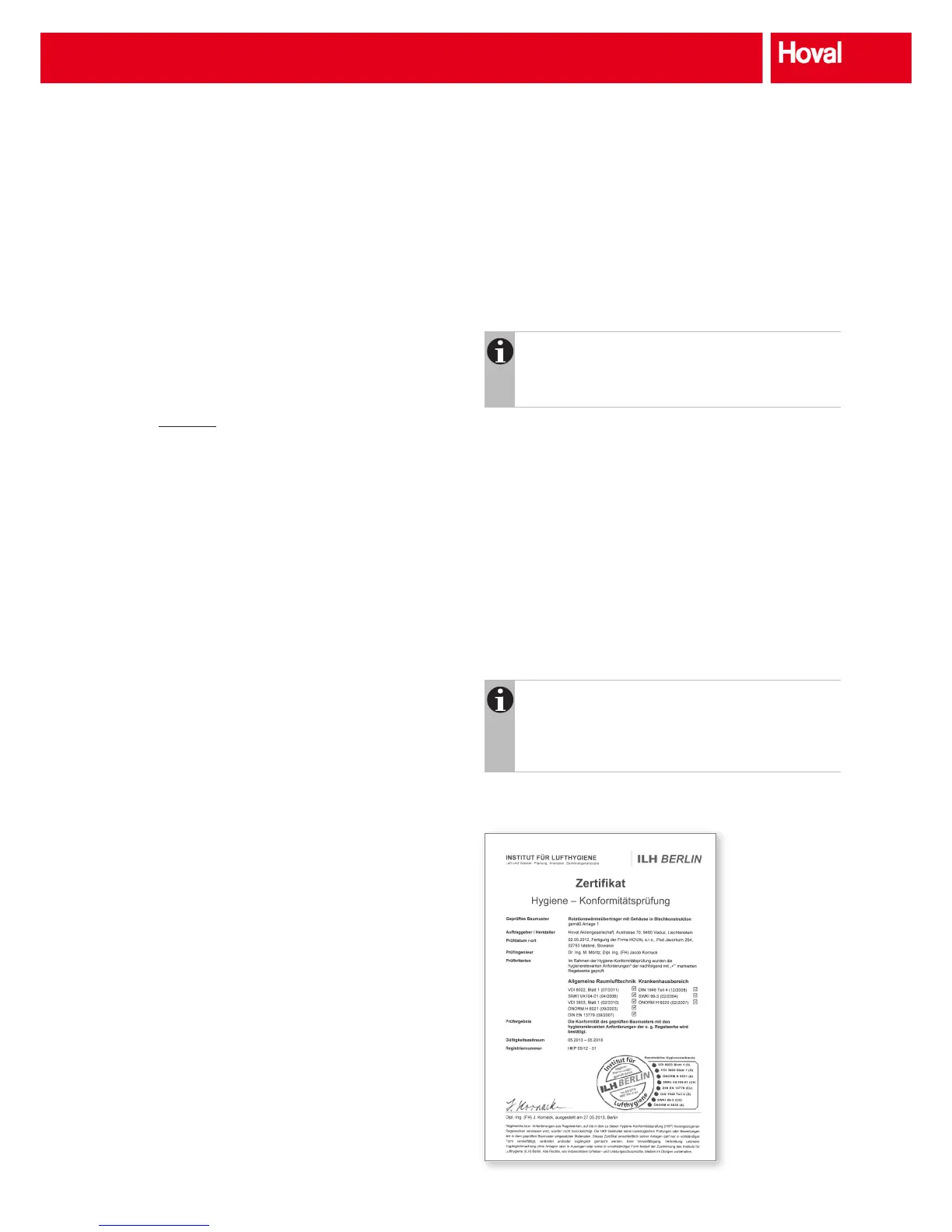
1.8 Hygiene
Hoval rotary heat exchangers with high tightness seal have
been tested for conformity with hygiene requirements at the
Institute for Air Hygiene in Berlin. The test criteria were the
requirements relevant to hygiene for applications in general
building ventilation and in hospital applications. All hygiene
requirements were met.
Notice
Hoval rotary heat exchangers are tested and certi-
ed for operation in hospitals in accordance with
DIN 1946-4. Install rotary heat exchangers with the
'coated casing' option for such applications.
Fig. 6: Certicate of
hygiene conformity test
(valid for Hoval rotary
heat exchangers with high
tightness seal)
Principle and Operation



 To Next Page