2
1 Principle and Operation
Hoval rotary heat exchangers are regenerators with rotating
heat accumulators (category 3) in accordance with the guide-
lines for heat recovery (e.g. VDI 2071).
The heat-dissipating and heat-absorbing air ows heat
or cool the rotating, air-permeable storage accumulator.
Depending on the air conditions and the surface of the
accumulator material, humidity may also be transferred in the
process. Supply and exhaust air must therefore be brought
together and ow through the heat exchanger.
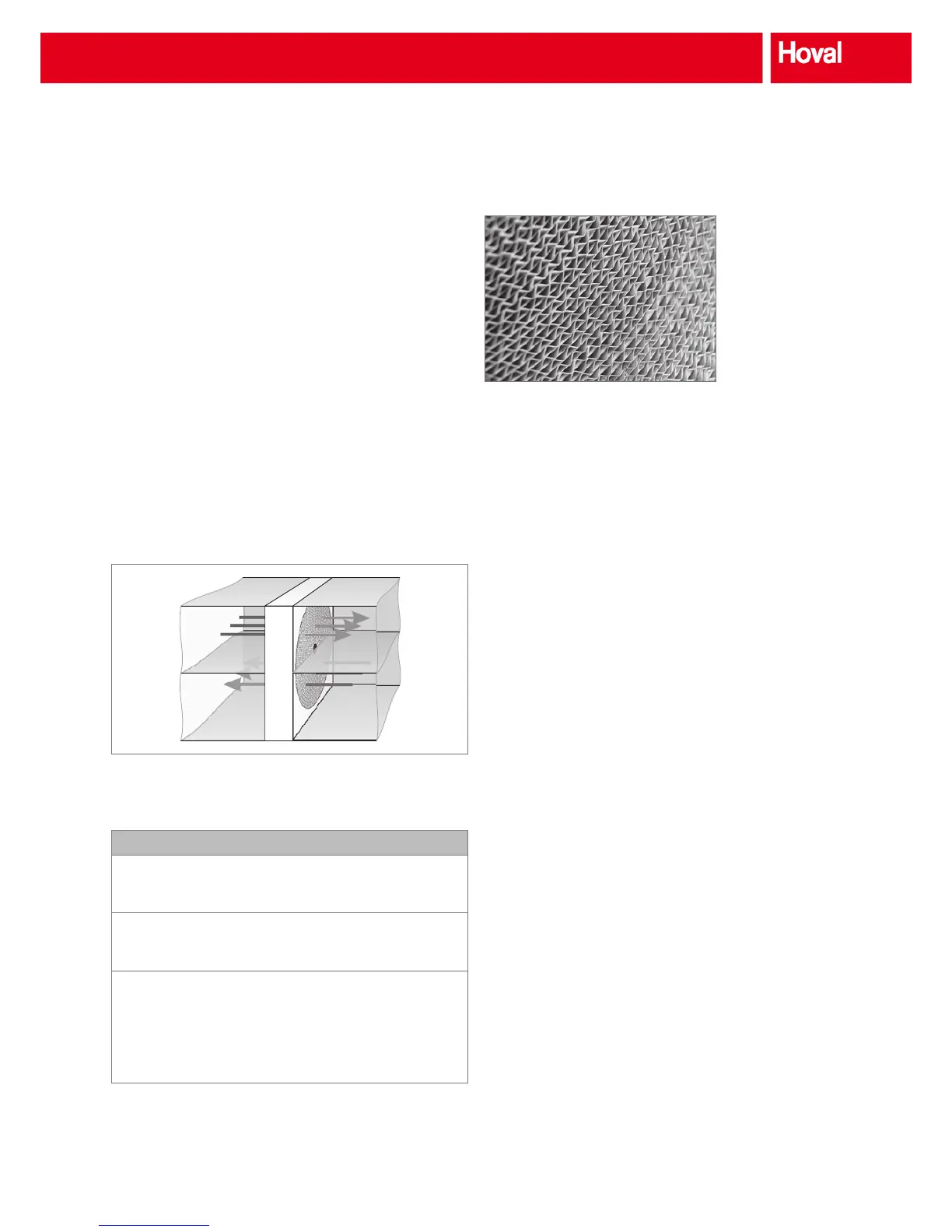
The storage mass consists of triangular, axially arranged
small ducts made of thin metal foil. The depth of the storage
mass (viewed in the direction air ow) is generally 200 mm;
the airway height is normally 1.4 – 1.9 mm, depending on the
application. With these dimensions the storage mass gener-
ates a laminar ow in the wheel ducts.
Fresh air
t
21
x
21
Supply air
t
22
x
22
Exhaust air
t
12
x
12
Extract air
t
11
x
11
Fig. 1: Function diagram and air conditions
Denition of key data according to Eurovent
Temperature efciency
t
22
- t
21
η
t
=
t
11
- t
21
Humidity efciency
x
22
- x
21
η
x
=
x
11
- x
21
Legend: t = Temperature [K; °C]
x = Absolute humidity [g/kg]
Index: …
11
Extract air
…
21
Fresh air
…
12
Exhaust air
…
22
Supply air
1.1 Heat transmission
The wheel with its axially arranged, smooth ducts acts as a
storage mass, half of which is heated by the warm air and
the other half of which is cooled by the counter-ow of cold
air. The temperature of the storage mass therefore depends
on the axis coordinates (wheel depth) and the angle of
rotation.
The function is easy to understand by following the status
of a wheel duct through one revolution (see Fig. 3). The
following can be recognised with reference to the heat
transfer from this process:
■ The air temperature after the exchanger varies; it depends
on the location on the wheel.
■ The heat recovery efciency can be varied by varying the
speed.
■ The heat recovery efciency can be changed with the
storage mass. This can be done with different cross-sec-
tions of the wheel ducts, different thickness of the storage
material or by changing the wheel depth. However, in all
cases this varies the pressure drop.
■ The specic heat output depends on the temperature
difference between warm air and cold air. The rotary heat
exchanger is therefore suitable for heat and cool recovery,
i.e. for winter and summer operation.
Fig. 2: Geometry of
storage mass



 To Next Page