1.1 Heat transmission
The wheel with its axially arranged, smooth ducts acts as a
storage mass, half of which is heated by the warm air and
the other half of which is cooled by the counter-ow of cold
air. The temperature of the storage mass therefore depends
on the axis coordinates (wheel depth) and the angle of
rotation.
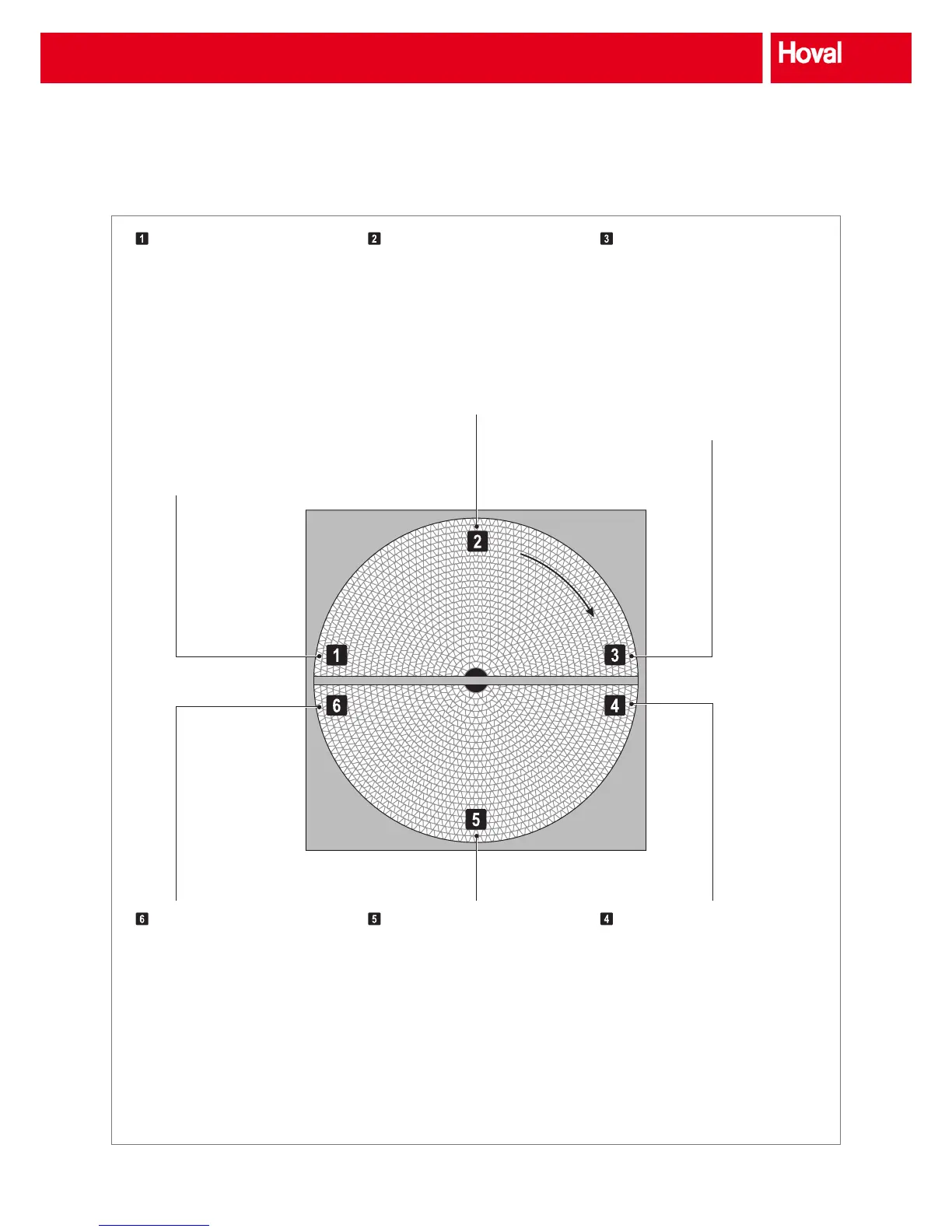
The function is easy to understand by following the status
of a wheel duct through one revolution (see Fig. 3). The
following can be recognised with reference to the heat
transfer from this process:
■ The air temperature after the exchanger varies; it depends
on the location on the wheel.
■ The heat recovery efciency can be varied by varying the
speed.
■ The heat recovery efciency can be changed with the
storage mass. This can be done with different cross-sec-
tions of the wheel ducts, different thickness of the storage
material or by changing the wheel depth. However, in all
cases this varies the pressure drop.
■ The specic heat output depends on the temperature
difference between warm air and cold air. The rotary heat
exchanger is therefore suitable for heat and cool recovery,
i.e. for winter and summer operation.
Fig. 2: Geometry of
storage mass
Fig. 3: States depending on the turning angle
Warm air entry
The rotation of the storage mass has
moved the wheel duct from the cold air
to the warm air. The storage material is
cooled almost to the temperature of the
cold air. This applies particularly to the
entry side of the cold air (= exit side of the
warm air). The warm air now ows through
the duct with reference to the temperature
in the counter-ow and is cooled greatly.
The storage mass is therefore heated. The
local temperature efciency, i.e. directly
at the inlet to the warm air, is very high.
Condensation can also occur very easily.
Mid warm air
The wheel duct now has passed half of
its time in the warm air. The storage mass
has been heated by the owing warm air;
therefore, the warm air is not cooled down
as much as in entry inlet zone. The wall
temperature at the entry and exit is approxi-
mately the same. Condensation occurs only
with large humidity differences.
Warm air exit
The wheel duct is now shortly before entry
to the cold air. It has virtually reached the
temperature of the extract air at the entry
side. The transferred performance is still
only low.
The dwell time in the warm air and in the
cold air, i.e. the speed of rotation, is deci-
sive for the performance of the rotary heat
exchanger. It depends on the storage mass
(thickness, geometry), the heat transfer and
the air velocity.
Cold air exit
The wheel duct has passed through the
cold-air section. The storage mass has
greatly cooled, almost down to the cold-air
temperature in the entry section. After
crossover to the warm air side, the cycle
starts anew.
Mid cold air
Half of the dwell time in the cold air is past.
The storage mass has already cooled
signicantly. The temperatures at the entry
and exit are approximately equal.
Cold air entry
After the transition from the warm air to the
cold air, the wheel duct now has cold air
owing through in the opposite direction
(referring to the temperature). With the
high temperature difference the transferred
performance is very high, i.e. the cold air is
very strongly heated; in reverse the storage
mass is strongly cooled. Any conden-
sate formed on the exchanger surface is
(partially) absorbed by the heated cold air.
W
A
R
M
A
I
R
C
O
L
D
A
I
R
Principle and Operation



 To Next Page