7
1.9 Reliable data
Hoval rotary heat exchangers are always tested by inde-
pendent test organisations (e.g. at the building technology
testing laboratory of the University of Lucerne). All technical
data are based on these measurements. This means that
they are reliable data for planners, installers and operators.
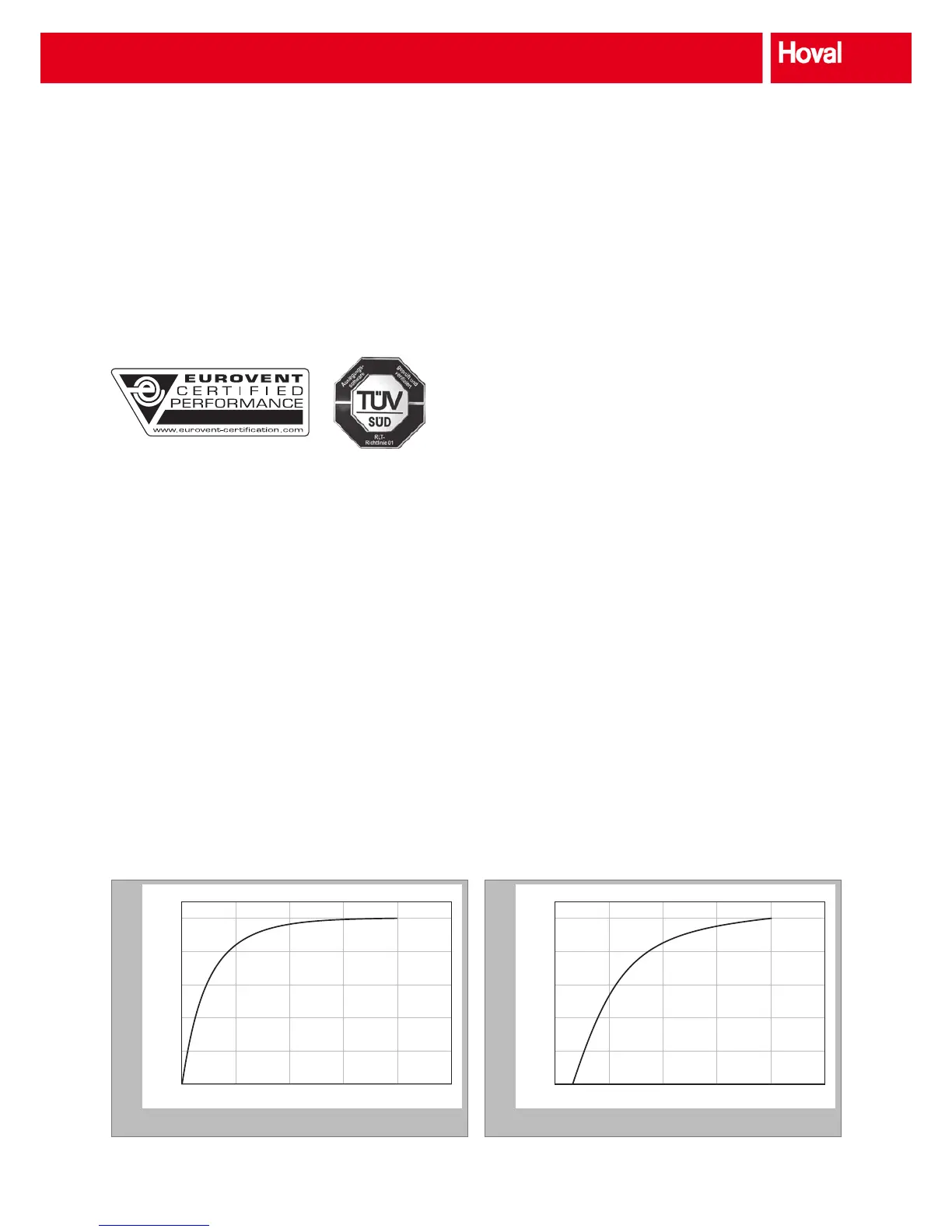
Relative humidity efciency
0
5
10 15 20 25
0 %
20 %
40 %
60 %
80 %
100 %
Speed of rotation [rpm]
Fig. 8: Dependency of the humidity efciency on the rotational speed
Relative temperature efciency
0
5
10 15 20 25
0 %
20 %
40 %
60 %
80 %
100 %
Speed of rotation [rpm]
Fig. 7: Dependency of the temperature efciency on the rotational speed
2 Performance control
The Hoval rotary heat exchanger always operates as a
temperature rectier between the two air streams. The
ow direction of the heat is irrelevant in this context, i.e.
depending on the temperature gradients between extract
air and fresh air either heat or cold is harvested. Therefore,
regulation of the output of the Hoval rotary heat exchanger
is not necessary if the extract air temperature is identical to
the setpoint temperature. In this case, the fresh air is always
either heated or cooled in the direction of the set temperature
by the heat exchanger.
However, in most cases there are heat sources in the
ventilated rooms (people, machines, lighting, solar radiation,
processing systems) that increase the room temperature,
i.e. the extract air temperature is higher than the setpoint
temperature. In this case, check the outside temperature
from which the system is heated at full performance of the
rotary heat exchanger and – if this cannot be tolerated – the
performance of the heat exchanger must be controlled.
It is very simple and economical to reduce the performance
of the rotary heat exchanger for heating and also for humidity
transmission by reducing the speed of rotation. All Hoval
rotary heat exchangers can therefore be supplied with
speed-controlled drives.
There is also the option of diverting one or both air streams
past the wheel by a bypass. The method – used primarily in
process technology and at various air ow rates – must be
installed by the customer.
Performance control



 To Next Page