EasyManua.ls Logo

HP 48G - Page 32

HP 48G
84 pages
Print Icon
To Next Page IconTo Next Page
To Previous Page IconTo Previous Page
Loading...
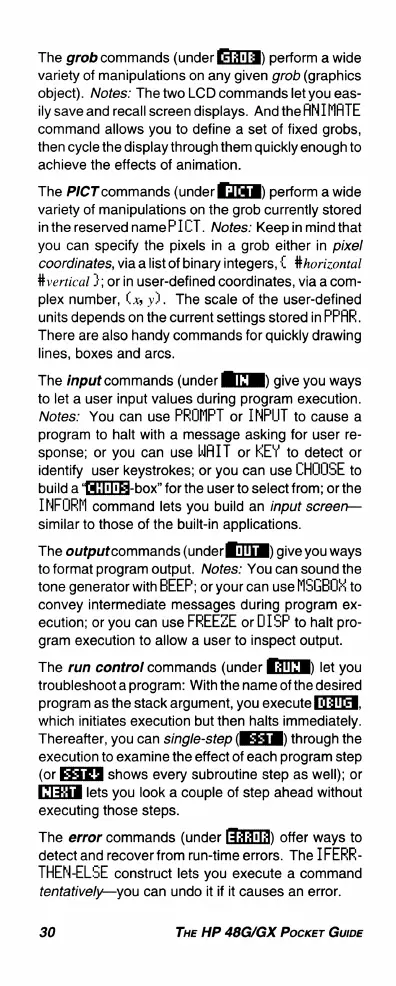
The
grob
commands
(under
(i)
perform
a
wide
variety
of
manipulations
on
any
given
grob
(graphics
object).
Notes:
The
two
LCD
commands
let
you
eas-
ily
save
and
recall
screen
displays.
And
the
ANIFATE
command
allows
you
to
define
a
set
of
fixed
grobs,
then
cycle
the
display
through
them
quickly
enough
to
achieve
the
effects
of
animation.
The
PICT
commands
(under
[II&M)
perform
a
wide
variety
of
manipulations
on
the
grob
currently
stored
inthe
reserved
namePICT.
Notes:
Keep
in
mind
that
you can
specify
the
pixels
in
a
grob
either
in
pixel
coordinates,
via
a
list
of
binary
integers,
1.
#horizontal
#vertical
I;
orin
user-defined
coordinates,
via
a
com-
plex
number,
{x
y).
The
scale
of
the
user-defined
units
depends
on
the
current
settings
stored
in
PPAR.
There
are
also
handy
commands
for
quickly
drawing
lines,
boxes
and
arcs.
The
input
commands
(under
[lIZIM)
give
you
ways
to
let
a
user
input
values
during
program
execution.
Notes:
You
can
use
PROMPT
or
INPUT
to
cause
a
program
to
halt
with
a
message
asking
for
user
re-
sponse;
or
you can
use
WAIT
or
KEY
to
detect
or
identify
user
keystrokes;
or
you can
use
CHOOSE
to
build
a
“fiTE-box”
for
the
user
to
select
from;
or
the
INFORM
command
lets
you
build
an
input
screen—
similar
to
those
of
the
built-in
applications.
The
outputcommands
(under
[IiITERl)
give
you
ways
to
format
program
output.
Notes:
You
can
sound
the
tone
generator
with
BEEP;
or
your
can
use
MSGEOX
to
convey
intermediate
messages
during
program
ex-
ecution;
or
you can use
FREEZE
or
DISF
to
halt
pro-
gram
execution
to
allow
a
user
to
inspect
output.
The
run
control
commands
(under
[TH)
let
you
troubleshoot
a
program:
With
the
name
of
the
desired
program
as
the
stack
argument,
you
execute
[{HTE,
which
initiates
execution
but
then
halts
immediately.
Thereafter,
you
can
single-step
(IEELIB)
through
the
execution
to
examine
the
effect
of
each
program
step
(or
shows
every
subroutine
step
as
well);
or
lets
you
look
a
couple
of
step
ahead
without
executing
those
steps.
The
error
commands
(under
FTAIR)
offer
ways
to
detect
and
recover
from
run-time
errors.
The
IFERE-
THEM-ELSE
construct
lets
you
execute
a
command
tentatively—you
can
undo
it if
it
causes
an
error.
30
THe
HP
48G/GX
Pocker
GuiDe

Related product manuals