58 IEEE 1394 Fundamentals and Interface Overview Chapter 4
The terms shown in Figure 4-1 are defined in the following table.
Features of the
IEEE 1394 Bus
The following features of the IEEE 1394 bus apply to all bus applications
including VXI systems.
* Daisy-chain or branching configurations are allowed. There can be no
closed loops (i.e. more than one connection between any two devices).
* Up to 63 devices (including 16 HP E8491As) are allowed per bus segment.
One host adapter represents one bus segment.
* There is a maximum of 16 hops between any two devices. The bus cable
length cannot exceed 72 meters between any two devices.
* Live/hot connections. A VXI mainframe anywhere in the configuration
can be turned on/off without affecting the other mainframes. The IEEE 1394
bus automatically reconfigures itself any time a VXI mainframe (or other
device) is added or removed. It is best to do this however, if there are no
data transactions taking place elsewhere in the system.
Table 4-1. Definition of Terms.
Host Adapter Links the computer’s PCI bus to the IEEE 1394 interface. To use a
host adapter, computers must be PCI Rev. 2.0 compliant.
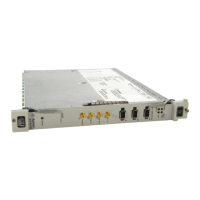
HP E8491A
1394-to-VXI
Interconnect
Links the IEEE 1394 interface to the VXI backplane. Provides the
backplane’s clock and trigger resources.
Root Node Each device (HP E8491A) on the bus is a “node.” In VXI systems,
the PC is always the root node having cycle master and bus master
capabilities.
Branch Node A branch node has IEEE 1394 cables connected to two or more
ports. In Figure 1, VXI mainframe 1 is a branch node because of the
1394 cables connecting it to the PC (root node) and to VXI
mainframe 3 on its right.
Leaf Node A leaf node has a single IEEE 1394 cable connected to it.VXI
mainframes 2 and 3 are leaf nodes.
Parent A node (HP E8491A) is a parent if it is physically connected closer
to the root than an adjacent node. In Figure 1, VXI mainframe 1 is a
parent node because it is closer to the root than VXI mainframe 3.
Child A node (HP E8491A) is a child if it is farther from the root than an
adjacent node. In Figure 1, VXI mainframe 3 is a child node
because it is farther from the root than VXI mainframe 1.
A node with a single IEEE 1394 cable connected to it (leaf node) is
always a child (VXI mainframe 2).
Hop A hop is a IEEE 1394 cable link between nodes. There can be no
more than 16 hops between any two nodes. In the diagram above,
there is a maximum of three hops between nodes. The distance
between any two nodes cannot exceed 72m.
Artisan Technology Group - Quality Instrumentation ... Guaranteed | (888) 88-SOURCE | www.artisantg.com



 To Next Page