EasyManua.ls Logo

HP HP-28S - Specifying a Pair of Columns; Finding the Correlation; Finding the Covariance

HP HP-28S
341 pages
Print Icon
To Next Page IconTo Next Page
To Previous Page IconTo Previous Page
Loading...
Specifying a Pair
of
Columns
Before
performing
paired-sample
statistics, specify
which
columns
of
the
statistics matrix
~DAT
contain
the
independent
and
dependent
data. In this example you
want
CPI
(in
column
1) to
be
the
indepen-
dent
data
and
PPI
(in
column
2) to
be
the
dependent
data.
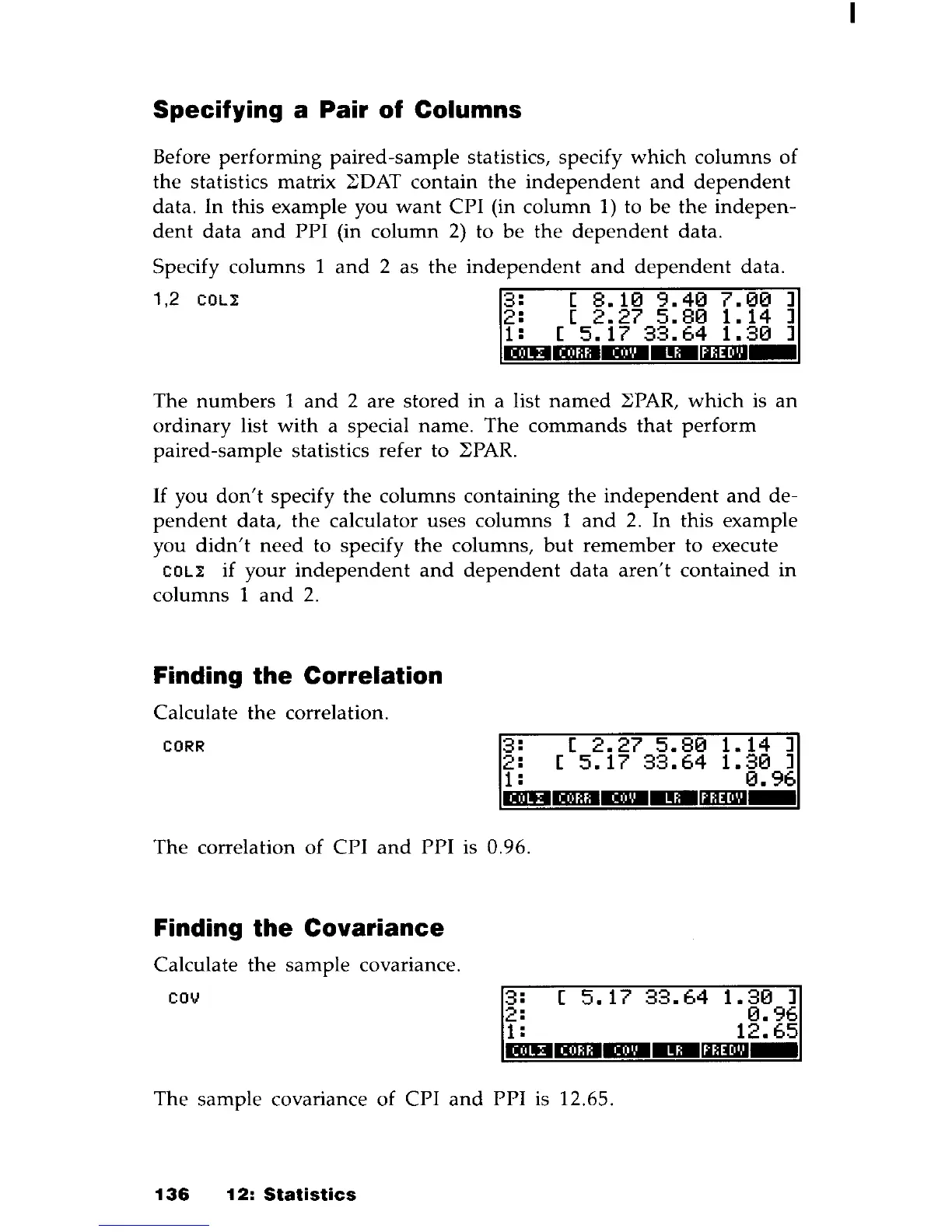
Specify
columns
1
1,2
COLI
and
2 as
the
independent
and
dependent
data.
3:
[8.10
9.40
7.00
]
2:
[2.27
5.80
1.14
]
1:
[5.17
33.64
1.30
]
mHmD
..
lDIIlDBlI_
The
numbers
1
and
2 are
stored
in a list
named
~PAR,
which
is
an
ordinary
list
with
a special
name.
The
commands
that
perform
paired-sample
statistics refer to
~PAR.
If
you
don't
specify
the
columns
containing
the
independent
and
de-
pendent
data,
the
calculator uses
columns
1
and
2.
In
this
example
you
didn't
need
to specify
the
columns,
but
remember
to execute
COLI
if
your
independent
and
dependent
data
aren't
contained
in
columns
1
and
2.
Finding
the
Correlation
Calculate
the
correlation.
CORR
3:
[2.27
5.80
1.14
]
2:
[5.17
33.64
1.30
]
1:
0.96
mHmD
..
lDIIlDBlI_
The
correlation
of
CPI
and
PPI
is 0.96.
Finding
the
Covariance
Calculate
the
sample
covariance.
COV
3:
[5.17
33.64
1.30
]
2:
0.96
1:
12.65
mHmD
..
lDIIlDBlI_
The
sample
covariance
of
CPI
and
PPI
is 12.65.
136
12:
Statistics

Table of Contents

Other manuals for HP HP-28S

Related product manuals