Need help?
Do you have a question about the HP M27fq and is the answer not in the manual?
Provides critical safety precautions for service personnel to minimize risk of injury.
Details essential service procedures and precautions for safe and reliable operation.
Outlines RoHS compliance requirements for products and replacement parts.
Describes the general information provided in the manual and service levels.
Explains how to find and apply firmware updates for the monitor.
Details post-repair checks, like AC leakage current, before returning the product.
Lists the key features and capabilities of the monitor.
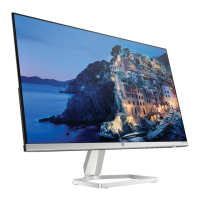
Identifies and describes the components located on the front of the monitor.
Identifies and describes the components located on the rear of the monitor.
Explains where to find the serial and product numbers for support purposes.
Provides an illustrated guide to identify the major components of the monitor.
Details the process and sources for ordering replacement parts and connectors.
Guides on how to prepare the workspace and gather necessary equipment for disassembly.
Provides step-by-step instructions for removing the rear cover of the monitor.
Details the procedure for repairing HDMI, DisplayPort, and audio connectors on the main board.
Provides instructions for repairing the DisplayPort connector (P300).
Details the steps to repair the HDMI connectors (P100, P200).
Outlines the procedure for testing the monitor's functions after repair.
Lists common problems, their causes, and recommended solutions for troubleshooting the monitor.
This document serves as a Maintenance and Service Guide for the HP M27fq monitor, model M31385. It provides comprehensive information for trained service personnel regarding the device's functionality, features, and detailed procedures for maintenance and repair.
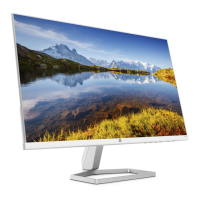
The HP M27fq monitor is designed for a wide range of users, offering a high-quality visual experience. Its primary function is to serve as a display unit, connecting to various source devices such as computers and game consoles via High-Definition Multimedia Interface (HDMI) and DisplayPort (DP) inputs. The monitor features a liquid crystal display (LCD) with active matrix and in-plane switching technology, ensuring vibrant and consistent colors across wide viewing angles. The screen is nonglare and utilizes an LED backlight, contributing to comfortable viewing and energy efficiency.
Key usage features of the M27fq include its ability to support lower resolutions while maintaining image quality through custom scaling, preserving the original aspect ratio. The monitor boasts a wide color gamut, providing extensive coverage of sRGB color spaces for accurate color reproduction. Its wide viewing angle allows for clear visibility from various positions, whether sitting, standing, or moving from side to side. For user comfort, the monitor offers tilt adjustment capabilities, allowing users to find their preferred viewing angle.
The front of the monitor is equipped with intuitive controls, including a power button, a menu button, and three assignable OSD (On-Screen Display) buttons. These OSD buttons can be reconfigured through the OSD menu to quickly access the most commonly used operations, enhancing user convenience. The OSD menu itself provides adjustments in several languages for easy setup and screen optimization. Additionally, the monitor supports Plug and Play functionality, simplifying setup with compatible operating systems. For enhanced security, a security cable slot is located on the rear of the monitor, allowing for the attachment of an optional security cable. The HP Display Assistant software further aids in adjusting monitor settings and includes theft deterrence features. An energy saver feature is integrated to meet requirements for reduced power consumption, aligning with environmental standards.
Maintenance features are a significant focus of this guide, designed for professional service technicians. The document outlines important safety information and precautions that must be followed during any service or maintenance operation. This includes ensuring a dry and clean working environment, using proper safety devices and approved tools, and disconnecting power before opening the product's cabinet. Special attention is given to electrostatic discharge (ESD) safety procedures when handling electrical components. The guide also addresses RoHS (Restriction of Hazardous Substance in Electrical and Electronic Equipment Directive) requirements, emphasizing the use of lead-free solder wire and compliant replacement parts when applicable.
The service procedures are categorized into two levels: cosmetic/appearance/alignment service and circuit board or standard parts replacement. The guide provides an illustrated parts catalog, detailing major components and their corresponding part numbers, which is crucial for ordering spare parts. Instructions on how to order parts are also included, directing technicians to HP's parts surfer website and an EU distributor for internal and external power supplies.
Detailed removal and replacement procedures are provided, starting with preparation for disassembly. This involves cleaning the disassembly room, identifying the disassembly area, and ensuring all necessary equipment and materials are available, such as a press fixture, working table, screwdriver, knife, gloves, cleaning cloth, ESD protection, and a scraper bar of specified dimensions. The guide meticulously describes the steps for removing the rear cover, which includes detaching the base stand, stripping screws, and disconnecting internal cables like the 8-pin FFC from the main board and the LVDS/LED cable from the panel.
A dedicated section on connector repair covers HDMI and DisplayPort connectors, which are located on the main board. For DisplayPort (P300) and HDMI (P100, P200) connectors, the guide provides step-by-step instructions for melting solder with a hot air gun and soldering iron, removing the old connector, placing a new component, and soldering it to the PCB, ensuring it matches the PCB footprint.
After any repair, a function test is mandatory to confirm that all functions are working correctly. The guide includes a function test table, specifying tests for HDMI and DisplayPort functionality, and the tools required (computer or DVD player). Finally, a support and troubleshooting section lists common problems, their possible causes, and recommended solutions, such as connecting the power cord, powering the monitor on, connecting video cables properly, exiting Sleep mode, adjusting OSD settings, and disabling OSD or power button lock functions. Firmware updates, if available, can be found on support.hp.com. Before returning a repaired product to the customer, an AC leakage current check on exposed metallic parts is required to ensure electrical safety.
 General
| Color depth | 8 bit |
|---|---|
| Color gamut | 99 % |
| Pixel pitch | 0.233 x 0.233 mm |
| Screen shape | Flat |
| Pixel density | 109 ppi |
| Backlight type | Edge LED |
| Display diagonal | 27 \ |
| Surface hardness | 3H |
| Anti-glare screen | Yes |
| Display technology | LED |
| Native aspect ratio | 16:9 |
| Maximum refresh rate | 75 Hz |
| Horizontal scan range | 30 - 120 kHz |
| Contrast ratio (typical) | 1000:1 |
| Display number of colors | - |
| Digital vertical frequency | 48 - 75 Hz |
| Display brightness (typical) | 300 cd/m² |
| Supported graphics resolutions | 640 x 480 (VGA), 720 x 400, 800 x 600 (SVGA), 1024 x 768 (XGA), 1280 x 1024 (SXGA), 1280 x 720 (HD 720), 1280 x 800 (WXGA), 1440 x 900 (WXGA+), 1600 x 900, 1680 x 1050 (WSXGA+), 1920 x 1080 (HD 1080), 1920 x 1200 (WUXGA), 2560 x 1440 |
| AC input voltage | 100 - 240 V |
| AC input frequency | 50 - 60 Hz |
| Power consumption (max) | 31.5 W |
| Power consumption (standby) | 0.5 W |
| Power consumption (typical) | 22.3 W |
| Operating temperature (T-T) | 5 - 35 °C |
| Storage relative humidity (H-H) | 5 - 95 % |
| Operating relative humidity (H-H) | 20 - 80 % |
| Cables included | AC, DisplayPort, HDMI |
| HDMI version | 1.4 |
| DisplayPort version | 1.2 |
| Package depth | 126 mm |
| Package width | 690 mm |
| Package height | 430 mm |
| Package weight | 5800 g |
| Product color | Silver |
| Market positioning | Home |
| Tilt angle range | -5 - 25 ° |
 Weight and Dimensions
| Depth (with stand) | 188.2 mm |
|---|---|
| Height (with stand) | 438.1 mm |
| Weight (with stand) | 3200 g |
| Depth (without stand) | 32 mm |
| Width (without stand) | 609.7 mm |
| Height (without stand) | 357.1 mm |

 To Next Page