T2™ 37
Axial Piston: Type of design for hydraulic motors and pumps in which the pistons are arranged
parallel with the spindle (input or output shaft).
Bypass Valve: A valve whose primary function is to open a path for the fl uid to bypass the motor
or pump. Also referred to occasionally as the freewheel valve or dump valve.
Case Drain Line (Return Line): A line returning fl uid from the component housing to the reser-
voir.
Cavitation: A concentrated gaseous condition within the fl uid causing the rapid implosion of a
gaseous bubble.
Center Section: A device which acts as the valve body and manifold of the transmission.
Charge Pump: A device which supplies replenishing fl uid to the fl uid power system (closed
loop).
Charge Pressure: The pressure at which replenishing fl uid is forced into a fl uid power system.
Charge Relief Valve: A pressure control valve whose primary function is to limit pressure in the
charge circuit.
Check Valve: A valve whose primary function is to restrict fl ow in one direction.
Closed Loop: A sealed and uninterrupted circulating path for fl uid fl ow from the pump to the
motor and back.
Decay Rate: The ratio of pressure decay over time.
End Cap: See “Center Section.”
Entrained Air: A mechanically generated mixture of air bubbles having a tendency to separate
from the liquid phase.
Gerotor: A formed rotor set operating about an eccentric that provides a fi xed displacement for
pumps or motors.
Hydraulic Motor: A device which converts hydraulic fl uid power into mechanical force and mo-
tion by transfer of fl ow under pressure.
Hydraulic Pump: A device which converts mechanical force and motion into hydraulic fl uid power
by producing fl ow.
Hydrostatic Pump: See “Hydraulic Pump.”
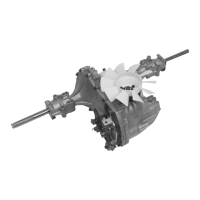
Hydrostatic Transaxle: A multi component assembly including a gear case and a hydrostati-
transmission.
Hydrostatic Transmission: The combination of a hydraulic pump and motor in one housing to
form a device for the control and transfer of power.
Inlet Line: A supply line to the pump.
GLOSSARY OF TERMS


 To Next Page