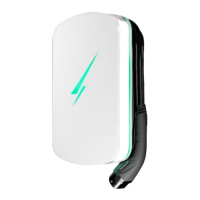
The Hypervolt Home 3.0 Smart EV Charger is a state-of-the-art electric vehicle charging unit designed for ease of installation and advanced functionality, providing a seamless charging experience for users. It incorporates industry-leading smart features and is backed by excellent customer service. The device is equipped with advanced built-in automatic monitoring systems to ensure user safety during operation.
Function Description:
The Hypervolt Home 3.0 is primarily an EV charger that connects to your home's electrical system to deliver power to your electric vehicle. It supports single-phase AC charging up to 7kW. The charger is designed to be wall or pole mounted and comes with a tethered charging cable, available in lengths of 5, 7.5, or 10 meters, with a Type 2 or Type 1 connector. It operates according to Mode 3 charging protocol, compliant with BS EN IEC 61851-1:2019. The unit features multi-colour LEDs for status indication and human-machine interface (HMI), with the logo on the front enclosure and an outer ring LED status indicator.
Usage Features:
The Hypervolt Home 3.0 offers a range of smart features and charging modes, all controllable via a dedicated mobile application available on both Google Play Store (Android) and App Store (Apple).
- Charging Modes: The charger supports three primary charging modes:
- Boost Mode: Charges at full power, prioritizing speed while still utilizing as much solar power as possible, relying on the grid to maintain fast charging.
- Eco Mode (Solar & Grid): Charges using solar power and as little grid power as possible. It guarantees a minimum charging rate of 1.4kW even if solar export is less than this.
- Super Eco Mode (Solar Only): Charges exclusively using solar energy, requiring a minimum of 6 amps or 1.4kW of solar export power.
- App Control: The Hypervolt app provides full function control, allowing users to:
- Monitor Charging: View real-time data for the current charge session, including charging rate, cost, consumption, and environmental impact (CO2 saved).
- Schedule Charging: Set up charging schedules to match cheap rate tariffs or specific times, with a summary of total charging time, distance, and energy gained. The charger can also be set to a "Random Start" mode, which delays the start of a charging session by up to 10 minutes, indicated by a "Waiting" status.
- Start/Stop Charging: Easily toggle charging on and off using a sliding button within the app.
- Lock Charger: Prevent unauthorized use by locking the charger via a padlock icon in the app.
- Adjust Current Limit: Set the maximum amount of current delivered from the charger, useful for trickle charging or managing household load.
- LED Customization: Configure LED brightness and choose from various colour sequences or seasonal modes for the status indicators.
- View Usage Records: Access historical charging data and energy consumption.
- Connectivity: The charger connects via Wi-Fi (802.11b/g/n @2.4 GHz) and Bluetooth LE (Version 4.2), enabling remote control and monitoring. An alternative "Hotspot" connection method is available for initial setup or troubleshooting network issues.
- Automated Load Management (ALM): This feature safely adjusts the maximum charging current an EV can draw to prevent overloading the property's electrical service. When activated, the charging current can drop as low as 6A. The ALM dial allows adjustment of the load manager activation limit, typically set to 6 for 60A.
- Hard Set Maximum Operating Current: For permanent derating, internal dip switches can be used to limit the maximum current the charger operates at, ranging from 10A to 32A. This is often requested by Distribution Network Operators (DNOs).
- Plug & Charge: Allows immediate charging upon plugging in the vehicle, bypassing schedules if desired.
Maintenance Features:
The Hypervolt Home 3.0 incorporates several features to ensure safety and facilitate maintenance:
- Safety Monitoring:
- Internal 6mA DC RCD: Provides protection against DC residual currents. External AC protection (Type A RCD recommended) is still required.
- PEN Fault Protection: Integrated PEN fault protection compliant with Amendment 2 of BS7671:2018, allowing connection to PME (TN-C-S) incoming services without an additional earth rod. In case of a damaged or disconnected PEN conductor, the system isolates all conductors to protect the user.
- Overheating Sensing: Built-in temperature sensors monitor heat generation. If excessive heat is detected, the charger automatically reduces the current delivered to the EV to prevent damage.
- Status Indication (LEDs): The multi-colour LEDs provide clear visual cues for the charger's status:
- Blue: Ready to use (solid), or plugged in and waiting for charge (pulsing). Pulsing white indicates no internet connection.
- Green: Car is charging (solid), with side LEDs indicating charging rate. Flashing green means waiting on a random delay.
- Purple: Set to scheduled charge but no car plugged in (solid), or car plugged in and waiting for scheduled charge (pulsing).
- Orange: Charger locked (solid), or a locked charger is being used (flashing).
- Yellow: Charger inhibited due to lack of solar export (Super Eco Mode Only) (solid), or charger stopped from app (pulsing).
- Red: Safety system activated, charger not charging. Requires checking the app and troubleshooting guide.
- Troubleshooting Guide: The manual provides a comprehensive troubleshooting guide for common issues such as no power, charging cable not disconnecting, charging session not starting, early session termination, slower-than-expected charging, and pulsing red light.
- Data Management: Users can delete personal data stored on the charger (Wi-Fi credentials, telemetries, settings) via the app's 'Factory Reset' option.
- Warranty Validation: The unit must be registered within 48 hours of installation by scanning a QR code or online to validate the warranty.
- Installation Guidance: The manual provides detailed instructions for installation, including mounting the charger, accessing connections, wiring and cabling, CT clamp connection for load management and solar input, and fitting the enclosure parts. It emphasizes compliance with BS7671 and IET Code of Practice for EV Charging Equipment Installation.


 To Next Page


 General