OtoRead Screener Appendix B: High Frequency DPOAE Page 52
out of 1000 with hearing loss were missed would require follow-up
testing on 500,000 babies. To our knowledge, no one has performed
such tests to date.
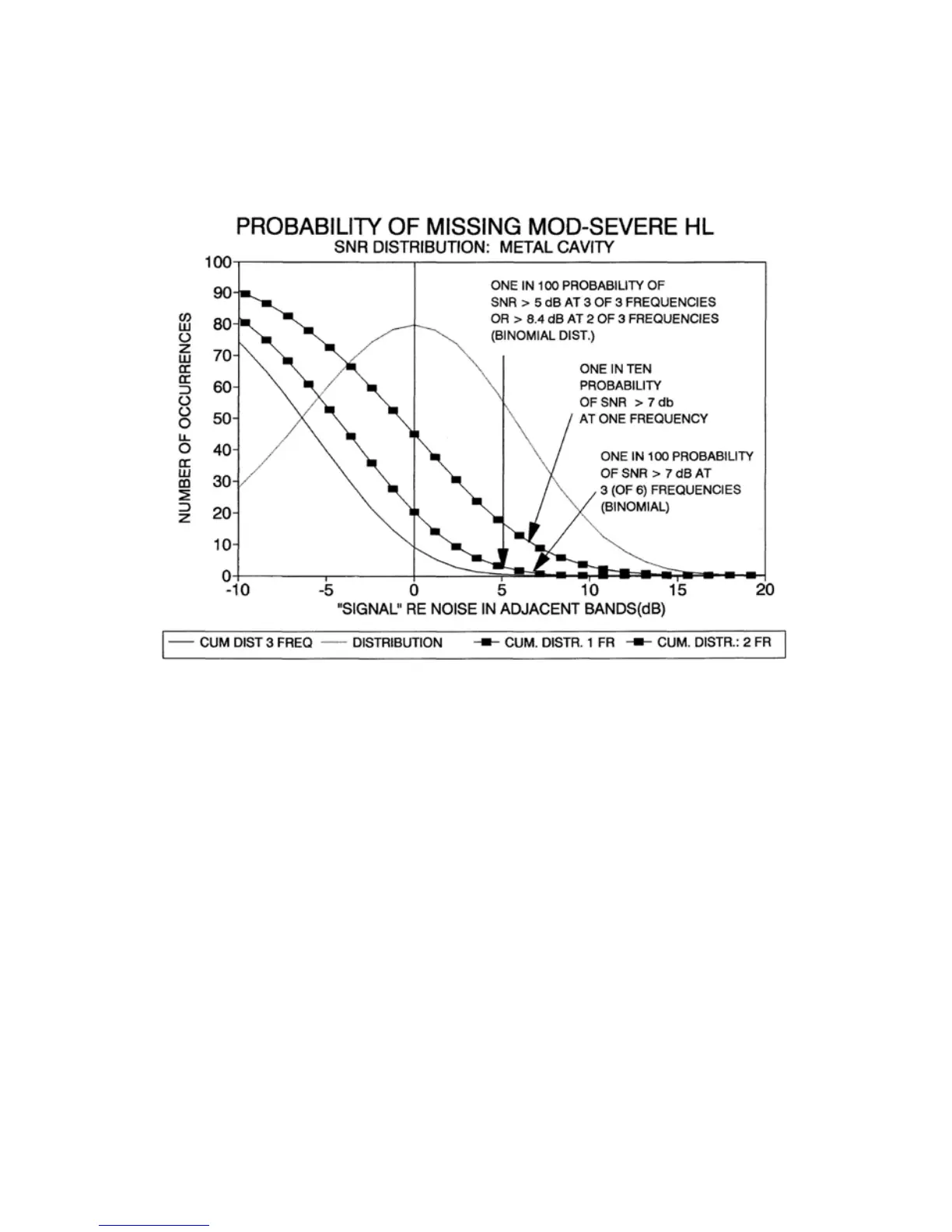
The same basic principles that underlie DPOAE Pass/Fail criteria
underlie TEOAE Pass/Fail criteria. In the case of transients, requiring
SNR of 4 dB at any three out of the six test frequencies drops the
probability of passing an ear with a significant hearing loss to less
than 1%.
Note: The SNR limits for transients are lower than the
corresponding limits for distortion products primarily because
the traditional noise calculation used in TEOAE measurements
gives a 3 dB lower SNR than the calculation used for DPOAEs.
Without that difference, the numerical SNR value for a PASS
with the two methods would be quite similar.
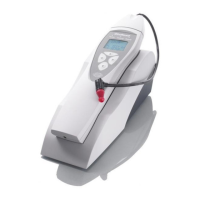
The OtoRead uses a novel noise rejection algorithm that permits
accurate DPOAE and TEOAE measurements in background noise
and babble as high as 55-65 dB SPL (A-weighted). Briefly explained,
use of available memory in the processor permits a post-hoc
statistical analysis that identifies those samples whose retention





 To Next Page