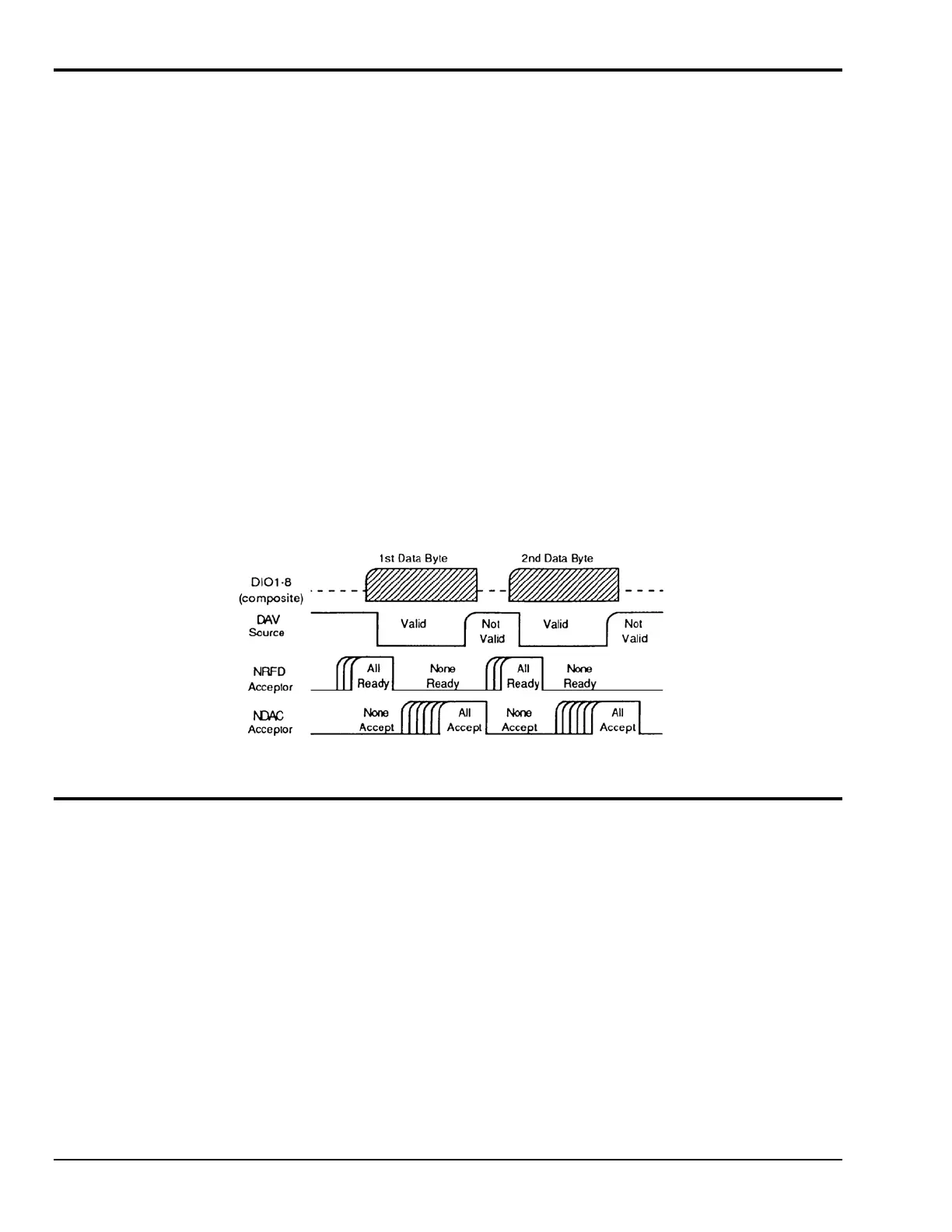
Handshake Lines
The GPIB uses three handshake-lines in an "I'm ready - Here's the data - I've got it" sequence.
This handshake protocol assures reliable data transfer, at the rate determined by the slowest Listener.
One line is controlled by the Talker, while the other two are shared by all Active Listeners.
The handshake lines, like the other IEEE 488 lines, are active low.
Data Valid (DAV)
The DAV line is controlled by the Talker. The Talker verifies that NDAC is asserted (active low) which
indicates that all Listeners have accepted the previous data byte transferred. The Talker then outputs data
on the bus and waits until NRFD is unasserted (high) which indicates that all Addressed Listeners are ready
to accept the information. When NRFD and NDAC are in the proper state, the Talker asserts DAV (active
low) to indicate that the data on the bus is valid.
Not Ready for Data (NRFD)
This line is used by the Listeners to inform the Talker when they are ready to accept new data.
The Talker must wait for each Listener to unassert the line (high) which they will do at their own rate
when they are ready for more data. This assures that all devices that are to accept the information are ready
to receive it.
Not Data Accepted (NDAC)
The NDAC line is also controlled by the Listeners. This line indicates to the Talker that each device
addressed to listen has accepted the information. Each device releases NDAC (high) at its own rate,
but the NDAC will not go high until the slowest Listener has accepted the data byte.
IEEE Bus Handshaking
Data Lines
The GPIB provides eight data lines for a bit parallel/byte serial data-transfer. These eight data lines use the
convention of DIO1 through DIO8 instead of the binary designation of D0 to D7. The data lines are
bi-directional and are active low.
4-4, IEEE 488 Primer 11-20-01 Digital488 User’s Manual



 To Next Page