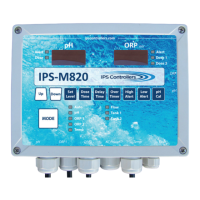
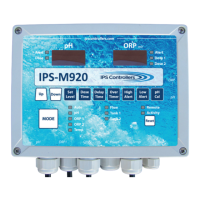
M920 & M920W pH/Dual ORP Controller Owner’s Manual
I. Introducon
A. Water Chemistry
Water chemistry is a complex science that contains many variables.
These variables not only aect the water environment itself, but they
can have adverse eects on your equipment as well as your health.
These are only some of the factors which we follow closely to ensure the
most healthy water interacons:
pH is the measurement of the acidity or basicity in an aqueous soluon.
A measurement below 7 is considered acid, while a measurement above
7 is base or alkaline. It is a signicant factor in determining the water
quality as it aects sanizer levels, water color, and human reacon to
the water.
ORP (Oxidaon Reducon Potenal) is the measurement of the oxidizing
capacity present in water. ORP cannot be fooled by the eects of pH,
total dissolved solids (TDS), stabilizers, and non-chlorine oxidizers.
A typical ORP sensor measures Hypochlorous Acid (HOCI), which is
the more eecve component of free chlorine. A higher ORP reading
equates to the sanizer working more eecvely.
Water balance is comprised of pH, calcium hardness, total alkalinity,
temperature, and TDS. When water is balanced, the Langelier Saturaon
Index is 0. Values above +0.3 lead to scaling and cloudy water, while
values below -0.3 can cause corrosion of pool equipment and surfaces. If
the water balance is not xed in a mely manner, secondary eects can
lead to rapidly declining water condions that can aect the health of
the water occupants.
pH and ORP work conversely to one another, and are aected by other
factors such as temperature, Cyanuric Acid, and TDS that can increase
the negave impacts of unbalanced water.
2


 To Next Page