Need help?
Do you have a question about the IPS Controllers M920 and is the answer not in the manual?
Defines pH and ORP, explains water chemistry importance for pool maintenance.
Critical safety guidelines for operating the controller, including electrical and physical safety.
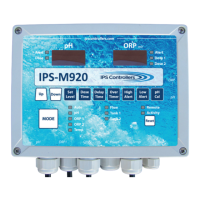
Details the IPS M920 controller, its functions, and associated components like flow cells.
Explains the functions of digital displays, LEDs, and pushbuttons on the controller's front panel.
Lists technical specifications of the M920/M920W controller, including enclosure size and electrical ratings.
Details power requirements, dip switch settings, and electrical connections for sensors and peripherals.
Initial steps for installation, including powering off equipment and relieving system pressure.
Lists necessary tools for installation, such as drills, taps, and wrenches.
Step-by-step guide for mounting the controller, installing sensors, and making electrical connections.
Outlines prerequisites for setting up remote monitoring via Wi-Fi or hardwire connections.
Explains how the IPS-M920 compares sensor readings to set levels and controls chemical feeding.
Provides instructions for powering on, establishing flow, calibrating sensors, and safely turning off the controller.
Details various operating modes (Auto, Standby) and how to adjust parameters like Set Level, Dose Time, and Alerts.
Covers procedures for winterizing the controller and cleaning the pH and ORP sensor tips for accurate readings.
Step-by-step guide for connecting the controller to a Wi-Fi network using a smartphone.
Instructions for connecting the controller to a Wi-Fi network using a desktop or laptop computer.
Guides on registering an account, adding the controller, and managing users for remote monitoring.
Diagnoses issues when pH is low or the alert LED is active, suggesting causes and solutions.
Addresses scenarios where pH is high or the alert LED is on, providing troubleshooting steps.
Guides on resolving low chlorine/bromine levels or an active alert LED related to ORP.
Solutions for high chlorine/bromine levels or an active alert LED concerning ORP.
Troubleshooting steps for when the controller's display or LEDs are not functioning.
Identifies reasons why chemical feeders might not be operating, including flow issues and blown fuses.
Steps to diagnose why the flow light LED on the controller is off, indicating potential flow problems.
Details the 5-year warranty for the main controller unit.
Outlines the 1-year warranty for other components like flow cells and sensors.
Specifies exclusions and limitations of the product's warranty coverage.
Instructions on how to submit warranty claims and return products for evaluation.
 General
| Brand | IPS Controllers |
|---|---|
| Model | M920 |
| Category | Controller |
| Language | English |

 To Next Page