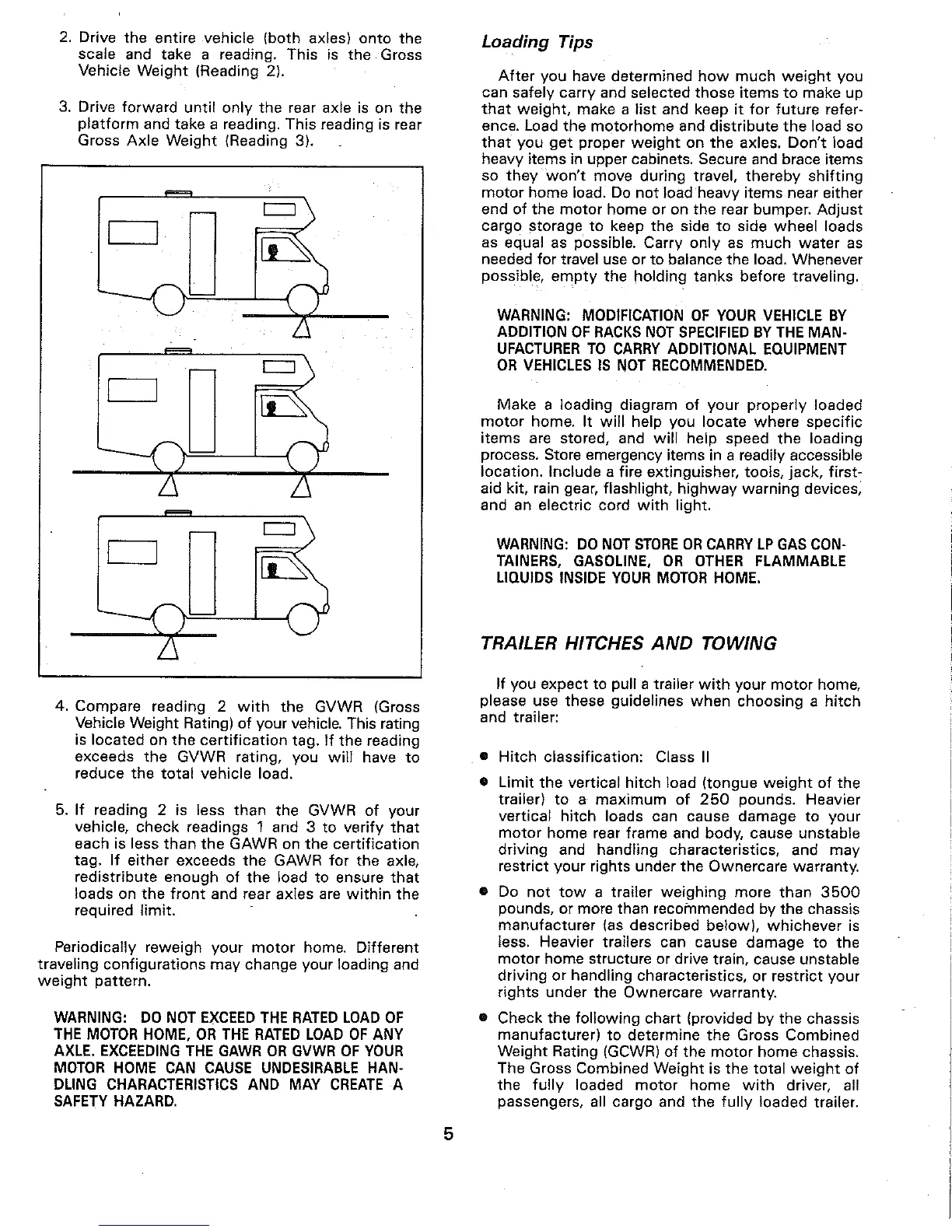
2.
Drive
the
entire vehicle (both axles) onto
the
scale and take a reading. This
is
the Gross
Vehicle Weight (Reading 2).
3.
Drive forward
until
only
the
rear axle
is
on the
platform
and take a reading. This reading is rear
Gross Axle Weight (Reading 3).
o
4. Compare reading 2
with
the GVWR (Gross
Vehicle Weight Rating) of your vehicle. This rating
is located on
the
certification
tag.
If
the
reading
exceeds the
GVWR rating, you
will
have
to
reduce
the
total
vehicle load.
5.
If
reading 2 is less than
the
GVWR of your
vehicle, check readings 1 and 3
to
verify
that
each is less
than
the
GAWR on
the
certification
tag.
If
either exceeds
the
GAWR
for
the axle,
redistribute enough
of
the
load to ensure
that
loads on
the
front
and rear axles
are
within
the
required
limit.
Periodically reweigh your
motor
home. Different
traveling configurations may change your loading and
weight
pattern.
WARNING:
DO
NOT
EXCEED
THE
RATED
LOAD
OF
THE
MOTOR
HOME,
OR
THE
RATED
LOAD
OF
ANY
AXLE.
EXCEEDING
THE
GAWR
OR
GVWR
OF
YOUR
MOTOR
HOME
CAN
CAUSE
UNDESIRABLE
HAN·
DLiNG
CHARACTERISTICS
AND
MAY
CREATE
A
SAFETY
HAZARD.
5
Loading Tips
After
you have determined
how
much
weight
you
can safely carry and selected those items
to
make up
that
weight,
make a
list
and keep
it
for
future
refer·
ence. Load
the
motorhome
and
distribute
the
load so
that
you
get
proper
weight
on
the
axles.
Don't
load
heavy items in upper cabinets.
Secure and brace items
so
they
won't
move during travel,
thereby
shifting
motor
home load.
Do
not
load heavy items near either
end
of
the
motor
home or on the rear bumper.
Adjust
cargo storage
to
keep the side
to
side
wheel
loads
as equal as possible. Carry
only
as
much
water
as
needed for
travel use
or
to balance
the
load. Whenever
possible,
empty
the
holding tanks before traveling.
WARNING:
MODIFICATION
OF
YOUR
VEHICLE
BY
ADDITION
OF
RACKS
NOT
SPECIFIED
BY
THE
MAN·
UFACTURER
TO
CARRY
ADDITIONAL
EQUIPMENT
OR
VEHICLES
IS
NOT
RECOMMENDED.
Make a loading diagram
of
your properly loaded
motor
home.
It
will
help you locate where specific
items are stored, and
will
help speed
the
loading
process.
Store emergency items in a readily accessible
location. Include a fire extinguisher, tools, jack,
first·
aid kit, rain gear, flashlight, highway warning devices;
and an electric cord
with
light.
WARNING:
DO
NOT
STORE
OR
CARRY
LP
GAS
CON·
TAINERS,
GASOLINE,
OR
OTHER
FLAMMABLE
LIQUIDS
INSIDE
YOUR
MOTOR
HOME.
TRAILER HITCHES
AND
TOWING
If
you expect
to
pull a trailer
with
your
motor
home,
please use these guidelines
when
choosing a
hitch
and trailer:
• Hitch classification: Class
II
• Limit
the
vertical hitch load (tongue
weight
of
the
trailer)
to
a
maximum
of
250
pounds. Heavier
vertical
hitch loads can cause damage to your
motor
home rear frame and body, cause unstable
driving and handling characteristics, and may
restrict your rights under
the
Ownercare warranty.
• Do
not
tow
a trailer weighing more
than
3500
pounds, or more than recommended by the chassis
manufacturer
(as described below),
whichever
is
less. Heavier trailers can cause damage
to
the
motor
home structure or drive train, cause unstable
driving
or
handling characteristics, or restrict your
rights under
the
Ownercare warranty.
• Check
the
following chart (provided by the chassis
manufacturer)
to
determine
the
Gross Combined
Weight Rating (GCWR) of the
motor
home chassis.
The Gross Combined Weight is
the
total
weight
of
the
fully
loaded
motor
home
with
driver, all
passengers, all cargo and the
fully
loaded trailer.



 To Next Page