with
clean water. Acid foaming around terminals
or
on
top
of
the
battery
is normal acid neutralization.
Avoid getting the soda solution in
the
battery.
Be
sure
the
vent caps are
tight.
Dry the cables and terminals.
Don't
use grease on
the
bare metal inside
the
cable
terminals
to
prevent corrosion. Grease is
an
insulator.
Electricity
will
not
flow
through it. A plastic ignition
spray will protect the terminals after you have cleaned
and reinstalled them.
To
prevent the
battery
from shaking in
its
carrier,
be sure
the
hold-down
nuts are
tight.
Check them
often. Keep the carrier and hold-down
nuts
clean and
free
of
corrosion and chemical accumulation.
Battery
Charging
Normally the battery
will
be
kept charged by
either
the
motor
home charging system
while
on
the
road,
or by
the
AC/DC
power
converter
when
plugged into
AC service.
On
those occasions
when
the
battery
needs
to
be
charged from a different charging source,
please
follow
these safety guidelines:
WARNING: NEVER EXPOSE THE BATTERY
TO
OPEN
FLAME
OR
ELECTRIC SPARK. CHEMICAL
ACTION
IN
THE
BATTERY
GENERATES
HYDROGEN
GAS WHICH
IS
FLAMMABLE AND EXPLOSIVE.
DO
NOT ALLOW
BATTERY
ELECTROLYTE
TO
CONTACT
SKIN,
EYES,
FABRICS,
OR
PAINTED SURFACES.
THE ELECTROLYTE
IS
A SULPHURIC ACID SOLU-
TION WHICH COULD CAUSE SERIOUS PERSONAL
INJURY
OR
PROPERTY DAMAGE. WEAR
EYE
PROTECTION WHEN WORKING WITH BATTERIES.
•
Do
not
smoke near batteries being charged
or
which
have been recently charged.
• Do
not
break live circuits
at
the
terminals
of
the
battery.
Use
care
when
connecting
or
disconnecting
booster leads
or
cables on
fast
chargers. Poor connections
are
a common cause
of
electrical arcs
which
can cause explosions.
• Check and adjust
the
electrolyte level before
charging.
Fill each cell
to
the
indicator
with
distilled water.
• Do
not
charge
the
battery
at a rate
that
causes
the
electrolyte
to
spew
out
of
the
vent
caps.
Always
remove
vent
caps before charging
the
battery.
Selecting
a
Replacement
Battery
When
the
battery
requires replacement, always
choose a battery
with
the same physical and electrical
characteristics
as
the
original equipment.
In
all cases,
do
not
use a
regular
automotive
battery
for
replacement. Your dealer or
an
authorized Fleetwood
Service Center can advise you on proper
battery
selection. .
27
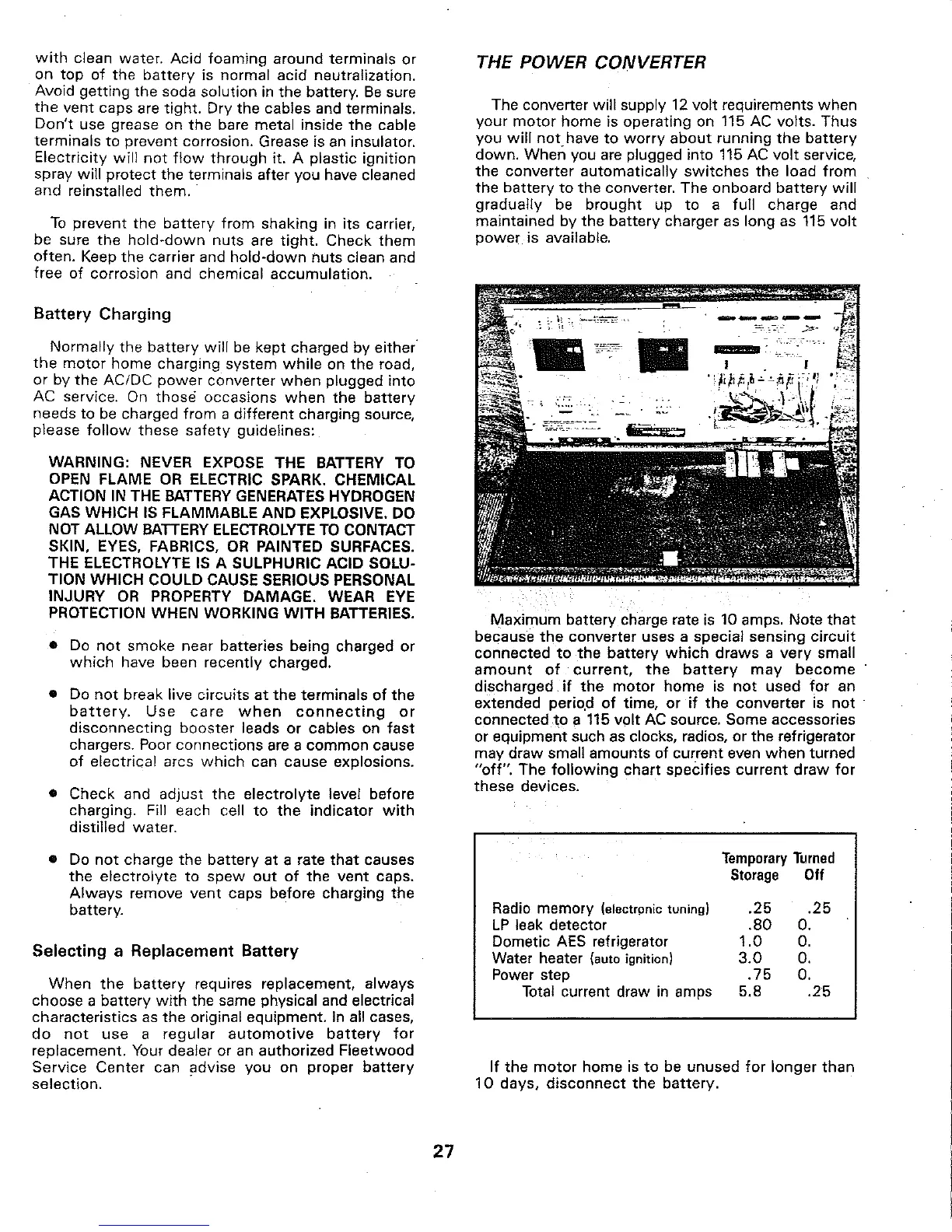
THE POWER CONVERTER
The converter will supply
12
volt requirements when
your
motor
home is operating on 115 AC volts. Thus
you
will
not_
have
to
worry
about
running
the
battery
down. When you
are
plugged into
115
AC
volt
service,
the
converter automatically
switches
the
load
from
the
battery
to
the converter. The onboard
battery
will
gradually be
brought
up
to
a full charge and
maintained by
the
battery charger as long as 115
volt
power
is available.
-----
-
-,
-
-~-
Maximum
battery charge rate is 10 amps. Note
that
because
the
converter uses a special sensing
circuit
connected
to
the
battery
which
draws
a
very
small
amount
of
current,
the
battery
may
become
discharged
if
the
motor
home is
not
used
for
an
extended perio,d
of
time,
or
if
the
converter is
not
.
connected
to
a 115
volt
AC source. Some accessories
or equipment such
as
clocks, radios,
or
the refrigerator
may draw
small amounts of current even
when
turned
"off".
The
following
chart
specifies
current
draw
for
these devices.
Radio memory
(electr~mic
tuning)
LP
leak detector
Dometic
AES
refrigerator
Water heater
(.uto
ignition)
Power step
Total current draw
in
amps
Temporary
Turned
Storage
Off
.25
.
80
1.0
3.0
.
75
5.8
.25
O .
o.
O.
O .
.25
If
the
motor
home
is
to
be
unused
for
longer
than
10
days,
disconnect
the
battery.



 To Next Page