signal could
be
an advantage - you
may
be situated
-in
the
shadow of a hill or mountain and the only signal
you
can receive is a reflected one.
.
Television and FM signals
are
exceedingly complex.
When
mixed
with
reflections
of
themselves, their
complexity
increases even more. Phase cancellations
and beat-frequency components add
up
to
cause
the
interference associated
with
multipath distortion. This
type
of distortion is compounded by
the
fact
that
your
vehicle
may
be
moving, causing
an
infinite series of
direct
and reflected signals. The
fault
is normally
not
with
your receiver, although receivers
with
inadequate
multipath
compensation circuitry may compound
the
problem. Neither is your antenna system usually at
fault. The idea
that
antennas,
whether
amplified or
unamplified,
"pull
in"
a signal is a popular miscon-
ception.
An
antenna does
not
pull a signal
out
of
the
air
by
antenna elements. A good antenna design can
improve
the
rejection
of
multipath
signals, though.
Since distance from
the
broadcast
tower
is critical
to
reception clarity, remember
that
TV
and FM signals
have a range
of
only
about
75
miles under
the
best
of
atmospheric and geographic conditions. The good
reception you
get
at
parks located
at
great distances
from
broadcast facilities is probably
the
result
of
satellite,
microwave
or
other
cable
distribution
systems. The antenna on your
RV·
is
no
competition
for- these very expensive installations. The very best
RV
antenna systems compromise performance and
efficiency
for
light
weight
and compactness. The
amplifiers used in these systems
attempt
to
overcome
these
compromises by presenting a reasonably good
signal
to
the
TV
or FM radio terminals. But these
antennas have a
usable range
of
only
about
50
miles
under
the
best
of
conditions. Beyond
that
distance,
or in marginal conditions, antenna performance falls
off
rapidly. In
that
case,
the
amplifier
only
amplifies
the
noise,
or
"snow"
being picked up
by
the
antenna
elements.
Minimizing
Multipath
Distortion
and
Improving
Signal
Quality
There is obviously very little
that
you can do about
geography
while
you travel - except enjoy it. But
if
multipath
disto.rtion becomes a nuisance,
try
these
tips:
• Re-orient the receiving antenna. Sometimes turning
the
antenna
will
pick up the
stronger
of
either the
direct or reflected
signal.
Try
turning or rotating the
antenna
throughout
its range.
You
may
find
your
signal in a very unexpected direction.
•
With
FM stereo signals,
switch
the
unit
to
MONO,
if
possible. Some
of
the
phase and noise
compo-
nents
of
a stereo signal
will
disappear in MONO
mode.
• Reduce
the
treble
setting
to
reduce background
noise.
Although
not
yielding
the
best high-fre-
quency performance, at
least you may be able
to
reduce
the
irritation
of
the
distortion.
29
GENERATOR POWER
PLANT
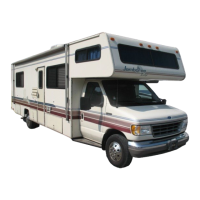
Your
motor
home may
be
equipped
with
a gasoline-
powered generator
which
will
provide complete
electrical self-containment
when
regular public
utility
AC power is unavailable. Controls
are
at
the
generator
and at a remote
control panel located inside the
motor
home.
The
115
volt
output
of
the
generator is connected
directly
to
a receptacle located inside
the
power
cord
storage compartment. With
the
generator power plant
operating and
the
power
cord plugged
into
this
receptacle,
power
is available at all
of
the
115
volt
power
outlets
in
the
motor
home,
just
as
if
the
cord
were connected
to
an external source. Gasoline
for
the generator is taken from the main fuel tank through
a
special feeder tube
which
is higher in the
tank
than
the
feeder
tube
to
the
motor home. This arrangement
prevents
the
generator from running the
motor
home
fuel
tank
dry.
NOTE: Refer
to
your
Generator Power Plant
Manufacturer's Instruction Manual (provided in your
Owner's
Information
Kit)
for
service
information
before starting
the
generator. Do
not
start unit
with
a heavy
power
load.
Always
wait
at least
three
minutes
after
starting generator before
turning
on
(or plugging in) heavy electrical loads, such as
the
roof
air conditioner.
To
start
the
generator, hold
the
switch in
the
START
position
until
the
unit
starts, then release
the
switch.
If
the
unit
is
slow
to
start,
DO
NOT hold
the
switch
in
the
START position for more than 10 seconds.
Release the switch,
wait
15
seconds, then repeat. This
will
help avoid overheating and
damaging
the
generator starting system. If
this
system fails
to
start,
the
generator
manual
starting
instructions
are
discussed in the generator power
plant manufacturer's
instructions.
To
stop the unit, hold switch to the
STOP
position
until
the
engine stops.
Generator Operating
Safety
Precautions
• Read and understand
the
generator operating,
maintenance and safety instructions furnished
in your
Owner's
Information Kit.
• Do
not
smoke or use an open flame near
the
generator
unit
or
fuel tank.
• WARNING:
DO
NOT BLOCK THE
GENERATOR
VENTILATING AIR INLETS
OR
OUTLETS. THE
AIR-COOLED ENGINE REQUIRES A CONSTANT
SUPPLY
OF
COOLING AIR. RESTRICTED VEN-
TILATNG AIR INLETS
OR
OUTLETS CAN CAUSE
ENGINE FAILURE
OR
FIRE
FROM ENGINE
OVERHEATING.
• Do
not
use generator ventilating air for heating
any interior
living space. Ventilating air can
contain high concentrations of
lethal gases.
• WARNING: DO NOT
PLACE
FLAMMABLE
MA-
TERIAL
OR
STORE
ANY
OTHER
MATERIALS IN
THE GENERATOR COMPARTMENT.



 To Next Page