TO
CHANGE A FRONT WHEEL:
1.
Move
the
vehicle
to
a level,
firm
surface.
2.
To
provide clearance
for
the jack, carefully drive
the
flat
tire up on
the
wheel chock.
3. Turn
off
the
engine, place transmission selector
in'
"P"
and set the parking brake.
4. Block
both
the
front
and
back
wheel in
the
opposite corner from
the
wheel
to
be changed.
5.
On questionable surfaces, use a board or
other
solid, flat material under the jack
to
provide a firm
. base and minimize
the
possibility
of
shifting.
6.
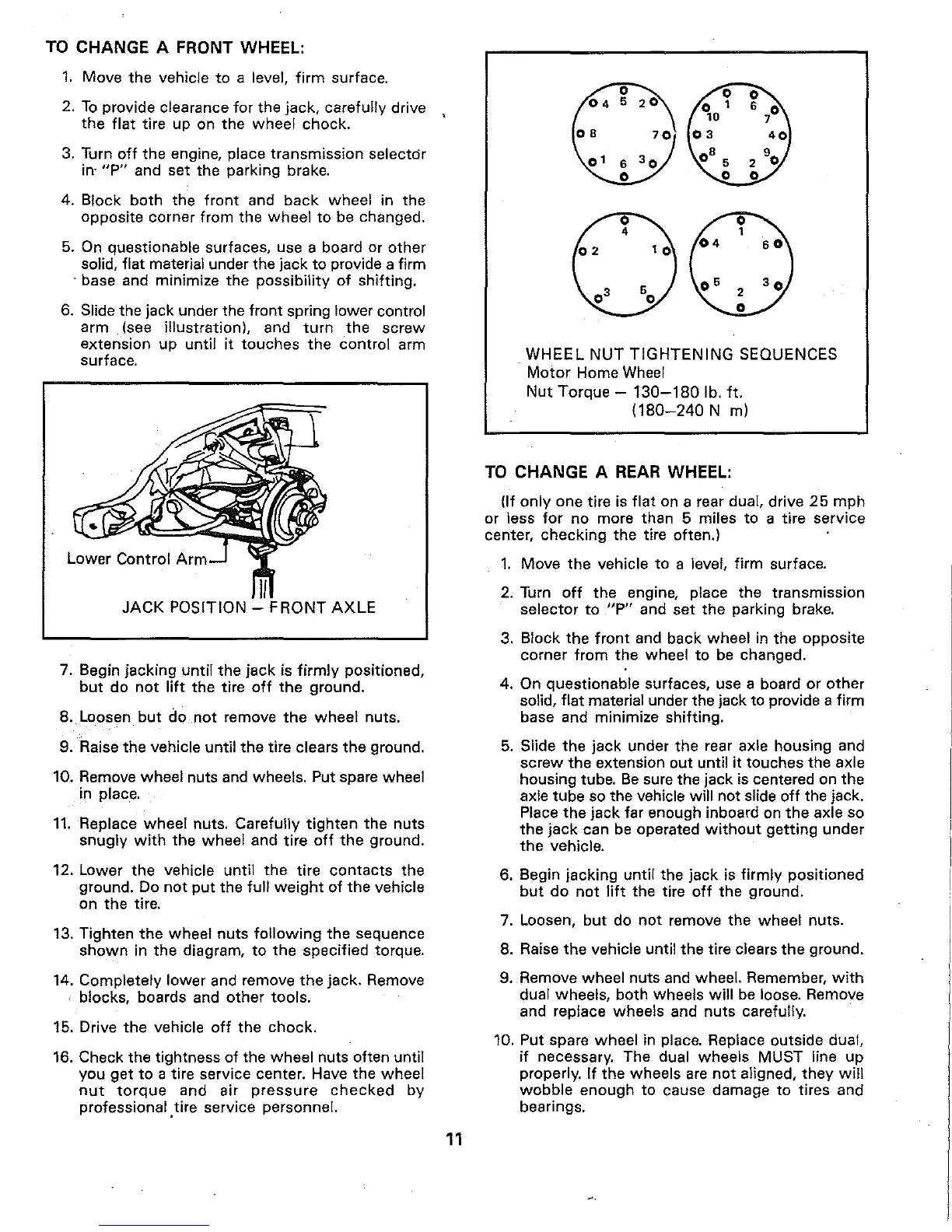
Slide the jack under the front spring lower control
arm (see illustration), and
turn
the
screw
extension up until
it
touches
the
control arm
surface.
Lower Control
Arm
JACK
POSITION -
7. Begin jacking
until
the
jack
is
firmly
positioned,
but
do
not
lift
the
tire
off
the
ground.
8. Loosen
but
do
not
remove
the
wheel
nuts.
9. Raise
the
vehicle until
the
tire clears
the
ground.
10. Remove wheel nuts and wheels. Put spare wheel
in place.
11.
Replace
wheel
nuts. Carefully
tighten
the
nuts
snugly
with
the
wheel and tire
off
the
ground.
12. Lower
the
vehicle
until
the
tire
contacts
the
ground. Do
not
put
the full
weight
of
the
vehicle
on
the
tire.
13. Tighten
the
wheel
nuts
following
the
sequence
shown
in
the
diagram,
to
the
specified torque.
14.
Completely lower and remove
the
jack. Remove
blocks, boards and
other
tools.
15.
Drive
the
vehicle
off
the
chock.
16. Check the tightness of the wheel nuts often until
you
get
to
a tire service center. Have
the
wheel
nut
torque
and air
pressure
checked
by
professional.tire service personnel.
11
WHEEL
NUT
TIGHTENING
SEQUENCES
Motor
Home Wheel
Nut
Torque -
130-180
lb.
ft.
(180-240
N
m)
TO
CHANGE A
REAR
WHEEL:
(If
only
one tire is
flat
on a rear dual, drive
25
mph
or
less
for
no more than 5 miles
to
a tire service
center, checking
the
tire often.)
1.
Move
the
vehicle
to
a level, firm surface.
2. Turn
off
the
engine, place
the
transmission
selector
to
"P"
and set
the
parking brake.
3. Block
the
front
and back wheel in the opposite
corner
from
the
wheel
to
be
changed.
4.
On questionable surfaces, use a board or
other
solid, flat material under the jack
to
provide a firm
base and minimize shifting.
5.
Slide
the
jack
under
the
rear axle housing and
screw
the
extension
out
until
it
touches
the
axle
housing tube.
Be
sure the jack is centered on
the
axle tube so
the
vehicle will not slide
off
the jack.
Place
the
jack
far enough inboard on
the
axle so
the
jack
can be operated
without
getting
under
the
vehicle.
6. Begin jacking until the
jack
is
firmly
positioned
but
do
not
lift
the tire
off
the
ground.
7. Loosen,
but
do
not
remove
the
wheel
nuts.
8. Raise
the
vehicle until
the
tire clears
the
ground.
9. Remove wheel nuts and wheel. Remember,
with
dual wheels,
both
wheels will
be
loose. Remove
and replace wheels and
nuts
carefully.
10.
Put spare wheel in place. Replace outside dual,
if
necessary. The dual wheels MUST line up
properly.
If
the
wheels
are
not
aligned,
they
will
wobble
enough
to
cause damage
to
tires and
bearings.



 To Next Page