LIQUID
PETROLEUM
GAS
SYSTEM
Liquified petroleum
(LP)
gas is provided from
storage tanks
to
operate your range, oven, furnace,
water
heater, and
as
an
alternate energy source for
the
refrigerator.
LP
gas is a colorless gas
which
has
been treated to have
an
odor similar
to
garlic to permit
detection
if
a leak occurs. With proper handling pre-
cautions,
it
is safe and provides modern conveniences
wherever you travel.
LP
gas is stored in a special
tank
mounted
on
the
motor
home chassis.
It
is stored as
a
liquid under pressLire
and
vaporizes under the control
of a pressure regulator.
WARNING:
LP
GAS IS FLAMMABLE AND POTEN-
TIALLY EXPLOSIVE.
USE
PROPER
HANDLING,
LIGHTING,
AND
VENTILATING PROCEDURES.
FILLING LP GAS TANKS
To
fill
the
chassis-mounted storage tank, drive
the
vehicle
to
an
LP
gas supplier or one
of
the
service
stations
which
sell
LP
gas.
WARNING: TURN
OFF
LP
GAS MAIN VALVE
BE-
FORE
FILLING
LP
GAS TANKS
OR
ENTERING
AN
LP
GAS BULK PLANT
OR
MOTOR FUEL SERVICE
STATION.
TURN
OFF
ALL
PILOT
LIGHTS AND
APPLIANCES INDIVIDUALLY
BEFORE
REFUELING
OF
MOTOR FUEL TANKS AND/OR PERMANENTLY
MOUNTED LP-GAS CONTAINERS.
WHEN NOT
INDIVIDUALLY
TURNED
OFF,
AUTOMATIC IGNI-
TION APPLIANCES
MAY
CONTINUE
TO
SPARK
WHEN
LP
GAS
IS
TURNED
OFF
AT THE CON-
TAINER. DO NOT FILL
LP
GAS CONTAINERS
TO
MORE
THAN
BO%
OF
CAPACITY.
LP GAS REGULATOR
The regulator reduces
the
high pressure
of
the
gas
from
the
tank
to
a low, even pressure to service
the
appliances in
the
motor
home. The regulator is pro-
tected
from freezing road spray and
other
foreign
matter
by a water-resistant cover. WARNING:
DO
NOT
ATTEMPT
TO
ADJUST THE REGULATOR. IT HAS
BEEN
PRESET
BY
THE MANUFACTURER
OF
THE
REGULATOR.
IF
ANY ADJUSTMENT IS REQUIRED,
IT
MUST
BE
MADE
BY
A QUALIFIED
LPG
SERVICE
TECHNICIAN USING SPECIAL EQUIPMENT.
USING LP GAS SYSTEM
AT
LOW TEMPERATURES
Your gas system will
function
at
low
temperatures,
provided you choose a
type
of
LP
gas
which
has a
boiling
point
lower
than any temperature you expect
to
encounter. Ask your
LP
gas supplier or your
motor
home dealer
for
information on products available in
your area.
If, despite precaution, the gas
flow
to
your
17
appliances should fail
at
low
temperatures, ice may
have
built
up in
the
regulator. Try
melting
the
ice by
warming
the
regulator using· a small
light
bulb.
DO
NOT
USE
AN
OPEN
FLAME. Once
flow
is restored,
make certain
that
the
regulator cover is properly
installed to prevent
water
from entering
the
regulator
which
will
cause
it
to
freeze again.
If
the
problem
persists, ask your
LP
gas supplier
to
service
the
tank
or regulator, removing the
moisture
or adding an ice-
inhibitor as required.
.
Aside from
the
possibilities
of
freezing during cold
temperatures, your
LP
gas system is affected signifi-
cantly
as
temperature drops. The liquid propane
in
the
tank is,
of
course,
much
colder than
the
air
that
normally surrounds
the
tank. The liquid in
the
tank
vaporizes by absorbing heat from
the
surrounding
air.
But
as
the
air temperature drops closer
to
the
temperature of
the
liquid propane, the propane doesn't
vaporize as easily.
Consequently, the
BTU
value
of
the
LP
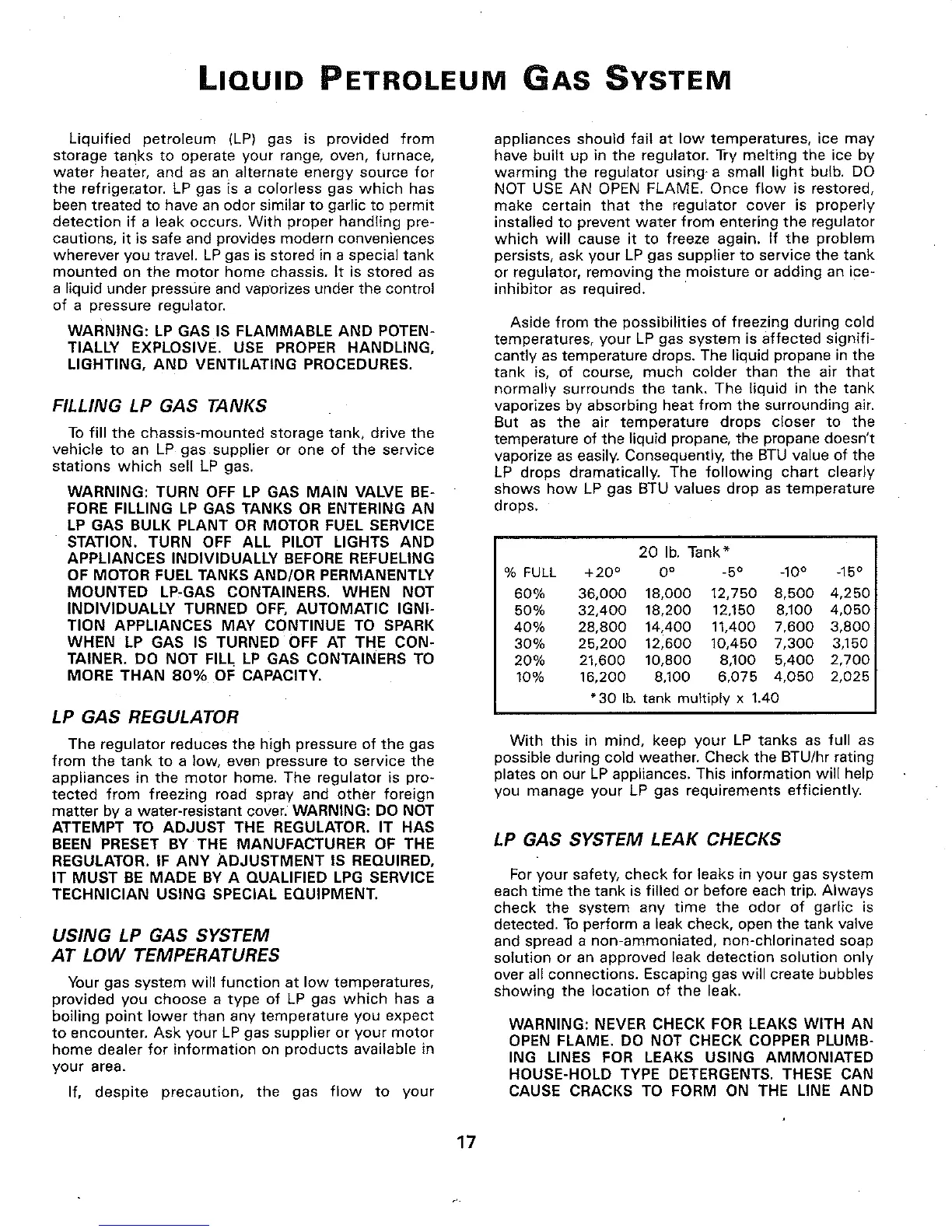
drops dramatically. The
following
chart
clearly
shows
how
LP
gas BTU values drop
as
temperature
drops.
20
lb.
Tank'
%
FULL
+20
0
0
0
_50
-10
0
-15
0
60%
36,000
18,000
12,750
8,500
4,250
50%
32,400
18,200
12,150 8,100
4,050
40%
28,800
14,400
11,400
7,600
3,800
30%
25,200
12,600
10,450
7,300
3,150
20%
21,600
10,800
8,100
5,400
2,700
10%
16,200
8,100
6,075
4,050
2,025
*
30
lb.
tank multiply x 1.40
With
this
in mind, keep your
LP
tanks
as
full as
possible during cold weather. Check the BTU/hr rating
plates on our
LP
appliances. This information will help
you manage your
LP
gas requirements efficiently.
LP GAS SYSTEM LEAK CHECKS
For
your safety, check
for
leaks in your gas system
each time the tank is
filled
or
before each trip. Always
check
the
system any
time
the
odor
of
garlic
is
detected.
To
perform a leak check, open the tank valve
and spread a non-ammoniated, non-chlorinated soap
solution
or
an
approved leak detection solution
only
over all connections. Escaping gas will create bubbles
showing
the
location of
the
leak.
WARNING:
NEVER CHECK
FOR
LEAKS WITH AN
OPEN
FLAME.
DO
NOT CHECK
COPPER
PLUMB-
ING LINES
FOR
LEAKS USING AMMONIATED
HOUSE-HOLD TYPE DETERGENTS. THESE CAN
CAUSE CRACKS
TO
FORM
ON
THE
LINE
AND



 To Next Page