THE
ELECTRICAL
SYSTEMS
The electrical systems in
your
motor
home
are
designed and
built
in accordance
with
all regulations,
codes, and standards in
effect
at
the
time
of
manufacture.
There are three
distinct
electrical systems in your
motor
home.
• Chassis system. This is
the
vehicle electrical
system.
It
includes
the
stop, tail,
turn
signal,
clearance
lights,
and
instrument
panel
accessories.
•
12
volt
DC living system. All
12
volt
lighting
fixtures
and
convenience
outlets,
12
volt
powered vents, fans, motors, and 12
volt
accessories are included in
this
system. The
fresh water pump and any
12
volt entertainment
equipment are connected to this system. The 12
volt
power
source is a 12
volt
lead-acid storage
battery
located in
the
battery
compartment.
Twelve
volt
power
is
also provided by
an
AC/DC
converter. Battery charge is maintaned by
the
motor
home engine alternator, or by
the
charging
circuit
included in the converter.
• 115
volt
AC system. This system provides
grounded electrical service
for
appliances such
as air conditioners,
TV, blender, etc. The 115-volt
system also provides a
power
source
for
the
converter. Your
motor
home is equipped
with
a
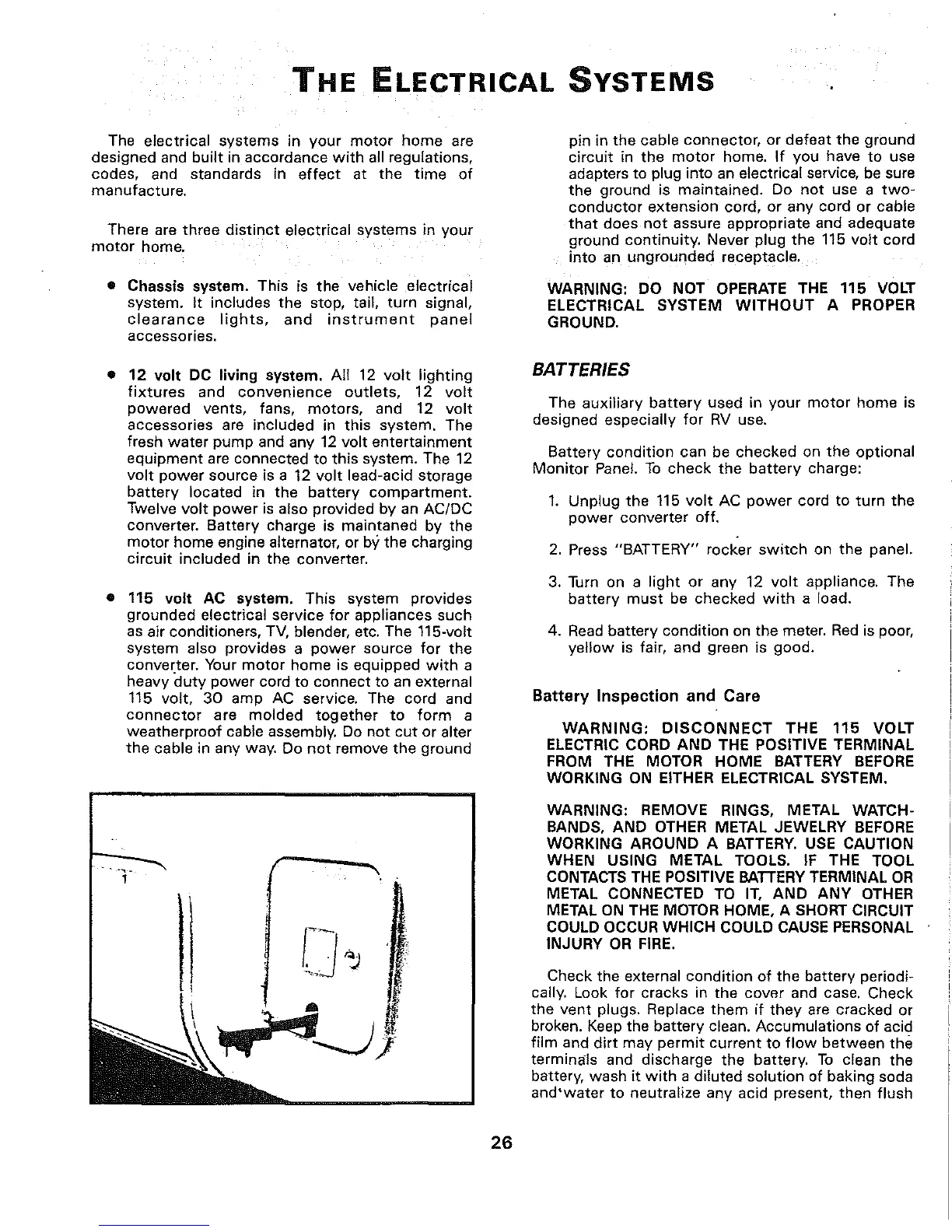
heavy 'duty power cord
to
connect
to
an
external
115
volt,
30
amp AC service. The cord and
connector
are molded
together
to
form
a
weatherproof cable assembly.
Do
not
cut
or
alter
the
cable in any way. Do
not
remove
the
ground
CJ~
26
pin in
the
cable connector, or
defeat
the
ground
circuit in
the
motor
home.
If
you have
to
use
adapters to plug into an electrical service,
be
sure
the
ground is maintained. Do
not
use a
two-
conductor
extension cord,
or
any cord
or
cable
that
does
not
assure appropriate and adequate
ground continuity. Never plug
the
115
volt
cord
into
an
ungrounded receptacle.
WARNING: DO NOT OPERATE THE 115 VOLT
ELECTRICAL SYSTEM
WITHOUT
A PROPER
GROUND.
BATTERIES
The auxiliary
battery
used in your
motor
home is
designed especially
for
RV
use.
Battery
condition
can be checked on
the
optional
Monitor
Panel.
To
check
the
battery
charge:
1.
Unplug
the
115
volt
AC
power
cord
to
turn
the
power
converter off.
2.
Press "BATTERY" rocker
switch
on
the
panel.
3. Turn on a
light
or
any 12
volt
appliance. The
battery
must
be
checked
with
a load.
4.
Read
battery condition on the meter.
Red
is poor,
yellow is fair, and green is good.
Battery
Inspection
and
Care
WARNING:
DISCONNECT
THE 115 VOLT
ELECTRIC CORD
AND
THE POSITIVE TERMINAL
FROM
THE MOTOR HOME BATTERY
BEFORE
WORKING
ON
EITHER ELECTRICAL SYSTEM.
WARNING: REMOVE RINGS,
METAL WATCH-
BANDS, AND OTHER METAL JEWELRY
BEFORE
WORKING AROUND A BATTERY.
USE
CAUTION
WHEN USING METAL TOOLS.
IF
THE TOOL
CONTACTS
THE
POSITIVE
BATTERY
TERMINAL
OR
METAL CONNECTED
TO
IT,
AND
ANY
OTHER
METAL
ON
THE MOTOR HOME, A SHORT CIRCUIT
COULD OCCUR WHICH COULD
CAUSE
PERSONAL
INJURY
OR
FIRE.
Check the external condition
of
the
battery periodi-
cally. Look for cracks in
the
cover and case. Check
the
vent
plugs. Replace
them
if
they
are cracked or
broken.
Keep
the battery clean. Accumulations of acid
film and
dirt
may
permit
current
to
flow
between
the
terminals and discharge
the
battery.
To
clean
the
battery, wash
it
with
a diluted solution of baking soda
and'water
to
neutralize any acid present, then flush



 To Next Page