11.
Replace wheel nuts. Carefully
tighten
the
nuts
snugly in sequence
shown
in
the
diagram.
12.
Apply
the
specified
torque
to
all
nuts
in
sequence. Dual wheels
must
be
tightened
with
both
wheels
off
the
ground.
13.
Lower
the
jack. Remove jack, blocks, boards and
other
tools and equipment.
14. Check
the
tightness of the wheel nuts often until
you
get
to
a tire service center. Have
the
wheel
nut
torque
and
air
pressure
checked
by
professional tire service personnel.
TOWING
If
your
motor
home ever needs
to
be
towed,
please
follow
these instructions:
• Secure any loose
or
protruding parts
of
damaged
vehicle.
• Inspect points
of
attachment
to
the
disabled
vehicle.
If
attachment
points are damaged or
deteriorated, select
other
attachment
points at
a substantial frame structural member.
• Never
allow
anyone
to
go under a vehicle
while
it
is being lifted by
towing
equipment unless
the
disabled vehicle is adequately supp'orted by
safety
stands.
Do
not
tow
the
motor
home from
the
rear. Towing
from the rear will cause the
front
tires and suspension
to
be seriously overloaded, possibly resulting in tire
or
front
suspension failure. The rear frame extensions
are
not
designed
to
withstand
the
loads imposed by
lifting
from
the
rear.
If
the
rear wheels are disabled, place
the
motor
home
on a
flat
bed trailer, or use a heavy
duty
dolly
under
the
rear wheels and
tow
from
the
front.
NOTE:
IF
YOUR
MOTOR
HOME MUST
BE
TOWED,
PREVENT
DAMAGE
BY
HAVING
THE
TOW
TRUCK
DRIVER
FOLLOW
THE
INSTRUCTIONS
IN
THE
CHASSIS OWNER'S MANUAL.
The vehicle may
be
towed
on
the
rear wheels
with
the
parking brake released and
the
transmission in
neutral provided a speed
of
35
mph and a distance
of
50
miles is
not
exceeded.
If
this speed
or
distance
must
be exceeded, disconnect the propshaft or place
the
rear
wheels
on a dolly.
DO
NOT TOW
ANY
VEHICLE
AT
SPEEDS
OVER
50
MPH.
The
safety
of
the
operator and all others in
the
vicinity
of
the
tow
truck
and
the
towed
vehicle
must
be considered
at
all
times
during a
towing
operation.
DO NOT ALLOW ANY PERSON
TO
RIDE
IN THE
TOWED VEHICLE. Safe operating speeds depend on
weather, road, traffic,
visibility
conditions, and
the
•
12
condition
of
the
towed
vehicle. Avoid panic stops.
Obey all state and local laws regarding items such
as
warning signals,
night
illumination, speed, etc.
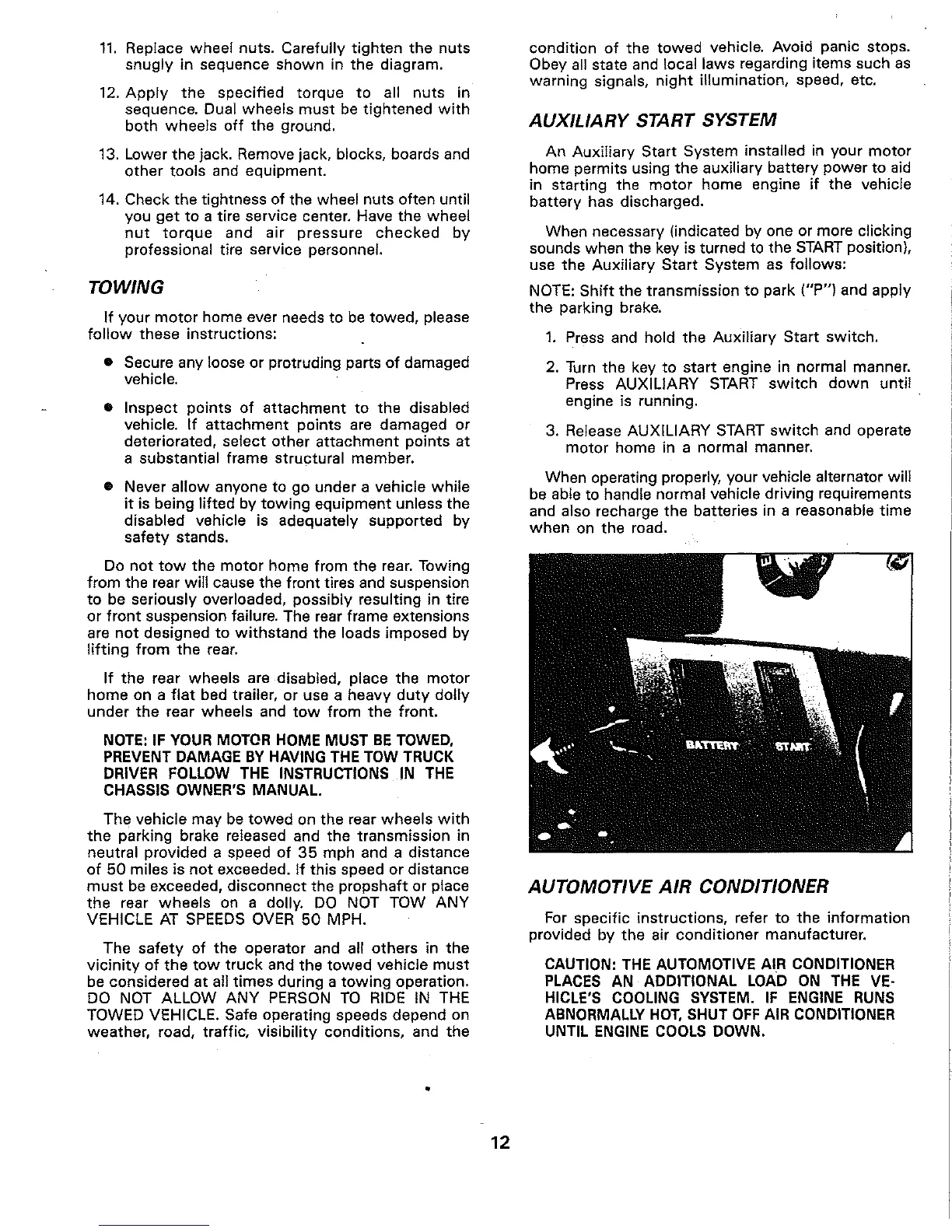
AUXILIARY START SYSTEM
An
Auxiliary Start System installed in your
motor
home permits using
the
auxiliary battery
power
to
aid
in starting
the
motor
home
engine
if
the
vehicle
battery
has discharged.
When necessary (indicated
by
one or more clicking
sounds when the key is turned to
the
START
position),
use
the
Auxiliary
Start
System as follows:
NOTE:
Shift
the
transmission
to
park
("P")
and apply
the
parking brake.
1.
Press and hold
the
Auxiliary
Start
switch.
2.
Turn
the
key
to
start
engine in normal manner.
Press AUXILIARY
START
switch
down
until
engine is running.
3. Release AUXILIARY
START
switch
and operate
motor
home in a normal manner.
When operating properly, your vehicle alternator will
be
able
to
handle normal vehicle driving requirements
and also recharge
the
batteries in a reasonable
time
when
on
the
road.
AUTOMOTIVE
AIR
CONDITIONER
For specific
instructions,
refer
to
the
information
provided by
the
air
conditioner
manufacturer.
CAUTION:
THE
AUTOMOTIVE
AIR
CONDITIONER
PLACES
AN ADDITIONAL
LOAD
ON
THE
VE·
HICLE'S COOLING
SYSTEM.
IF
ENGINE
RUNS
ABNORMALLY
HOT,
SHUT
OFF
AIR
CONDITIONER
UNTIL
ENGINE
COOLS
DOWN .



 To Next Page