WARNING:
KEEP
TIRES
PROPERLY
INFLATED. A
TIRE
THAT IS
RUN
LONG DISTANCES
OR
AT
HIGH
SPEEDS WHILE SERIOUSLY
UNDER-INFLATED
WILL OVERHEAT
TO
THE POINT WHERE THE
TIRE
MAY
LOSE
AIR SUDDENLY AND/OR CATCH
FIRE,
POSSIBLY RESULTING IN
DAMAGE
TO
THE
VEHICLE AND
ITS
CONTENTS AND/OR PERSONAL
INJURY.
CHANGING A FLAT
TIRE
CONSULT THE CHASSIS OPERATOR'S
MANUAL
FOR
INFORMATION ON TIRE CHANGING.
Even
with
good tire maintenance and normal
driving, you may experience a
flat
tire. The best
way
to
solve
this
problem is
to
summon
professional help
through your auto club, travel service, or a local
truck
service facility.
If
none
of
these is available, and
circumstances require you
to
change the tire yourself,
. there are several items
that
you MUST
be
aware
of
before you
attempt
to
change a
flat
tire:
• Your
motor
home is
built
on
a
truck
chassis, and
therefore rides on
truck
wheels and tires. These
tires and wheels can
weigh
up
to
100 pounds
or more.
IF
YOU
ARE
NOT
PHYSICALLY
CAPABLE
OF
LIFTING AND MOVING 100
POUNDS
OR
.
MORE,
DO
NOT
UNDER
ANY CIRCUMSTANCES
ATTEMPT
TO
CH~NGE
A
FLAT
TIRE.
• Truck tires and wheels are installed
with
the
wheel
nuts
tightened
very tightly.
IF
YOU
ARE
NOT
PHYSICALLY
CAPABLE
OF
BREAKING
LOOSE
NUTS
THAT
HAVE
BEEN
TIGHTENED
UP
TO
180
LB.!FT.
OF
TORQUE,
AND
THEN
RE-TIGHTEN
TO
THIS
TORQUE,
DO
NOT
UNDER
ANY CIRCUM-
STANCES
ATTEMPT
TO
CHANGE A
FLAT
TIRE.
• The
motor
home itself
with
all
of
your travel gear
is extremely heavy,
weighing
up
to
seven tons.
The axle jack furnished
with
your
motor
home
is
capable
of
lifting
the
weight
on one wheel, or
about one-fourth
of
the
total gross
weight
of
the
vehicle. The ground
or
road surface under
the
vehicle may not support the weight
of
the vehicle
on
the
small surface area
of
the
jack. A strong
board or other
flat
surface may
be
necessary
under the jack
to
spread
the
load and stabilize
the jack.
WARNING:
TO
AVOID
PERSONAL
INJURY
AND/OR
PROPERTY
DAMAGE IF A BLOWOUT
OR
OTHER TIRE DAMAGE OCCURS, TRY
TO
OBTAIN
EXPERT TIRE SERVICE
HELP.
IF
YOU MUST
REMOVE
ANY
WHEELS
AND
CHANGE THE
TIRE
WITHOUT PROFESSIONAL
HELP,
TAKE
OFF
THE
TIRE AND RIM ASSEMBLY
AND
PUT ON THE
SPARE
TIRE
AND RIM ASSEMBLY FOLLOWNG
THE
INSTRUCTIONS IN THE CHASSIS OPERATOR'S
MANUAL.
DO
NOT REINFLATE A TIRE THAT HAS
BEEN
FLAT,
OR
IS SERIOUSLY LOW
ON
AIR. HAVE
10
THE TIRE REMOVED FROM THE WHEEL
AND
CHECK THE TIRE
AND
TUBE
FOR
DAMAGE.
NEVER ADD
AIR
TO
TIRES
UNLESS AN ACCURATE
PRESSURE
GAUGE IS USED.
REQUIRED
TOOLS
AND
EQUIPMENT
• Hydraulic
jack
with
minimum
4-ton
capacity.
WARNING: THE JACK IS DESIGNED
FOR
USE AS
A TOOL
FOR
TIRE CHANGING
ONLY.
IT
IS NOT
INTENDED
FOR
USE AS A LEVELING DEVICE
OR
AS A LIFT
FOR
SERVICE PURPOSES.
•
Lug
wrench
to
fit
wheel nuts,
with
at least a
two-
foot
breaker bar handle.
• Torque wrench
with
at least
300
Ib.!ft. capacity.
• Wheel blocks.
• Board
or
other
flat
surface
to
place under
the
jack.
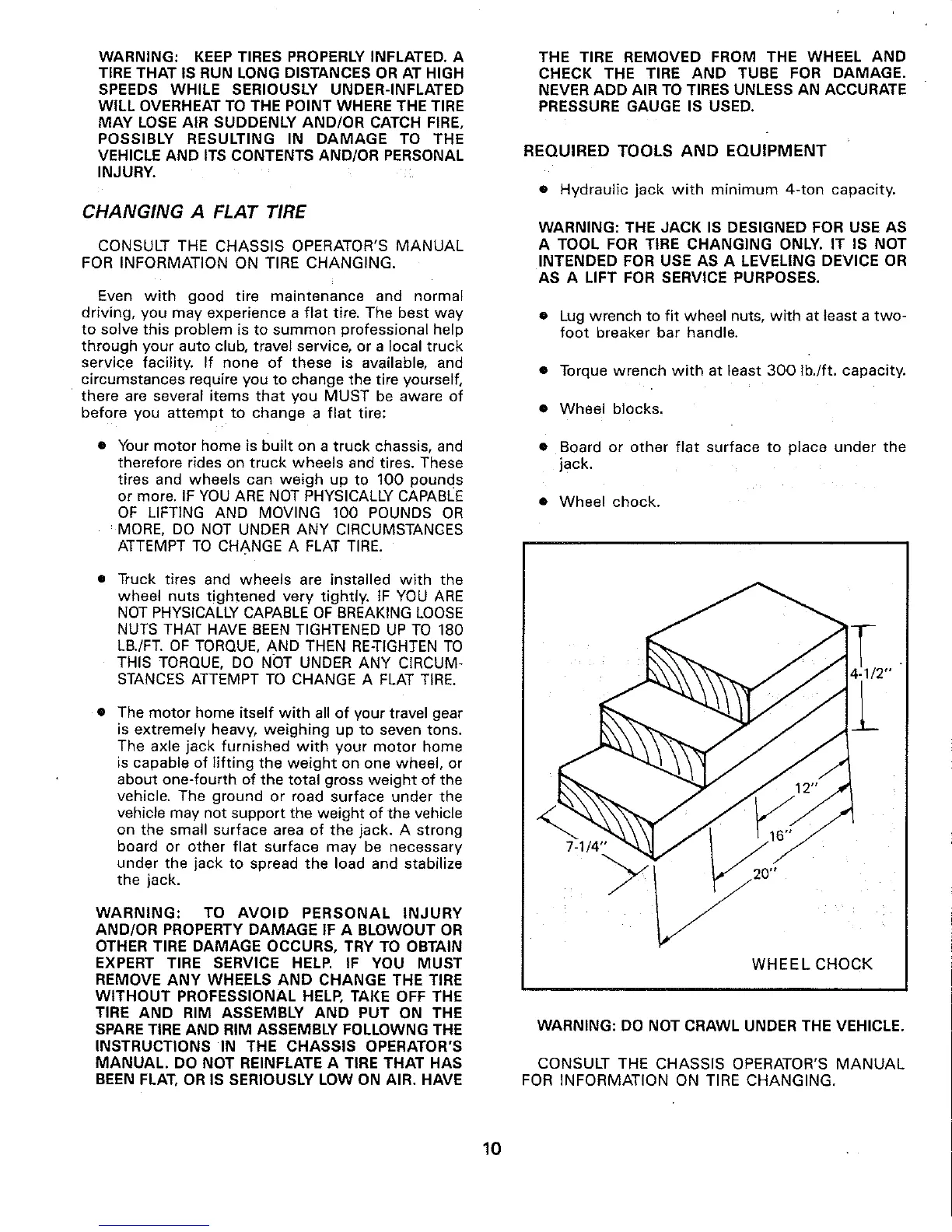
• Wheel chock.
WHEEL
CHOCK
WARNING:
DO
NOT CRAWL UNDER THE VEHICLE.
CONSULT
THE CHASSIS OPERATOR'S
MANUAL
FOR
INFORMATION
ON
TIRE
CHANGING.



 To Next Page