THD
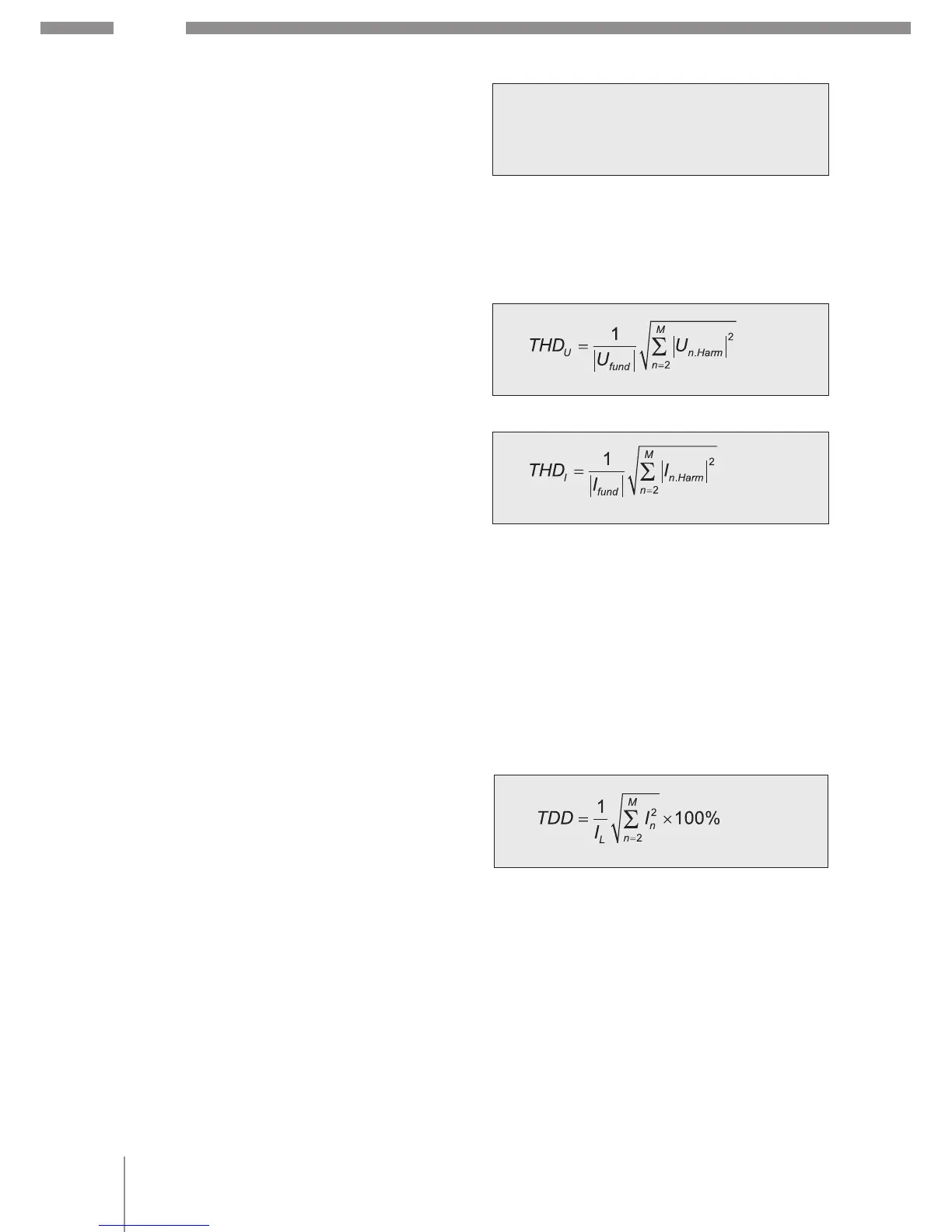
• THD (Total Harmonic Distortion) is the distortion factor and provides the relation of the harmonic parts of an oscillation
to the mains frequency.
Distortion factor for the voltage
• M = 40 (UMG604, UMG508, UMG96RM)
• M = 50 (UMG605, UMG511)
• fund corresponds to n=1
Distortion factor for the current
• M = 40 (UMG604, UMG508, UMG96RM)
• M = 50 (UMG605, UMG511)
• fund corresponds to n=1
ZHD
• THD for the interharmonics.
• Is calculated in the product series and UMG511 UMG605.
Interharmonics
• Sinusoidal oscillations, which frequencies are not a multiple integer of the mains frequency.
• Is calculated in the product series and UMG511 UMG605.
• Calculation and measurement methods in accordance with the DIN EN 61000-4-30.
• The order number of inter harmonics corresponds to the order number of the next smallest harmonic. For example,
between the 3rd and 4th harmonic of the 3rd inter harmonics.
TDD (I)
• TDD Total demand distortion, harmonic current distor-
tion in % of maximum demand load current
• IL =
Maximum demand load current
• M = 40 (UMG604, UMG508, UMG96RM)
• M = 50 (UMG605, UMG511)
Ripple control signal U (EN61000-4-30)
The ripple control signal U is a voltage (200ms measured value) which is measured at a carrier frequency specified by the
user. Only frequencies beneath 3kHz are observed.
Ripple control signal I
The ripple control signal I is a current (200ms measured value) which is measured at a carrier frequency specified by the
user. Only frequencies beneath 3kHz are observed.
xxx[0] = mains frequency (50Hz/60Hz)
xxx[1] = 2nd harmonic (100Hz/120Hz)
xxx[2] = 3rd harmonic (150Hz/180Hz)
etc.
Order number of harmonics






 To Next Page