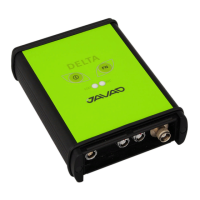
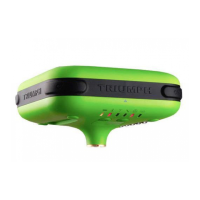
Description and Operation
Setup and Measuring
Static Measuring for Base Stations
30 www.javad.com
1.6.3. Static Measuring for Base Stations
Static measuring is the classic measuring method, well suited for all kinds of baselines (short, medium,
long). At least two receiver antennas, plumbed over measuring marks, simultaneously collect raw data at
each end of a baseline during a certain period of time. These two receivers track four or more common
satellites, have a common data logging rate (5–30 seconds), and the same elevation mask angles. The
length of the observation sessions can vary from a few minutes to several hours. The optimal observation
session length depends on the following factors:
• The length of the baseline measured
• The number of satellites in view
• The satellite geometry (DOP)
• The antenna’s location
• The ionospheric activity level
• The types of receivers used
• The accuracy requirements
• The necessity of resolving carrier phase ambiguities
After the measuring completes, data the receivers collect can be downloaded onto a computer and
processed using post-processing software (for example, JAVAD GNSS Justin).
1.6.4. Kinematic (Stop & Go) Measuring for Rover Stations
In a kinematic, stop and go measuring, the stationary receiver (Base station) is set up at a known point
such as a measuring monument, or an unknown point. The receiver continually tracks satellites and logs
raw data into its memory. The Rover receiver is set up at an unknown point and collects data in static
mode for 2 to 10 minutes. When finished, assign the Rover to kinematic status and move to the next
measuring point. At this point, and each subsequent point, the receiver is changed to static mode to
collect data. So, while moving, the Rover is in kinematic mode, and while collecting data, the Rover is in
static mode.
1.6.5. Real Time Kinematic Measuring
With RTK measuring, as with kinematic measuring described above, one receiver serves as the reference
station and conducts observations with its antenna affixed to a stationary tripod or some other device. The
other receiver functions as a rover and conducts observations (using an antenna) affixed to a mobile pole
and moved to observation points.
Unlike post-processed kinematic measurings, RTK measurings utilize a communications link between
the Base and Rover. Using a radio modem link, the Base receiver transmits its measurement and location
data to the Rover receiver. The Rover, based on the transmitted data and its own observation data,
immediately conducts a baseline analysis and outputs the results.


 To Next Page