Installing the refrigerant piping
To install the refrigerant piping correctly, you must do the following:
1. Install the vapor line and liquid line.
2. Install a liquid-line filter drier on the liquid line.
3. Braze the refrigerant lines and service valves.
4. Install the thermostatic expansion valve (TXV).
5. Check the refrigerant system for leaks.
6. Evacuate the refrigerant lines and the indoor coil.
7. Release refrigerant into the system.
Installing the vapor and liquid lines
About this task:
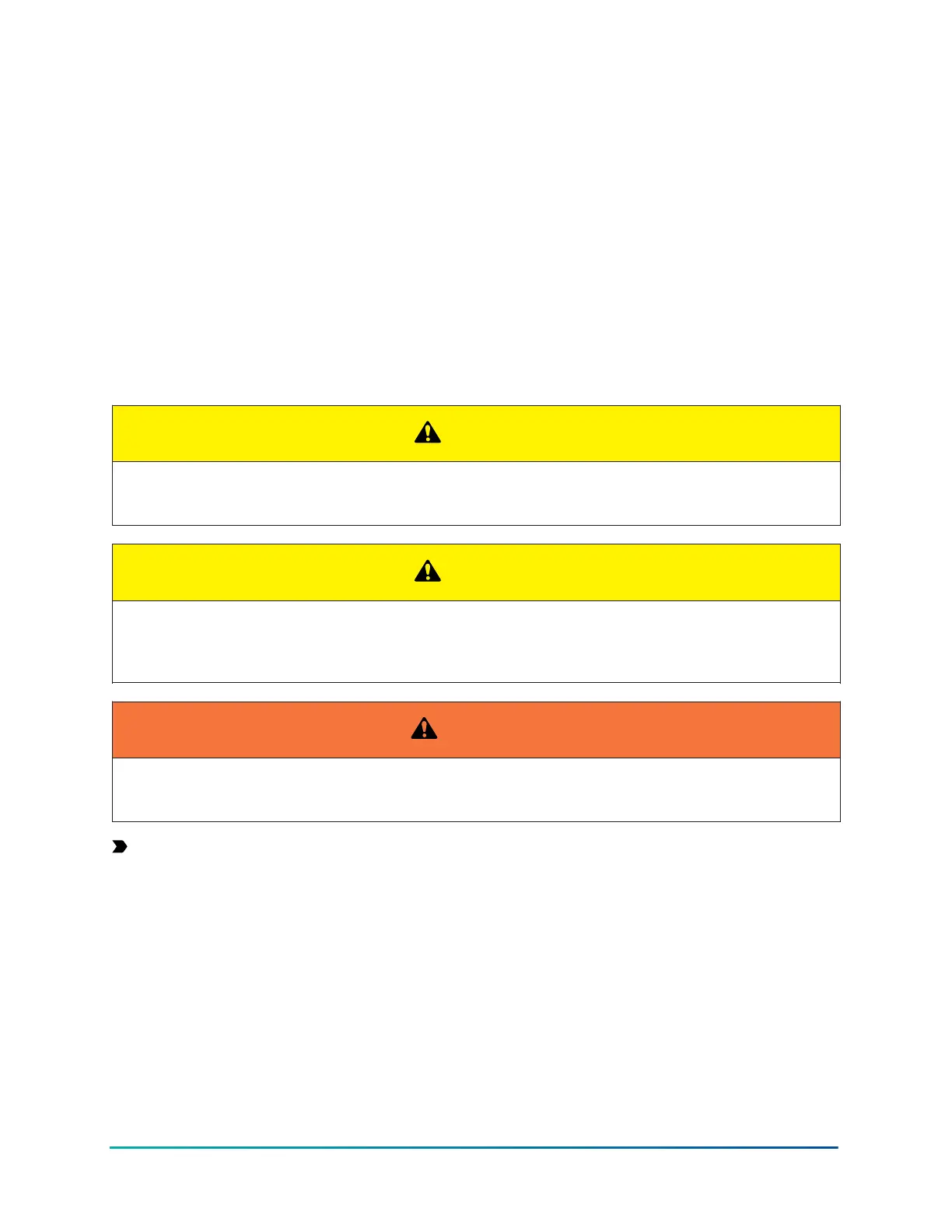
CAUTION
When installing refrigerant piping through the wall, keep the piping capped to prevent debris from
entering. Do not place the pipe directly on the ground.
CAUTION
This system uses R-454B refrigerant, which operates at lower pressures than R-410A. No other
refrigerant may be used in this system. Gauge sets, hoses, refrigerant containers, and the recovery
system must be designed to handle R-454B. If you are unsure, consult the equipment manufacturer.
WARNING
Never install a suction-line filter-drier in the liquid line of an R-454B system. Failure to follow this
warning can cause a fire, injury or death.
Important: For long-line applications, you must install interconnecting lines over 100 ft with
liquid-line solenoid. Refer to the Piping Application Guide for more information.
To install the vapor and liquid lines, do the following:
• Connect the outdoor unit to the indoor coil using field-supplied refrigerant grade (ACR) copper
tubing that is internally clean and dry. You must install units with only the tubing sizes for
approved system combinations as specified in the Tabular Data Sheet. The charge given is
applicable for total tubing lengths up to 15 ft (4.57 m).
• Install the refrigerant lines with as few bends as possible. Make sure not to damage the
couplings or kink the tubing. Use clean hard-drawn copper tubing where no appreciable
amount of bending around obstruction is necessary. If you must use soft copper, make sure to
avoid sharp bends that may cause a restriction.
23Installation Manual: R-454B Outdoor Split-System Air Conditioner
Johnson Controls Ducted Systems



 To Next Page