• Install the refrigerant lines so that they do not obstruct service access to the coil, indoor unit, or
filter.
• Isolate the refrigerant lines to minimize noise transmission from the equipment to the
structure.
• Make sure that the vapor line is insulated with a minimum of 1/2 in. foam rubber insulation
such as Armaflex or an equivalent. Make sure that the liquid line is insulated if it may be
exposed to direct sunlight, high temperatures, or excessive humidity.
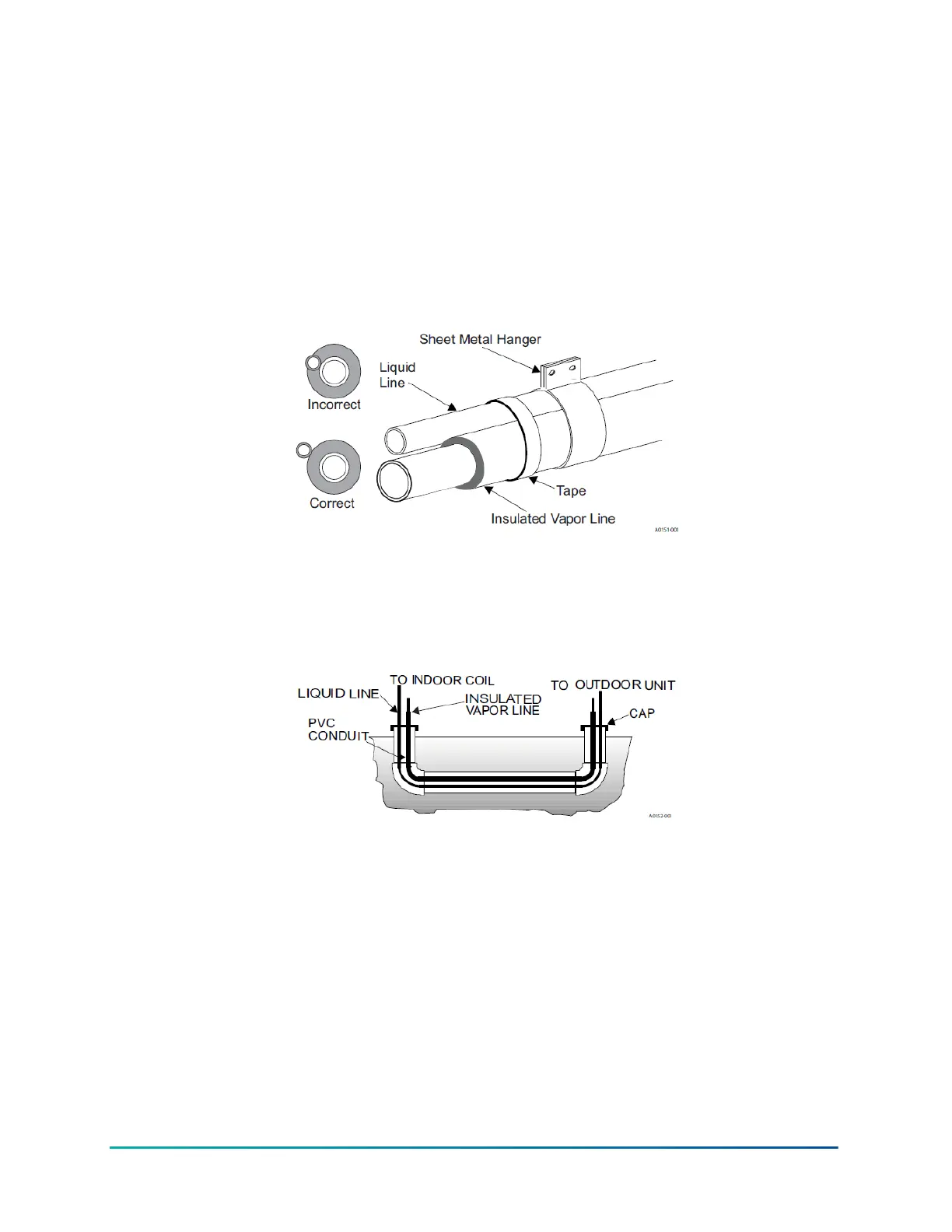
• Tape and suspend the refrigerant lines correctly. Do not allow tube metal-to-metal contact. See
Figure 7.
Figure 7: Installation of vapor line
• Use PVC piping as a conduit for all underground installations as shown in Figure 8. Keep buried
lines as short as possible to minimize the build up of liquid refrigerant in the vapor line during
long periods of shutdown.
Figure 8: Underground installation
• Pack fiberglass insulation and a sealing material such as permagum around refrigerant lines
where they penetrate a wall to reduce vibration and retain some flexibility.
Installation Manual: R-454B Outdoor Split-System Air Conditioner24
Johnson Controls Ducted Systems



 To Next Page